Reading guide · study guidance
Before you begin
Psalm 51 in Hebrew numbering corresponds to Psalm 50 in Greek Septuagint numbering. A different number can point to the same psalm. Before looking up a reference, identify which numbering system the book or reading sheet uses; subtracting one everywhere will send you to the wrong place at several boundaries.
This guide gives you a complete comparison for Psalms 1–150, six worked cases, and a printable lookup card. In about ten minutes, practise matching a reference in one system with the corresponding text in another. These are original study instructions, not a new Bible translation.
Sources: Septuagint numbering of the Psalms
Reading guide · study guidance
Start with the edition in your hands
Find the Bible's title page, introduction, or a note beside a double-numbered psalm. Write down the edition and the system it says it follows. If the system is not stated, keep that field open and consult the publisher or the person who supplied the reading. Do not infer it from a reader's denomination alone.
The Orthodox Church in America (OCA) provides the Greek–Hebrew comparison used here. Our table reverses its columns for readers starting from Hebrew numbering. “Greek” here means the Septuagint, often abbreviated LXX. The table is a locating aid; it does not rank editions or settle differences in translation.
For the opening example, fill your card with “Hebrew 51 → Greek 50.” Then compare the heading, the opening wording, and the passage around your target. Record the opening in your own short phrase. The matched number is the beginning of checking a reference, not the end.
Sources: Septuagint numbering of the Psalms
Reading guide · study guidance
The complete two-way table
Choose the column matching your source, find its row, then read across. The verse ranges in the Hebrew column apply to that column; do not carry the same verse number into another edition without checking.
| Hebrew numbering | Greek (LXX) numbering | Lookup pattern |
|---|---|---|
| 1–8 | 1–8 | Same number |
| 9 and 10 | 9 | Two Hebrew psalms share one Greek psalm |
| 11–113 | 10–112 | Hebrew number minus one |
| 114 and 115 | 113 | Two Hebrew psalms share one Greek psalm |
| 116:1–9 | 114 | First portion of Hebrew 116 |
| 116:10–19 | 115 | Second portion of Hebrew 116 |
| 117–146 | 116–145 | Hebrew number minus one |
| 147:1–11 | 146 | First portion of Hebrew 147 |
| 147:12–20 | 147 | Second portion of Hebrew 147 |
| 148–150 | 148–150 | Same number again |
The numerical relationships are checked against OCA's official table; the teaching layout and exercises are Bibleward's. No translation text is reproduced. This comparison covers the shared numbered sequence through 150; it makes no claim about additional material in particular editions.
Sources: Septuagint numbering of the Psalms
Reading guide · study guidance
Three checks before you copy a reference
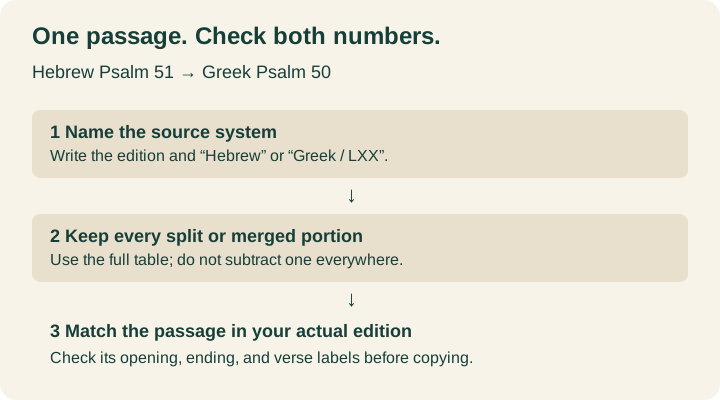
Name the source system. “Psalm 113” alone leaves an ambiguity. Put “Hebrew” or “Greek/LXX” beside it when comparing editions.
Check for a split or merge. If the row contains two numbers or verse ranges, keep the complete range. A whole psalm may not have a single-number equivalent.
Match the text in the target edition. Use its own heading, opening, and verse labels. This chapter-level table does not automatically resolve all edition-specific verse numbering.
Suppose a reading sheet says Greek Psalm 113 and your Bible uses Hebrew numbers. The table sends you to Hebrew Psalms 114 and 115 together. If the sheet assigns only part of Greek 113, you still need the assigned passage or opening words to locate the precise portion. Do not choose Hebrew 114 alone merely because it comes first.
Sources: Septuagint numbering of the Psalms
Reading guide · study guidance
Six cases to work through
Try the “Your task” column before reading the answer. Write both systems in your working, even when their numbers happen to match.
| Case | Your task | Answer and check |
|---|---|---|
| 1. An unchanged boundary | Convert Hebrew Psalm 8 to Greek numbering. | Greek 8. The first row ends at 8; the next row behaves differently. |
| 2. A merge | A source assigns Greek Psalm 9 in full. What Hebrew material should you locate? | Hebrew Psalms 9 and 10. Preserve both numbers for the whole assignment. |
| 3. The familiar mismatch | Match Hebrew Psalm 51. | Greek Psalm 50. It sits inside the Hebrew 11–113 range. |
| 4. Another merge | Convert Greek Psalm 113 in full. | Hebrew Psalms 114 and 115. This is not the ordinary plus-one rule. |
| 5. A split | Match Hebrew Psalm 116:10–19, then ask what happens to the whole psalm. | That portion corresponds to Greek 115. The whole Hebrew 116 corresponds to Greek 114 and 115. Check target verse labels separately. |
| 6. The final split and return | Match Hebrew 147:12–20, then Hebrew 148. | The portion corresponds to Greek 147; Hebrew 148 corresponds to Greek 148. The previous portion, Hebrew 147:1–11, is Greek 146. |
An answer is complete when it preserves a split or merged range and names both systems. This is a reference exercise, not a test of faith. If your edition appears different, record what you see and check its own notes rather than changing the text to fit your memory.
Sources: Septuagint numbering of the Psalms
Reading guide · study guidance
Keep a card for your next reading
| Field | Worked example | Your next lookup |
|---|---|---|
| Source edition or reading sheet | Teaching example: a sheet using Greek numbering | Write the actual title here |
| Source reference and system | Greek Psalm 113, complete | Record both reference and system |
| Corresponding range | Hebrew Psalms 114–115 | Keep every number or portion needed |
| Opening and ending check | Compare both psalms with the assigned text before marking a range | Note your own short description |
| Remaining question | A partial assignment needs more than the psalm number | Record anything still unclear |
Use the complete printable worksheet for another lookup. It contains the table, practice cases, answers, and a blank card. You can save the downloaded HTML for offline use or print it as a PDF using your browser.
Sources: Septuagint numbering of the Psalms
Reading guide · study guidance
Continue reading the passage
Once you find the right text, read its complete unit before applying it. If the notation itself is unfamiliar, visit how to read Bible references. For directions above a psalm, use the Psalm headings and musical directions guide. Then choose a manageable next passage from Bibleward's reading plans.
May God bless you with patience and attention as you return to the words of the psalm.
Sources: Septuagint numbering of the Psalms
Reading guide · study guidance
Source and scope
Orthodox Church in America: Septuagint numbering of the Psalms. Official comparison checked October 5, 2026 (UTC); source publication date not stated. Its numbering relationships inform the table. OCA's source text and layout are not reproduced.
Study guidance, not Scripture. AI-assisted writing and automated source/context review; no individual pastoral endorsement is claimed. The lookup examples and card are original editorial learning aids. A numbering difference alone does not establish that a passage has been removed or added.
Sources: Septuagint numbering of the Psalms
Original printable reading resource
Keep the worksheet beside your reading
Open the worksheet from the article link to read or print it in your browser. Download the same self-contained HTML file below to keep an offline copy, including the exercises and answer guidance.
- Download the complete printable worksheet (HTML)
Original questions, reference tables and answer guidance. Print from your browser or save as PDF; no account or online submission is needed.
Sources: Septuagint numbering of the Psalms
Sources and further reading
- Septuagint numbering of the Psalms
Complete Hebrew–Greek comparison, including the split portions of Hebrew Psalms 116 and 147; live source read on 2026-10-05 UTC. Source publication date not stated.
Study guidance · not Scripture. AI-assisted writing and automated content review; no individual pastoral endorsement is claimed.