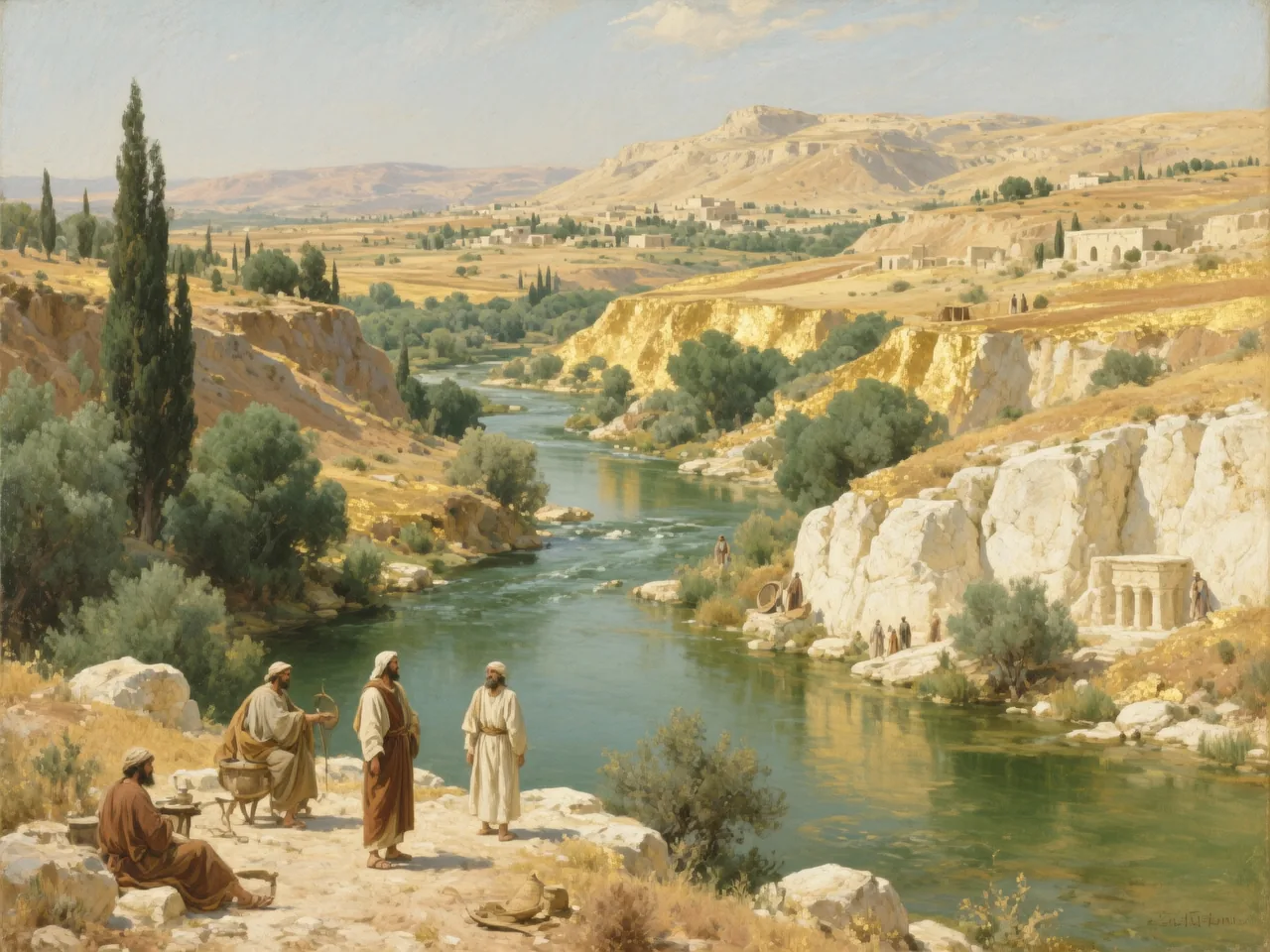
Day 01 · Mark 1:1–15 · Berean Standard Bible
Mark 1:1–15 explained: the beginning of the good news
Mark 1:1–15 introduces Jesus before describing his public ministry. John prepares the way, Jesus is baptized and tested, and he announces God's approaching kingdom. Read it first as the opening of a story about Jesus' identity, rather than as a list of tasks you must master before you can begin.
This guided day and both English narrators are free. No account is needed.
The narrator introduces the good news, John preaches and baptizes in the wilderness, Jesus is baptized and tested, John is arrested, and Jesus begins proclaiming in Galilee.
Mark 1:1–15
1 This is the beginning of the gospel of Jesus Christ, the Son of God.
2 As it is written in Isaiah the prophet: “Behold, I will send My messenger ahead of You, who will prepare Your way.”
3 “A voice of one calling in the wilderness, ‘Prepare the way for the Lord, make straight paths for Him.’”
4 John the Baptist appeared in the wilderness, preaching a baptism of repentance for the forgiveness of sins.
5 People went out to him from all of Jerusalem and the countryside of Judea. Confessing their sins, they were baptized by him in the Jordan River.
6 John was clothed in camel’s hair, with a leather belt around his waist. His food was locusts and wild honey.
7 And he proclaimed: “After me will come One more powerful than I, the straps of whose sandals I am not worthy to stoop down and untie.
8 I baptize you with water, but He will baptize you with the Holy Spirit.”
9 In those days Jesus came from Nazareth in Galilee and was baptized by John in the Jordan.
10 As soon as Jesus came up out of the water, He saw the heavens breaking open and the Spirit descending on Him like a dove.
11 And a voice came from heaven: “You are My beloved Son; in You I am well pleased.”
12 At once the Spirit drove Jesus into the wilderness,
13 and He was there for forty days, being tempted by Satan. He was with the wild animals, and the angels ministered to Him.
14 After the arrest of John, Jesus went into Galilee and proclaimed the gospel of God.
15 “The time is fulfilled,” He said, “and the kingdom of God is near. Repent and believe in the gospel!”
Study guide · not Scripture
Meaning & context
Historical & literary context · Mark 1:1–15
An opening that tells us who to look for
Mark starts with an announcement about Jesus, not a birth narrative. The action moves from John's wilderness ministry to the Jordan, then the wilderness again and finally Galilee. Allen Hilton's Yale study highlights an important reading clue: the narrator identifies Jesus before many characters in the story understand him.
Sources: Mark 1 — Berean Standard Bible · The Gospel of Mark: Session One — Jesus Right on Time
Scripture observation · Mark 1:4–8
1. John prepares; Jesus is the one to watch
In verses 4–8, people confess their sins and receive John's baptism. John does not present himself as the destination. He points to someone greater and distinguishes his water baptism from the coming one's baptism with the Holy Spirit. Keep that contrast in view as Jesus enters the scene.
Sources: Mark 1 — Berean Standard Bible
Scripture observation · Mark 1:9–13
2. Baptism is followed by testing
Verses 9–11 identify Jesus as the beloved Son and describe the Spirit descending on him. The next scene is testing in the wilderness, not immediate comfort or applause. Mark places divine affirmation and a difficult experience next to each other; difficulty alone is not presented as proof of divine rejection.
Sources: Mark 1 — Berean Standard Bible
Scripture observation · Mark 1:14–15
3. Good news calls for a response
After John's arrest, Jesus announces the kingdom and calls people to repent and believe. Notice the order in verses 14–15: the announcement comes with an invitation to respond. The focus is God's good news, not a technique for earning approval by completing a reading schedule.
Sources: Mark 1 — Berean Standard Bible
Tradition note · Mark 1:4–11
Baptism questions need a wider conversation
Christians differ about baptism's recipients and meaning. Catholic teaching includes infant baptism; the Southern Baptist statement describes the immersion of a believer. These are examples, not an exhaustive map. This opening passage should not be used alone to settle every later baptism question.
Sources: Catechism of the Catholic Church: Who Can Receive Baptism? · Baptist Faith and Message 2000 · Mark 1 — Berean Standard Bible
Pastoral application · Mark 1:1–15
Begin with one honest question
As you continue, ask what this passage shows about Jesus and what you still want to understand. You may take your time. A completed day is not a measure of your worth or proof of your relationship with God; this guide supports reading rather than judging it.
Sources: Mark 1 — Berean Standard Bible
Sources & review
Bibleward · AI-assisted study guide
AI-assisted explanation; sources and Scripture references checked by automated review on September 11, 2026. This is not a recorded human pastoral approval.
- Mark 1 — Berean Standard Bible — Mark 1:1–15; Scripture observations checked against local checksum-verified BSB v5.9, not the website's supplementary commentary.
- The Gospel of Mark: Session One — Jesus Right on Time — Pages 1–3: Mark 1:1–15, the reader's knowledge of Jesus' identity, and the abrupt narrative opening.
- Catechism of the Catholic Church: Who Can Receive Baptism? — Paragraphs 1246–1255, especially 1250–1252 on infant baptism; cited as a Catholic position, not universal agreement.
- Baptist Faith and Message 2000 — Article VII: baptism of a believer by immersion; cited as a Southern Baptist position.
- Berean Bible: Licensing and Terms — Public-domain dedication effective April 30, 2023; all uses permitted. Third-party commentary has not been reproduced.
Scripture is the Berean Standard Bible (BSB), dedicated to the public domain. Exact Scripture remains separate from these original AI-assisted Bibleward explanations. Linked commentary is cited and summarized, not reproduced; no permission to reuse third-party prose or artwork is implied.
Report a content concernReflection, prayer, and reading progress stay in this browser; they are not synced to an account.