Reading guide · study guidance
Before you begin
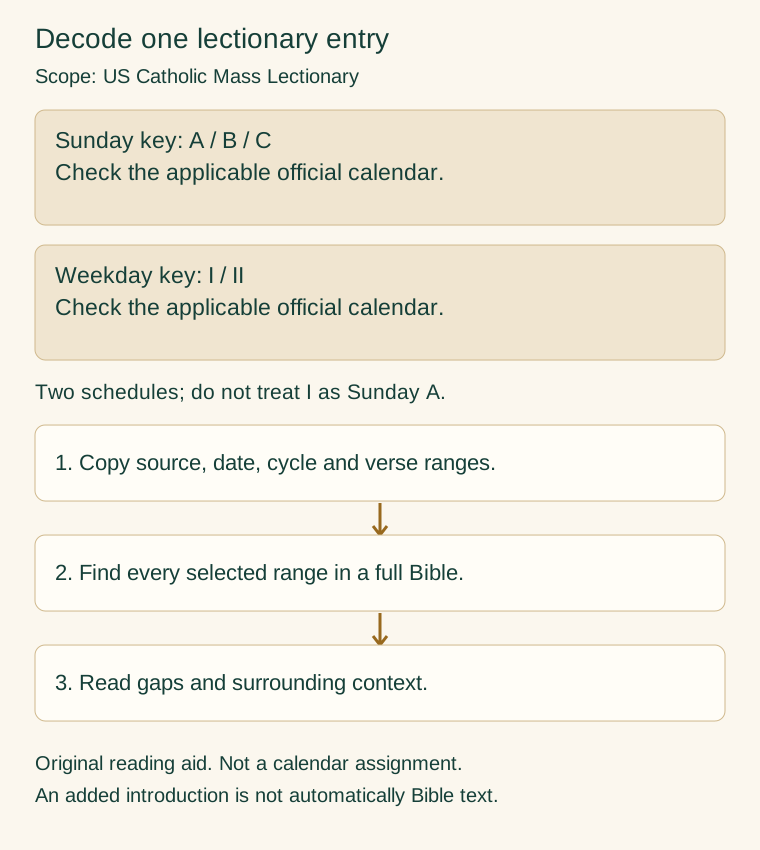
To read a lectionary entry, identify the calendar and tradition, decode its book and verse ranges, and find those ranges in a complete Bible. Then read the nearby verses that the selection leaves out. The entry tells you what is selected for a service; your Bible shows where that selection belongs in the larger passage.
Sources: Berean Standard Bible v5.9: verified canonical corpus · Berean Bible Free Licensing · Questions about the Lectionary
Reading guide · study guidance
Start with the right calendar
Scope: the United States Catholic Mass Lectionary, as explained by the USCCB. Other churches may use different calendars or arrangements. Check the name on your own reading sheet before applying this key.
A lectionary organizes selected readings for worship. A pericope is a selected passage. An incipit is an introductory phrase supplied for the reading; it need not reproduce the opening wording at that point in the biblical book. Read the USCCB lectionary FAQ alongside your church's current calendar.
| Mark on the reading sheet | What to check |
|---|---|
| Sunday A, B or C | The three-year Sunday cycle: mainly Matthew, Mark and Luke respectively; John also appears. |
| Weekday I or II | The two-year weekday cycle: I for odd-numbered years, II for even-numbered years. The Gospel cycle is the same in both. |
| A new liturgical year | The cycle changes at the First Sunday of Advent, rather than simply on January 1. |
| A feast or special celebration | Check its own assigned readings instead of extrapolating from an ordinary weekday. |
These labels identify a schedule, not how advanced a reader is. This guide does not calculate this year's cycle or publish an unverified future calendar. Copy the applicable designation from the official calendar for the date and celebration you actually need.
Sources: Berean Standard Bible v5.9: verified canonical corpus · Berean Bible Free Licensing · Questions about the Lectionary
Reading guide · study guidance
Build an entry card before you read
Use one row for the source entry and a second row for what you learn after opening your Bible. This prevents an added introduction, a chapter heading, or your own summary from becoming part of an imagined Bible quotation.
| Field | What to record |
|---|---|
| Source and date | Church or publisher, calendar year, date, and celebration exactly as supplied. |
| Cycle | Sunday or weekday, plus its printed cycle label; record “not supplied” when absent. |
| Book | Expand the abbreviation using the reading sheet's own key. |
| Reference | Chapter number and every verse range, preserving gaps. |
| Supplied introduction | Copy its location or describe it; compare it with the opening verse in your Bible. |
| Context | The preceding and following scene, argument, or paragraph that helps you read the selection. |
If a printed citation divides a verse with letters such as “a” or “b,” consult that edition's notation. Do not assume every Bible labels the same sub-verse boundaries. If your source is unclear, record the uncertainty rather than inventing a missing half verse.
Sources: Berean Standard Bible v5.9: verified canonical corpus · Berean Bible Free Licensing · Questions about the Lectionary
Reading guide · study guidance
Worked example: a deliberately fictional entry
Teaching example only — this is not an assigned Mass reading or an official lectionary entry. Our invented reading sheet says: “Practice session; cycle not supplied; Gospel: Mark 1:9–11, 14–15; supplied introduction: At that time.” The reference and introductory phrase are combined here solely to practise decoding.
Find the book and chapter. Open Mark, chapter 1. This example has one chapter and two selected ranges.
Mark the selected verses. The first range contains verses 9, 10 and 11; the second contains 14 and 15. The comma does not authorize reading verses 12–13 as part of the selection.
Read the gap privately for context. Verses 12–13 describe Jesus in the wilderness. Verses 14–15 move to Galilee and Jesus' proclamation after John's arrest. Reading the gap helps you notice the movement between the two selections.
Compare the introduction. Our invented introductory words are an aid on the practice sheet. They are not a claim about the exact opening wording of Mark 1:9.
Finish with the larger passage. Read Mark 1:1–20. Identify the preparation before the selected verses and the calling of disciples after them. Keep this context reading separate from the selection printed on the sheet.
The filled card therefore reads: source = fictional practice sheet; date = no real date; cycle = not supplied; book = Mark; ranges = 1:9–11 and 1:14–15; omitted internal range = 1:12–13; context to read = 1:1–20. These observations use the Berean Standard Bible (BSB); all wording here is original paraphrase.
Sources: Berean Standard Bible v5.9: verified canonical corpus · Berean Bible Free Licensing · Questions about the Lectionary
Reading guide · study guidance
Try three locating exercises
These are invented reference exercises, not a religious calendar. Use a complete Bible and write down verse numbers before checking the answer.
| Exercise | Your task | Check after trying |
|---|---|---|
| 1. Luke 10:25–37 | Locate the person who first asks a question, then identify the final instruction. | The legal expert's question begins at 10:25; Jesus' closing instruction is at 10:37. Read 10:25–29 before the story in 10:30–35. |
| 2. Mark 1:9–11, 14–15 | List the selected verses and the internal gap. | Selected: 9, 10, 11, 14, 15. Gap: 12–13. Do not merge the citation into 1:9–15 without noting the difference. |
| 3. John 6:1–5, 10–15 | Locate the omitted conversation before the people sit down. | The gap is 6:6–9, including Philip's and Andrew's responses and the boy's food. Read it before interpreting the action in 6:10–15. |
A useful answer points to the text. There is no score for faithfulness and no penalty for rereading. For an open question about context, more than one answer may work if the reader can show the relevant verses.
Sources: Berean Standard Bible v5.9: verified canonical corpus · Berean Bible Free Licensing · Questions about the Lectionary
Reading guide · study guidance
Keep a reusable card
Open the complete entry card, exercises and answer key. The worksheet includes a filled example and a blank card for your own source. Its blank fields are for your reading notes, not an online form.
For your next session, choose one real entry, verify it against the applicable official calendar, and read the complete surrounding passage. A selection can guide your attention without becoming the limits of your understanding.
Sources: Berean Standard Bible v5.9: verified canonical corpus · Berean Bible Free Licensing · Questions about the Lectionary
Reading guide · study guidance
Sources and next steps
USCCB: Questions about the Lectionary — source for the specifically US Catholic cycle and terminology summary; checked October 5, 2026.
Berean Standard Bible — the Bible text used to check Mark 1, Luke 10 and John 6. Passage descriptions are our paraphrases, not a reproduction of a lectionary.
Where to start reading the Bible — choose a manageable whole passage.
Bibleward reading plans — continue with another reading; Scripture text is free, and current guidance and audio access are shown on the site.
Study guidance and original practice materials, prepared with AI assistance and checked against the named sources; no pastoral or church endorsement is claimed. May God bless your attentive reading and the people with whom you share it.
Sources: Berean Standard Bible v5.9: verified canonical corpus · Berean Bible Free Licensing · Questions about the Lectionary
Original printable reading resource
Keep the worksheet beside your reading
Open the worksheet from the article link to read or print it in your browser. Download the same self-contained HTML file below to keep an offline copy, including the exercises and answer guidance.
- Download the complete printable worksheet (HTML)
Original questions, reference tables and answer guidance. Print from your browser or save as PDF; no account or online submission is needed.
Sources: Berean Standard Bible v5.9: verified canonical corpus · Berean Bible Free Licensing · Questions about the Lectionary
Sources and further reading
- Berean Standard Bible v5.9: verified canonical corpus
Exact JSONL rows checked by canonical book, chapter and verse; corpus SHA-256 c13b98acc5b8d4dfdd61900e4beee4e3afb231ba8b664154b244354af38356d4
- Berean Bible Free Licensing
Official public-domain declaration read live.
- Questions about the Lectionary
What is the difference between a Bible and a Lectionary?; How is the Lectionary arranged?
Study guidance · not Scripture. AI-assisted writing and automated content review; no individual pastoral endorsement is claimed.