Reading guide · study guidance
Before you begin
When Joram and Jehoram become confusing, identify each king by name, father and kingdom, then record the other king's regnal year. In 2 Kings 3:1 and 8:16, the son of Ahab belongs on the Israel track and the son of Jehoshaphat on the Judah track. A spelling alone is not a reliable person identifier.
Sources: Berean Standard Bible v5.9: verified canonical corpus · Berean Bible Free Licensing · 2 Kings chapter3: text and labeled notes · 2 Kings chapter8: text and labeled notes
Reading guide · study guidance
Read the whole notice, not only the name
A reign notice introduces a king by locating his rule alongside another ruler. A synchronism is that connection between two reigns. It gives you a relative marker — something happened during another king's numbered year — without itself supplying a modern calendar date.
Read 2 Kings 3:1–3 and 8:16–29 before filling the chart. The BSB, used for this guide, spells Ahab's son's name “Jehoram” in 3:1 and “Joram” in 8:16. The USCCB's displayed text uses “Joram” for the kings in both notices. Preserve your edition's wording on the card, while using father and kingdom to track the referent.
| Notice | King being introduced | Father | Kingdom | Other reign used as the time marker |
|---|---|---|---|---|
| 2 Kings 3:1 | Jehoram in BSB; Joram in the USCCB text | Ahab | Israel | Jehoshaphat of Judah, year 18 |
| 2 Kings 8:16 | Jehoram in BSB; Joram in the USCCB text | Jehoshaphat | Judah | Joram son of Ahab of Israel, year 5 |
| 2 Kings 8:25 | Ahaziah | Jehoram in BSB; Joram in the USCCB text | Judah | Joram son of Ahab of Israel, year 12 |
For each row, ask whose reign is beginning and whose reign is serving as the clock. Reversing those roles produces a different statement. Keep the verse reference attached so you can repair a mistaken row without reconstructing everything.
Sources: Berean Standard Bible v5.9: verified canonical corpus · Berean Bible Free Licensing · 2 Kings chapter3: text and labeled notes · 2 Kings chapter8: text and labeled notes
Reading guide · study guidance
Use two tracks and three connections
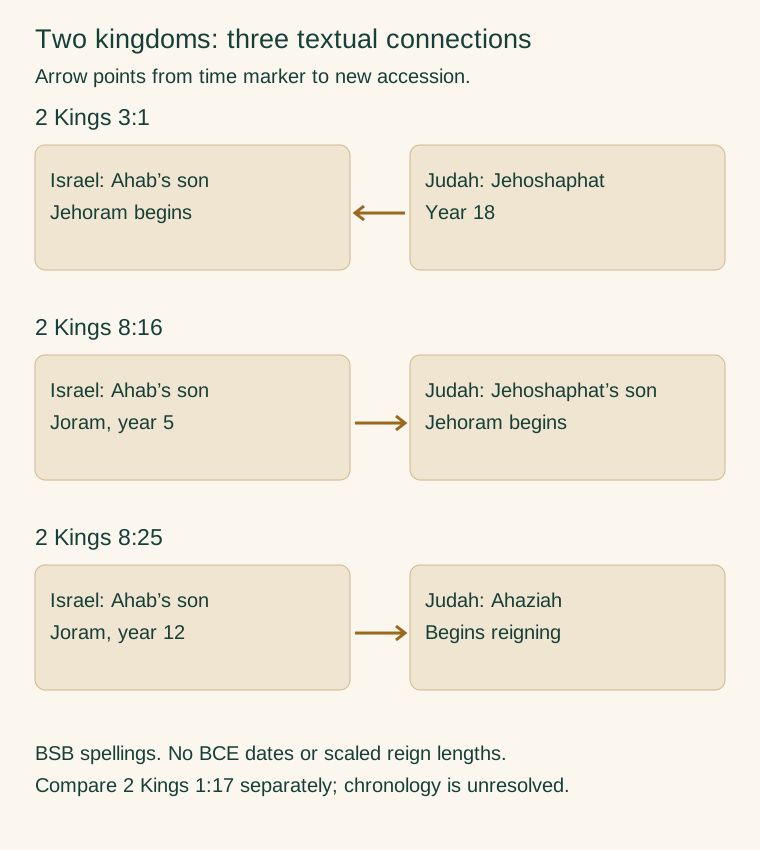
The diagram follows the notices, not a measured timeline. The arrow's origin supplies the numbered year; its destination is the accession being described.
2 Kings 3:1: Jehoshaphat's year 18 in Judah points to the start of Ahab's son's rule in Israel.
2 Kings 8:16: Ahab's son's year 5 in Israel points to the beginning of Jehoshaphat's son's rule in Judah.
2 Kings 8:25: Ahab's son's year 12 in Israel points to the beginning of Ahaziah's rule in Judah.
Do not measure distances between boxes or add their numbers as though they were one uninterrupted clock. These are three textual relationships. The chart does not decide accession-year conventions, overlapping reigns, or absolute BCE dates.
Sources: Berean Standard Bible v5.9: verified canonical corpus · Berean Bible Free Licensing · 2 Kings chapter3: text and labeled notes · 2 Kings chapter8: text and labeled notes
Reading guide · study guidance
Three person cards, with a spelling check
| Card | Anchor identity | Details that keep it separate |
|---|---|---|
| Israel card | Ahab's son: Jehoram/Joram | 2 Kings 3:1 associates his reign with Samaria and gives twelve years. In 8:16 and 8:25 his numbered years locate Judah's accessions. |
| Judah card | Jehoshaphat's son: Jehoram/Joram | 2 Kings 8:16 identifies his father and kingdom; 8:17 gives eight years in Jerusalem; 8:24 says his son Ahaziah succeeds him. |
| Judah successor card | Ahaziah, son of Jehoram/Joram | 2 Kings 8:25 introduces his reign; 8:26 gives one year in Jerusalem. In 8:29 he visits the wounded son of Ahab. |
This is a reading map of the identities as the notices distinguish them. It is not a claim to settle every historical reconstruction of the royal houses. In particular, Ahaziah here means the Judah ruler in 8:25–29; do not silently merge him with the Ahaziah in 2 Kings 1:17.
Filled spelling record: edition = BSB v5.9; 3:1 = Jehoram, son of Ahab, Israel; 8:16 = Joram, son of Ahab, Israel, and Jehoram, son of Jehoshaphat, Judah. Conclusion: in these cited BSB verses, the shorter spelling does not require inventing a third king.
Sources: Berean Standard Bible v5.9: verified canonical corpus · Berean Bible Free Licensing · 2 Kings chapter3: text and labeled notes · 2 Kings chapter8: text and labeled notes
Reading guide · study guidance
Place six verse cards on the tracks
Cover the answer column first. For a synchronism, put the new ruler on his kingdom's track and draw the time-reference connection from the other track. A verse involving both rulers may require two linked cards.
| Card and reference | Task | Answer and evidence |
|---|---|---|
| 1 — 2 Kings 3:1 | Place Ahab's son. Which other ruler supplies the clock? | Israel; Jehoshaphat of Judah supplies year 18. Both father and kingdom appear in the notice. |
| 2 — 2 Kings 8:16 | Place Jehoshaphat's son. Is his accession the Israel king's year 5 or his own year 5? | Judah; the fifth year belongs to Joram son of Ahab of Israel. |
| 3 — 2 Kings 8:17 | Attach the age, length of reign and city to the correct person. | Jehoshaphat's son on Judah's track: age 32, eight years, Jerusalem. Read 8:16 with it to identify the subject. |
| 4 — 2 Kings 8:24 | Add the successor after the death notice. | Judah: Jehoram/Joram's son Ahaziah succeeds him. The local paragraph identifies the father. |
| 5 — 2 Kings 8:25–26 | Give the new ruler's track and the cross-track time marker. | Ahaziah on Judah's track, beginning in the Israel ruler's year 12; verse 26 gives one year in Jerusalem. |
| 6 — 2 Kings 8:29 | Connect visitor and patient. Is this another accession notice? | Ahaziah of Judah visits wounded Joram son of Ahab at Jezreel. This is a visit within the story, not a new reign beginning. |
Sources: Berean Standard Bible v5.9: verified canonical corpus · Berean Bible Free Licensing · 2 Kings chapter3: text and labeled notes · 2 Kings chapter8: text and labeled notes
Reading guide · study guidance
Leave chronology questions visible
Now compare 2 Kings 1:17 with 3:1 and 8:16. The first gives a different synchronism for Ahab's son's accession. Do not erase that observation or “fix” your Bible by silently changing a year.
The USCCB note on 2 Kings 3:1 describes the chronological difficulty and different scholarly approaches, including co-regency proposals. Co-regency means rulers sharing a period of rule. This guide does not choose among those reconstructions. Record the exact difficulty in a separate note: “How should 1:17, 3:1 and 8:16 be related?”
The useful beginner result is smaller and firmer: you can show what each notice says, identify its subjects and ask a precise question. A responsible chart can contain an unresolved question without becoming useless.
Sources: Berean Standard Bible v5.9: verified canonical corpus · Berean Bible Free Licensing · 2 Kings chapter3: text and labeled notes · 2 Kings chapter8: text and labeled notes
Reading guide · study guidance
Print, check and continue
Open the two-kingdom worksheet, three person cards and six-card answer key. A reusable blank notice card lets you try the method elsewhere in Kings. Keep the edition and reference beside every name you record.
Sources: Berean Standard Bible v5.9: verified canonical corpus · Berean Bible Free Licensing · 2 Kings chapter3: text and labeled notes · 2 Kings chapter8: text and labeled notes
Reading guide · study guidance
Sources and next steps
USCCB: 2 Kings 3 and 2 Kings 8 — official displayed text and labeled editorial chronology notes; checked October 5, 2026.
Berean Standard Bible — checksum-verified BSB v5.9 used to verify the passage observations and spelling record. All explanations and cards use original paraphrase.
Identify the Herods in the New Testament — a different name-identification problem.
Where to start reading the Bible and Bibleward reading plans — choose your next manageable reading.
This is AI-assisted study guidance, with textual observations separated from historical reconstruction; no pastoral endorsement is claimed. May God bless your patience as you learn to follow the story carefully.
Sources: Berean Standard Bible v5.9: verified canonical corpus · Berean Bible Free Licensing · 2 Kings chapter3: text and labeled notes · 2 Kings chapter8: text and labeled notes
Original printable reading resource
Keep the worksheet beside your reading
Open the worksheet from the article link to read or print it in your browser. Download the same self-contained HTML file below to keep an offline copy, including the exercises and answer guidance.
- Download the complete printable worksheet (HTML)
Original questions, reference tables and answer guidance. Print from your browser or save as PDF; no account or online submission is needed.
Sources: Berean Standard Bible v5.9: verified canonical corpus · Berean Bible Free Licensing · 2 Kings chapter3: text and labeled notes · 2 Kings chapter8: text and labeled notes
Sources and further reading
- Berean Standard Bible v5.9: verified canonical corpus
Exact JSONL rows checked by canonical book, chapter and verse; corpus SHA-256 c13b98acc5b8d4dfdd61900e4beee4e3afb231ba8b664154b244354af38356d4
- Berean Bible Free Licensing
Official public-domain declaration read live.
- 2 Kings chapter3: text and labeled notes
3:1 and its separate scholarly note; observations verified against BSB, notes are not Scripture.
- 2 Kings chapter8: text and labeled notes
8:16–29 and separate chronology note.
Study guidance · not Scripture. AI-assisted writing and automated content review; no individual pastoral endorsement is claimed.