Historical context
Use a small family map, not one long biography
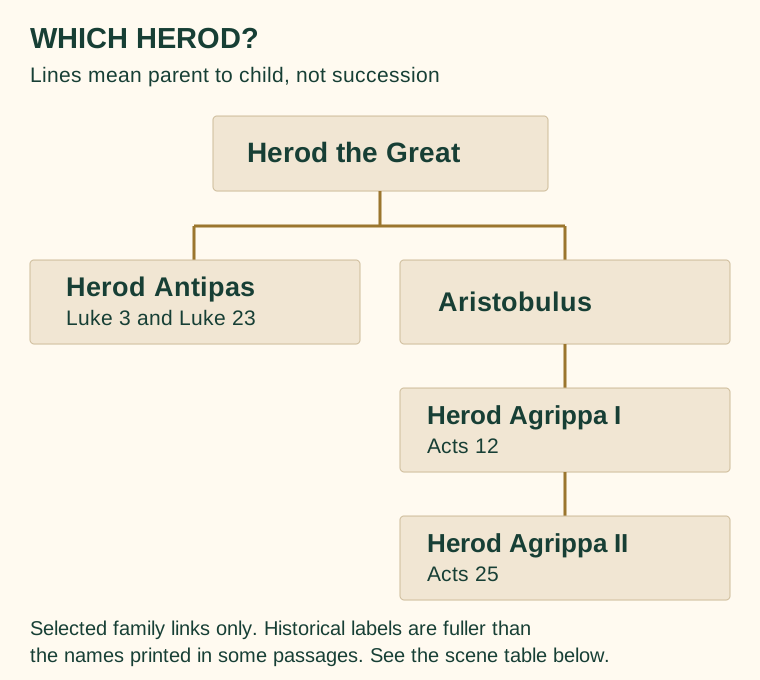
Start with the relationships below. This is an intentionally incomplete map: it keeps only the parent–child links needed to distinguish the four main names in this guide. Antipas and Agrippa I are not successive names for one person, and Agrippa II is not another name for his father.
Aristobulus is included as a connecting generation. The map does not assign every relative a biblical scene or imply a simple father-to-son transfer of one unchanged territory. An arrow here means family relationship only. It says nothing by itself about who ruled where or what that person did.
Background note: the labels the Great, Antipas, I, and II help readers separate historical people. A biblical paragraph may give only Herod or Agrippa. Keep the words printed in your translation in one note and the historical identification in another; do not silently add a fuller name inside a quotation.
| Parent | Child | Why the relationship matters here |
|---|---|---|
| Herod the Great | Herod Antipas | Different generations; separate the childhood and adult-ministry settings |
| Herod the Great | Aristobulus | Connecting generation in the Agrippa branch |
| Aristobulus | Herod Agrippa I | Agrippa I is Herod the Great’s grandson |
| Herod Agrippa I | Herod Agrippa II | The two Agrippas are father and son |
Sources: Herod — Encyclopedia of the Bible · Aristobulus — Encyclopedia of the Bible · Herod — Guide to the Scriptures · Composite “Herod” in Luke-Acts · Agrippa II — Encyclopaedia Judaica · Antiquities of the Jews 19.9.1–2
Textual observation and historical identification
Match five passages to four rulers
Read the passage clue before the last column. The first two columns describe what the named text actually supplies; the last column gives the conventional historical identification from the reference works. This distinction matters most in Acts 12, where the narrative uses Herod rather than the numbered name Agrippa I.
Luke 3 and Luke 23 belong to the same ruler’s adult-ministry setting. Luke 23:6–7 links Jesus’ Galilean origin with Herod’s jurisdiction, although Herod is in Jerusalem during this scene. A person’s current location and the territory he governs are different fields on your reading card.
Matthew 2:19–22 gives an especially useful stop sign: the Herod of its earlier scenes has died, and Archelaus is ruling in his father’s place in Judea. That is textual evidence against carrying the same childhood ruler forward into every later Gospel scene.
| Passage | What the text supplies | Historical identification |
|---|---|---|
| Matthew 2:1–22 | King Herod during the childhood story; his death is stated later in the chapter | Herod the Great |
| Luke 3:1, 19–20 | Herod is tetrarch of Galilee; he imprisons John | Herod Antipas |
| Luke 23:6–12 | Pilate sends Jesus to Herod because of jurisdiction; Herod is then in Jerusalem | Herod Antipas |
| Acts 12:1–4, 19–23 | King Herod acts against James and Peter; later the narrative reports his death | Herod Agrippa I |
| Acts 25:13–27 | King Agrippa arrives with Bernice; Festus brings Paul before the gathering | Herod Agrippa II |
Sources: Matthew 2 — Berean Standard Bible · Luke 3 — Berean Standard Bible · Luke 23 — Berean Standard Bible · Acts 12 — Berean Standard Bible · Acts 25 — Berean Standard Bible · Herod — Encyclopedia of the Bible · Herod — Guide to the Scriptures · Composite “Herod” in Luke-Acts · Agrippa II — Encyclopaedia Judaica
Editorial exercise grounded in named passages
Try the five scene cards before checking the map
Cover the map’s last column. For each card, write the name printed in the passage, one scene clue, and your proposed identification. Then open the answer. The point is to leave a trail another reader can check, not to guess faster.
If you can remember only one distinction at first, keep the two Acts cards apart. Acts 12 centers on James, Peter, and the church’s danger. Acts 25 centers on Paul’s case before Festus and the visiting Agrippa. The shared royal family does not make their actions interchangeable.
Sources: Matthew 2 — Berean Standard Bible · Luke 3 — Berean Standard Bible · Luke 23 — Berean Standard Bible · Acts 12 — Berean Standard Bible · Acts 25 — Berean Standard Bible · Herod — Guide to the Scriptures · Agrippa II — Encyclopaedia Judaica
Historical context and reading limits
Avoid three shortcuts that collapse the family
First shortcut: if someone is called king, it must be Herod the Great. Titles alone do not identify a person. Read them with the territory, other named officials, and stage of the narrative. A short card with three clues is more dependable than one familiar word.
Second shortcut: all similar names on a family chart are interchangeable. Archelaus is a separate son of Herod the Great named in Matthew 2:22. Philip also needs care: the reference works distinguish Philip the tetrarch in Luke 3:1 from the figure called Philip in the accounts of Herodias’ marriage. This small map omits those complicated marriage links; it does not merge the Philips or settle the naming debate.
Third shortcut: a literary comparison proves that the historical people were one person. Frank Dicken’s 2015 essay proposes that Luke–Acts presents a composite literary Herod across separate historical rulers. That is his narrative-critical interpretation, not a finding that the Great, Antipas, and Agrippa I were historically identical. You can study a repeated narrative pattern while retaining different identities.
Sources: Herod — Encyclopedia of the Bible · Herod — Guide to the Scriptures · Matthew 2 — Berean Standard Bible · Luke 3 — Berean Standard Bible · Composite “Herod” in Luke-Acts
Editorial reading practice
Make one card and return to the passage
Use this blank card: reference ___; exact name in my edition ___; office or title ___; territory named ___; people interacting with him ___; action in this paragraph ___; fuller identification and source ___. Leave absent information blank. The purpose is to mark the boundary between reading and background research.
Worked card: Luke 23:6–12; printed name Herod; jurisdiction connected with Galilee; current location Jerusalem; interactions with Pilate and Jesus; Jesus is questioned and sent back; historical identification Antipas, checked against the Herod reference. The card is a paraphrased reading note, not a new translation of the passage.
Finally, reread the scene with the identification beside you. Ask what this particular ruler says and does here. Do not transfer the conduct of a relative into the paragraph, and do not use a ruler’s conduct to characterize an entire people. When a source raises a question beyond this map, save the question with its reference and continue with the part you can verify.
Sources: Luke 23 — Berean Standard Bible · Herod — Encyclopedia of the Bible
Sources and further reading
- Herod — Encyclopedia of the Bible
Sections II (family), IV (Archelaus), V (Antipas), especially V.B.2 on the disputed Philip identification and V.B.3 on Jesus before Antipas.
- Aristobulus — Encyclopedia of the Bible
Entry 5: Aristobulus as Herod the Great’s son and father of Agrippa I.
- Herod — Guide to the Scriptures
Whole short entry: parent–child relationships and references for Herod the Great, Antipas, Agrippa I and Agrippa II. Publisher is a Latter-day Saint church; used for the named historical family references only.
- Agrippa II — Encyclopaedia Judaica
Opening paragraph identifies Agrippa II as son of Agrippa I; later paragraph connects him with Acts 25–26. No birth/death dates or character judgments are adopted.
- Composite “Herod” in Luke-Acts
Frank Dicken, June 2015; opening discussion distinguishes three historical people and separately proposes a composite literary characterization.
- Matthew 2 — Berean Standard Bible
Matthew 2:1–22: childhood scene, death of Herod, Archelaus named as his son.
- Luke 3 — Berean Standard Bible
Luke 3:1,19–20: Herod tetrarch of Galilee; John’s imprisonment.
- Luke 23 — Berean Standard Bible
Luke 23:6–12: Galilean jurisdiction, current Jerusalem location, questioning and return to Pilate.
- Acts 12 — Berean Standard Bible
Acts 12:1–4,19–23: Herod, James and Peter; later death of Herod.
- Acts 25 — Berean Standard Bible
Acts 25:13–27: Agrippa and Bernice visit Festus; Paul brought before the gathering.
- Antiquities of the Jews 19.9.1–2
Book 19, chapter 9, sections 1–2 explicitly identify the younger Agrippa as the deceased king’s son. Used only for the family relationship, not other claims in the chapter.
Reading aid · AI-assisted writing and automated content review; no individual pastoral or denominational endorsement is claimed.