Reading guide · study guidance
Before you begin
Acts 15 records a decision not to impose circumcision and the whole law of Moses on Gentile converts. The letter sent from Jerusalem instead names four requirements: avoid food sacrificed to idols, blood, meat from strangled animals, and sexual immorality. To understand that decision, read the dispute, the speakers' contributions, the agreed letter, and its reception together in Acts 15:1–35.
Gentiles means people from the nations beyond Israel. This guide follows the Berean Standard Bible (BSB) wording and distinguishes the narrative's reported decision from modern debates about its application. You can complete the letter card and five evidence exercises beside an open Bible.
Sources: Berean Standard Bible v5.9: checksum-verified corpus · Berean Bible Terms and Conditions · Bibleward reading plans · Acts 15, Berean Standard Bible · Acts15 text and explanatory notes
Reading guide · study guidance
Start with the disputed claim
Scripture observation. The dispute opens with men from Judea teaching a circumcision requirement in 15:1. Paul and Barnabas oppose them; the church sends these two and other believers to Jerusalem to meet the apostles and elders (15:2–4). In Jerusalem, some believers associated with the Pharisees argue that Gentiles must be circumcised and obey the law of Moses (15:5).
Write that claim on a background card before reading anyone's answer. Otherwise, the four requirements near the end can look like an isolated list with no question behind it. The narrative identifies particular speakers; it does not say that every Jewish believer made the same argument. Read Acts 15.
| Background field | Filled reading card | Evidence |
|---|---|---|
| Disputed claim | Gentile converts should be circumcised and required to obey Moses' law. | 15:1, 5 |
| Delegation sent to Jerusalem | Paul, Barnabas, and other believers whose names are not supplied here. | 15:2–4 |
| People considering the question | Apostles and elders meet; the assembly also appears in the account. | 15:6, 12 |
| Question to keep open | How will the final letter address the original claim? | Compare 15:1–5 with 15:23–29. |
Sources: Berean Standard Bible v5.9: checksum-verified corpus · Berean Bible Terms and Conditions · Bibleward reading plans · Acts 15, Berean Standard Bible · Acts15 text and explanatory notes
Reading guide · study guidance
Follow five stages without merging the speakers
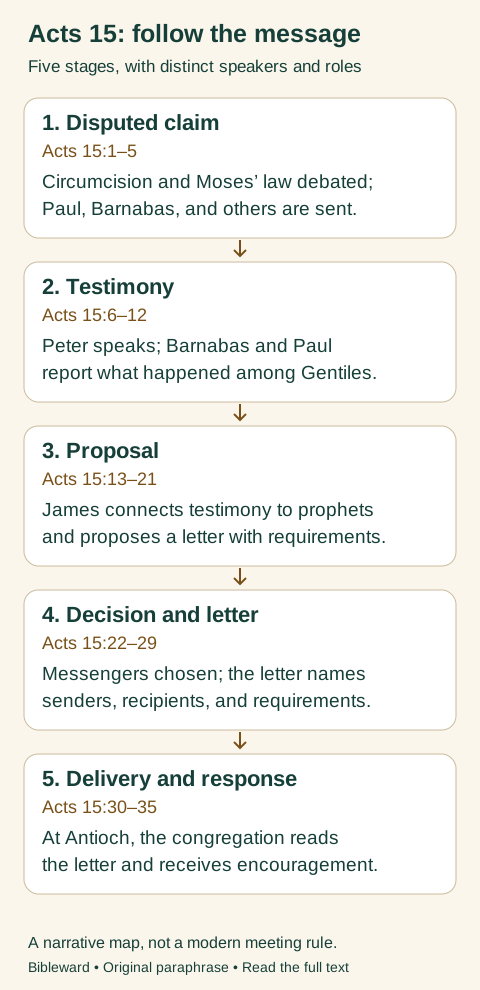
The diagram is an original reading aid, not a reconstruction of minutes or a voting procedure. Its five stages preserve four distinct kinds of contribution: a disputed claim, testimony, a proposal, and a shared decision. Delivery then shows what happened to that decision.
| Stage | Who speaks or acts? | What to record |
|---|---|---|
| 1. Dispute, 15:1–5 | Men from Judea; Paul and Barnabas; some Pharisee believers | The requirement being contested and the journey to Jerusalem. |
| 2. Testimony, 15:6–12 | Peter, then Barnabas and Paul | Peter recalls Gentiles receiving the Spirit and speaks of salvation through Jesus' grace (7–11). Barnabas and Paul recount signs and wonders among Gentiles (12). |
| 3. Proposal, 15:13–21 | James | He connects the testimony with the prophets, then proposes a letter and specified abstentions. |
| 4. Decision and letter, 15:22–29 | Apostles and elders with the whole church select messengers; the letter names its senders | Read the actual letter, not only James's preceding speech. |
| 5. Delivery and response, 15:30–35 | Messengers and congregation in Antioch | The letter is delivered and read; the people rejoice, and Judas and Silas encourage them. |
Peter's testimony is not James's proposal. James's proposal is not the entire delivery story. Keeping the names beside their verses helps you see how the account reaches its written outcome without inventing private motives, vote totals, or speeches Luke does not provide.
Sources: Berean Standard Bible v5.9: checksum-verified corpus · Berean Bible Terms and Conditions · Bibleward reading plans · Acts 15, Berean Standard Bible · Acts15 text and explanatory notes
Reading guide · study guidance
Read the letter as a document within the story
Scripture observation. The narrative says that the apostles and elders, together with the whole church, choose men to travel with Paul and Barnabas (15:22). The letter's opening names the apostles and elders as the senders, addressing Gentile believers in Antioch, Syria, and Cilicia (15:23). Those are related details, not interchangeable answers to “Who wrote, sent, carried, and received this?”
| Letter element | Text-supported answer | Reference |
|---|---|---|
| Named senders | The apostles and elders, addressing the recipients as fellow believers. | 15:23 |
| Recipients | Gentile believers in Antioch, Syria, and Cilicia. | 15:23 |
| Problem acknowledged | People had unsettled the recipients without the senders' authorization. | 15:24 |
| Named accompanying messengers | Judas called Barsabbas and Silas travel with Paul and Barnabas. | 15:22, 25–27 |
| Relationship of speech to writing | Judas and Silas are to confirm the same message in person. | 15:27 |
| Decision as the letter presents it | The writers attribute their judgment to the Holy Spirit and themselves, then name the requirements. | 15:28–29 |
| Delivery actually narrated | The congregation in Antioch gathers, receives the letter, and rejoices at its encouragement. | 15:30–31 |
The four requirements use the BSB's wording categories: idol-sacrificed food, blood, strangled-animal meat, and sexual immorality. Listing them identifies the letter's content. It does not by itself answer every present-day question about food, civil law, or church authority. Nor does the letter's attribution to the Spirit authorize this website to claim divine endorsement for its own advice.
Notice a useful limit: the letter addresses three geographical areas, but 15:30–35 describes its reception in Antioch. Do not turn its addressee line into three narrated delivery scenes.
Sources: Berean Standard Bible v5.9: checksum-verified corpus · Berean Bible Terms and Conditions · Bibleward reading plans · Acts 15, Berean Standard Bible · Acts15 text and explanatory notes
Reading guide · study guidance
Work one example, then try five checks
Filled example. Question: “Who confirms the letter aloud?” Answer: Judas and Silas. Evidence: 15:27 states their task; 15:32 describes their encouragement. Limit: those verses do not give a transcript of everything they said.
The printable worksheet includes five tasks with a separate answer key:
Put the five stages into narrative order.
Match Peter, Barnabas and Paul, and James to their contributions.
Separate senders, carriers, and recipients.
Compare the opening disputed requirement with the final letter.
Distinguish a narrated delivery from a location merely named as a recipient.
These checks test whether an answer can be found in the passage. They do not grade faith or require everyone to draw the same theological conclusion.
Sources: Berean Standard Bible v5.9: checksum-verified corpus · Berean Bible Terms and Conditions · Bibleward reading plans · Acts 15, Berean Standard Bible · Acts15 text and explanatory notes
Reading guide · study guidance
Keep interpretation and application in their proper place
Editorial reading method. Ask what changes between the opening demand and the final message, and why the writer includes both public discussion and a letter. A supported answer might notice that the dispute is addressed by identifiable people, communicated in writing, and confirmed by messengers. That is a reading inference, not a complete model for every modern church meeting.
Interpretive scope. This guide describes Acts 15's narrative and the BSB's terms. It does not settle the continuing application of the food provisions or competing Christian accounts of council authority. For comparison, the USCCB's Acts 15 text and notes give a Catholic-published explanation; distinguish its notes from the biblical text itself.
Read the whole 1–35 unit once more after filling the card. Bibleward's Day 54 Scripture reading covers 15:1–21; this resource continues through the letter and response. For your next passage, return to the reading plans or the beginner's starting guide. Scripture text is free; follow the current labels for guided and audio access.
A blessing for your reading: May God bless you with patience to listen closely, ask fair questions, and seek understanding with others.
AI-assisted study guidance and original worksheet; automated source and Christian-content review. This is not Scripture, a modern legal ruling, or an individual pastoral endorsement. Descriptions are original paraphrases checked against BSB v5.9.
Sources: Berean Standard Bible v5.9: checksum-verified corpus · Berean Bible Terms and Conditions · Bibleward reading plans · Acts 15, Berean Standard Bible · Acts15 text and explanatory notes
Original printable reading resource
Keep the worksheet beside your reading
Open the worksheet from the article link to read or print it in your browser. Download the same self-contained HTML file below to keep an offline copy, including the exercises and answer guidance.
- Download the complete printable worksheet (HTML)
Original questions, reference tables and answer guidance. Print from your browser or save as PDF; no account or online submission is needed.
Sources: Berean Standard Bible v5.9: checksum-verified corpus · Berean Bible Terms and Conditions · Bibleward reading plans · Acts 15, Berean Standard Bible · Acts15 text and explanatory notes
Sources and further reading
- Berean Standard Bible v5.9: checksum-verified corpus
Canonical references checked against pinned BSB v5.9 JSONL
- Berean Bible Terms and Conditions
Public-domain dedication and all-use permission effective April 30, 2023
- Bibleward reading plans
Day28 1 Corinthians12:12–27, Day54 Acts15:1–21, free Scripture and labeled guided/audio access
- Acts 15, Berean Standard Bible
Acts15:1–35, primary Scripture section
- Acts15 text and explanatory notes
Primary chapter and separately marked Catholic-published notes
Study guidance · not Scripture. AI-assisted writing and automated content review; no individual pastoral endorsement is claimed.