Reading guide · study guidance
Before you begin
This Zechariah eight night visions worksheet helps you keep those levels apart. Read the primary text in Zechariah 1, 2, 3, 4, 5 and 6. Then use the printable observation matrix. Every summary here is an original paraphrase.
Sources: World English Bible — Zechariah 1 · World English Bible — Zechariah 2 · World English Bible — Zechariah 3 · World English Bible — Zechariah 4 · World English Bible — Zechariah 5 · World English Bible — Zechariah 6
Reading guide · study guidance
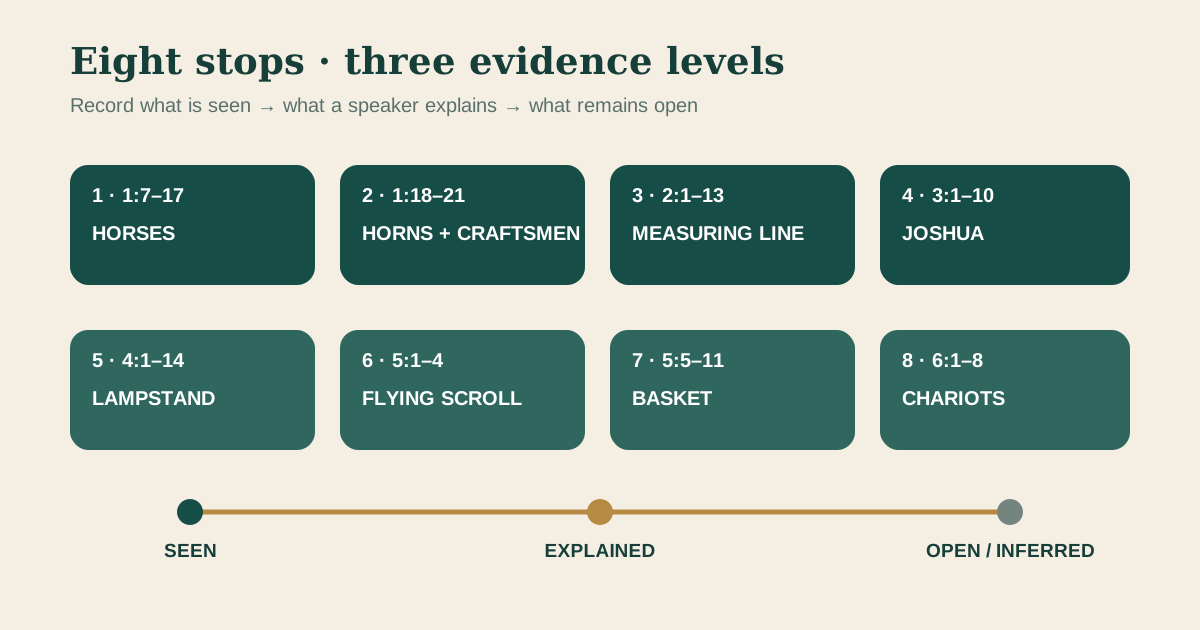
Eight stops through the night visions
The boundaries below are reading divisions. Zechariah does not number the visions from one through eight. This guide uses the sequence because each stop opens with a new sight or scene.
| Stop and range | What Zechariah sees | Question and answer | What remains open here |
|---|---|---|---|
| 1 · 1:7–17 | A rider among myrtle trees, with horses behind | Zechariah asks what they are; the interpreting angel promises to show him, and the riders report their patrol. The scene leads to a plea for Jerusalem and words of comfort and restoration. | Why each horse has its particular color is not explained. |
| 2 · 1:18–21 | Four horns, then four craftsmen | He asks what the horns are and what the craftsmen will do. The horns are linked with scattering Judah, Israel and Jerusalem; the craftsmen come against those horns. | The craftsmen are not individually named. |
| 3 · 2:1–13 | A man holding a measuring line | Zechariah asks where he is going; the man says he will measure Jerusalem. Angelic speech then describes an unwalled, populous city with the Lord as protection and glory. | The passage gives no completed set of physical measurements. |
| 4 · 3:1–10 | Joshua the high priest in dirty garments before the angel, with an accuser present | There is no repeated request to identify the objects. Commands remove Joshua’s dirty clothes; speech explains cleansing, responsibility and signs connected with the coming Branch and a stone. | Several symbols are named without a complete visual code. |
| 5 · 4:1–14 | A gold lampstand, bowl, lamps, pipes and two olive trees | Asked what he sees, Zechariah describes it and then asks what it means. The answer includes the word to Zerubbabel, the seven eyes and the identification of two anointed ones. | The passage does not explain every pipe or assign modern identities to the two figures. |
| 6 · 5:1–4 | A flying scroll with stated dimensions | The angel asks what Zechariah sees and explains it as a curse going across the land against stealing and false swearing. | The scene does not invite calculation of a present-day flight path. |
| 7 · 5:5–11 | A measuring basket, a woman inside, a heavy cover and two winged women carrying it | Zechariah asks what appears and where it is going. The angel identifies the woman with wickedness and says a house will be built for the basket in Shinar. | The two carriers are not named, and no contemporary nation is assigned to them. |
| 8 · 6:1–8 | Four chariots with differently colored horses emerging between bronze mountains | Zechariah asks what they are. The angel identifies them with four winds going out from before the Lord and gives their directions. | Not every color receives a separate meaning, and the bronze mountains are not decoded. |
Sources: World English Bible — Zechariah 1 · World English Bible — Zechariah 2 · World English Bible — Zechariah 3 · World English Bible — Zechariah 4 · World English Bible — Zechariah 5 · World English Bible — Zechariah 6
Reading guide · study guidance
Three evidence levels
Mark each note with one of these labels:
Seen: a detail Zechariah reports seeing.
Explained: an interpretation a speaker within the passage supplies.
Open or inferred: a detail the passage leaves unexplained, or a proposed connection made by a later reader.
For example, the flying object in 5:1–4 is seen as a scroll. The angel’s statement that it is a curse is explained. A claim that its measurements predict a current event is neither; it is an added proposal without support from this passage.
The same discipline applies to repeated features. Horses appear in the first and eighth stops. That resemblance is a direct observation. The text also describes both groups moving through the earth. A claim that every horse in both scenes has exactly the same role goes further and should be labeled inference.
Sources: World English Bible — Zechariah 1 · World English Bible — Zechariah 2 · World English Bible — Zechariah 3 · World English Bible — Zechariah 4 · World English Bible — Zechariah 5 · World English Bible — Zechariah 6
Reading guide · study guidance
Who speaks in the explanations?
The recurring reference to the angel speaking with Zechariah helps the reader follow much of the exchange. Yet not every stop uses the same pattern. In the first, a man among the myrtles also answers and the riders report; the Lord responds to the angel. In the Joshua scene, vision and courtroom-like action unfold without Zechariah first asking for a definition. In chapter 4, Zechariah asks twice about the olive trees before the final answer.
Do not fill a blank cell with an invented speaker. Marking that no question is recorded in a scene is better than forcing every stop into identical dialogue.
Sources: World English Bible — Zechariah 1 · World English Bible — Zechariah 2 · World English Bible — Zechariah 3 · World English Bible — Zechariah 4 · World English Bible — Zechariah 5 · World English Bible — Zechariah 6
Reading guide · study guidance
Four comparisons to make after all eight stops
Compare the earth patrol in 1:8–11 with the chariots sent out in 6:1–8. List the shared movement language, then list what differs.
Compare measuring Jerusalem in 2:1–5 with the measured scroll in 5:1–4. Does measurement perform the same function in both scenes?
Compare Joshua’s changed clothing in chapter 3 with the confined figure named in 5:5–11. Who supplies the explanation in each?
Compare the lampstand’s explained elements with its unexplained construction details. Which answer is explicit, and which questions stay open?
The worksheet has an eight-row matrix, eight reading cards and explained answers for these comparisons.
Sources: World English Bible — Zechariah 1 · World English Bible — Zechariah 2 · World English Bible — Zechariah 3 · World English Bible — Zechariah 4 · World English Bible — Zechariah 5 · World English Bible — Zechariah 6
Reading guide · study guidance
An eight-session route
Read one stop per session. Write only four notes: range, scene, speaker who explains and one open detail. At the eighth stop, return to the first and compare rather than merge. This pace is a reading option, not a requirement or a measure of spiritual maturity.
The vision sequence ends at 6:8 for this exercise because 6:9 begins a new word report about crowns and Joshua. Chapter 6 continues, so this boundary should not be mistaken for the end of the book’s message.
These chapters should not be used to predict a date for a current war, election or disaster. The text names Jerusalem, Judah, the nations, Joshua, Zerubbabel and other ancient participants. Moving from those references to a current event requires arguments this worksheet does not supply.
After the final card, choose another reading in Plans or visit where to start reading the Bible.
Sources: World English Bible — Zechariah 1 · World English Bible — Zechariah 2 · World English Bible — Zechariah 3 · World English Bible — Zechariah 4 · World English Bible — Zechariah 5 · World English Bible — Zechariah 6
Reading guide · study guidance
Sources and scope
World English Bible: Zechariah 1, 2, 3, 4, 5 and 6 — primary text used for the sequence, reported sights, questions and supplied explanations. The pages identify the updated WEB Protestant edition as public domain.
The eight-stop boundaries and evidence labels are Bibleward editorial aids. Interpretations of the visions differ across Christian traditions; this guide makes passage-level observations and does not present one detailed prophetic system as universal Christianity.
AI-assisted original reading resource. It is not Scripture, a prediction, or individual pastoral endorsement.
Sources: World English Bible — Zechariah 1 · World English Bible — Zechariah 2 · World English Bible — Zechariah 3 · World English Bible — Zechariah 4 · World English Bible — Zechariah 5 · World English Bible — Zechariah 6
Original printable reading resource
Keep the worksheet beside your reading
Open the worksheet from the article link to read or print it in your browser. Download the same self-contained HTML file below to keep an offline copy, including the exercises and answer guidance.
- Download the complete printable worksheet (HTML)
Original questions, reference tables and answer guidance. Print from your browser or save as PDF; no account or online submission is needed.
Sources: World English Bible — Zechariah 1 · World English Bible — Zechariah 2 · World English Bible — Zechariah 3 · World English Bible — Zechariah 4 · World English Bible — Zechariah 5 · World English Bible — Zechariah 6
Reading aid boundaries
How to use this reading aid
AI-assisted study guidance and automated review; no individual pastoral endorsement.
Eight stops and three evidence levels are editorial reading aids; Zechariah does not number eight visions.
The guide does not use the visions to predict present-day dates or events.
Sources: World English Bible — Zechariah 1 · World English Bible — Zechariah 2 · World English Bible — Zechariah 3 · World English Bible — Zechariah 4 · World English Bible — Zechariah 5 · World English Bible — Zechariah 6
Sources and further reading
- World English Bible — Zechariah 1
Full linked chapter page; verse text, sequence, editorial headings/footnotes and public-domain notice checked in this session.
- World English Bible — Zechariah 2
Full linked chapter page; verse text, sequence, editorial headings/footnotes and public-domain notice checked in this session.
- World English Bible — Zechariah 3
Full linked chapter page; verse text, sequence, editorial headings/footnotes and public-domain notice checked in this session.
- World English Bible — Zechariah 4
Full linked chapter page; verse text, sequence, editorial headings/footnotes and public-domain notice checked in this session.
- World English Bible — Zechariah 5
Full linked chapter page; verse text, sequence, editorial headings/footnotes and public-domain notice checked in this session.
- World English Bible — Zechariah 6
Full linked chapter page; verse text, sequence, editorial headings/footnotes and public-domain notice checked in this session.
Study guidance · not Scripture. AI-assisted writing and automated content review; no individual pastoral endorsement is claimed.