Textual observation
Give each setting its own reading card
Tabernacle, temple, and synagogue do not describe one building carried unchanged through every Bible story. Start with the place and the action in the passage. This chart uses three selected scenes; it is a reading aid, not an inventory of every use of these words.
In Exodus 40 the tent belongs to Israel’s journey. In 1 Kings 6 the building belongs to Solomon’s reign. Luke 4 presents Jesus reading in Nazareth. Put that narrative setting on your card before adding details from a study Bible or a picture. A scene’s place in the story is not automatically the date when its book was written.
| Setting | Location and mobility | Scene in the story | What this passage shows |
|---|---|---|---|
| Tabernacle — Exodus 40 | Tent associated with Israel’s journeys | Moses sets it up | Furniture arranged; offerings and washing; cloud and onward travel |
| Temple — 1 Kings 6 | A fixed sanctuary, unlike the travelling tent | Solomon builds the temple | Stone and timber construction; inner sanctuary; court |
| Synagogue — Luke 4:16–21 | A gathering place in Nazareth | Jesus’ public ministry | Isaiah scroll, reading, attendant and spoken explanation |
Sources: World English Bible Classic: Exodus 40 · World English Bible Classic: 1 Kings 6 · World English Bible Classic: Luke 4
Original schematic · not to scale
Read the function before imagining the architecture
The three diagrams on this page are original sketches of selected textual functions. They are not archaeological reconstructions, complete architectural plans, or visitor routes. Their boxes organize your notes; they do not assign precise dimensions, seating arrangements, or access rules.
For the Exodus card, connect the tent, its screened ark, and the outside altar and basin. For the Kings card, distinguish the court, main building, and inner sanctuary prepared for the ark. For the Luke card, connect Jesus, the Isaiah scroll, the attendant, and the listeners. The last diagram represents an interaction, not a guessed room layout.
Keep one blank margin called “not supplied here.” A modern illustration can feel vivid enough to become part of your memory of the text. The blank margin helps you retain the difference between a feature the passage names and a feature an artist has supplied. A complete reconstruction would require evidence beyond this guide.
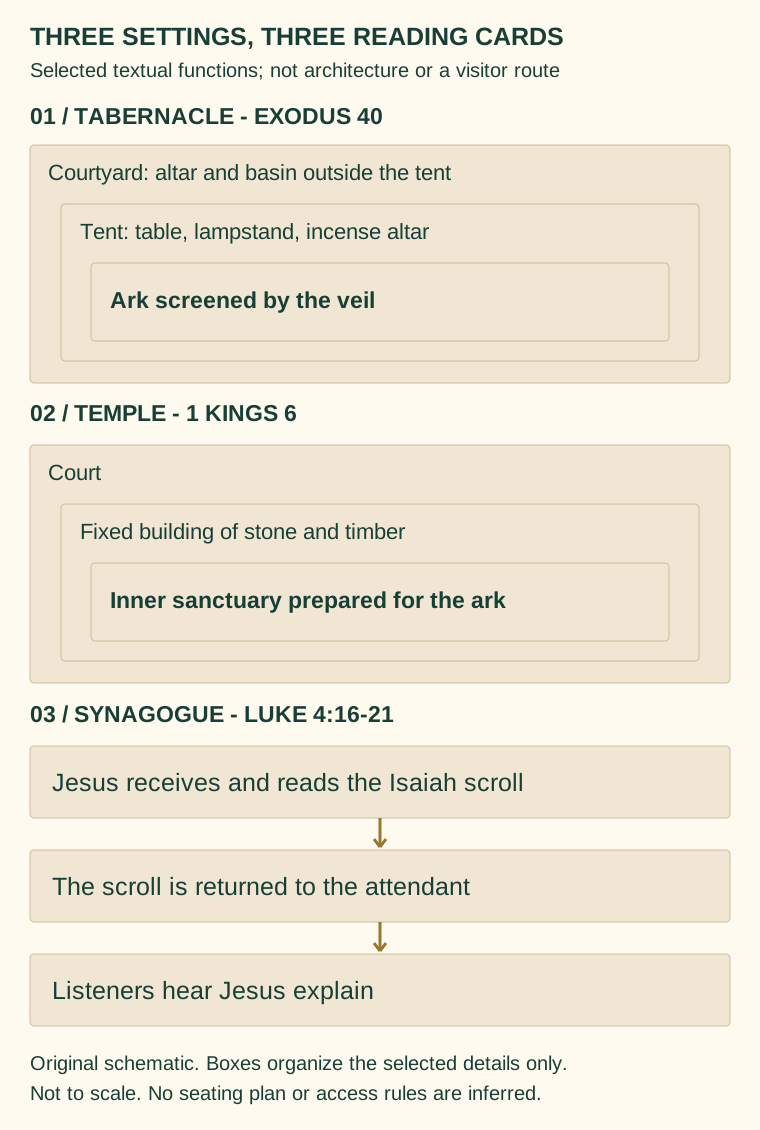
Sources: World English Bible Classic: Exodus 40 · World English Bible Classic: 1 Kings 6 · World English Bible Classic: Luke 4
Worked textual comparison
Jerusalem in Luke 2; Nazareth in Luke 4
Read Luke 2:41–46 and Luke 4:16–21 as two scenes. The first places Jesus’ family in Jerusalem for Passover and later locates him in the temple among teachers. The second names Nazareth and a synagogue, where he reads from Isaiah and then speaks. Both include learning, but that overlap does not make the places interchangeable.
Try covering the building names and locating each scene from the remaining clues. Then uncover the names and correct your note. Record one verse reference for the location and another for the action; this makes your answer checkable by a reading partner.
For a next reading, keep the same card beside a Gospel passage in the existing Jesus and the Gospels path. The purpose is to notice where people actually are, not to delay reading until you can draw every ancient building.
Sources: World English Bible Classic: Luke 2 · World English Bible Classic: Luke 4
Historical context and reading limits
Correct three common shortcuts
“All three are sacrifice centers” is too broad for these scene cards. Exodus 40 explicitly includes offerings. Luke 2:22–24 mentions a sacrifice in the Jerusalem visit. Luke 4:16–21 describes reading and speaking; it supplies no evidence for a sacrificial altar in that synagogue. Do not move an activity from one setting to another without a source.
“Synagogues appeared only after the temple disappeared” also fails. Rabbi Jonathan E. Blake’s historical introduction explains that synagogues existed alongside the Second Temple. Luke’s own narrative contains both temple and synagogue scenes. This limited point does not settle the debated beginnings of every synagogue practice.
“A modern building with a familiar religious name works exactly like the ancient one” is an assumption. Luther Seminary’s discussion of 1 Kings 6 cautions readers about projecting a modern house of worship onto the Jerusalem temple. Ask which period, community, and activity your comparison concerns instead of treating a shared name as a complete explanation.
Sources: World English Bible Classic: Exodus 40 · World English Bible Classic: Luke 2 · World English Bible Classic: Luke 4 · What Is the Purpose of the Synagogue? · Jerusalem Temple and temples of the ancient Near East
Original practice
Make a setting card for your next passage
Write five short lines: passage, place-name, kind of setting, explicit action, and unknown detail. Leave the unknown line open if the passage does not answer it. A useful card can be incomplete; a confident invented detail cannot help your partner check the reading.
If you consult a dictionary, add its title and the precise claim it helped with. Keep that background line separate from the verse reference. When two resources describe different periods, do not combine their details into a single imagined scene.
Read the paragraph again with your card beside it. Notice whether knowing the place changes a question you want to ask about the action. You can then follow the passage’s own movement using the route-diagram guide, or return to the broader beginner reading method.
Sources: World English Bible Classic: Luke 4 · Jerusalem Temple and temples of the ancient Near East
Sources and further reading
- World English Bible Classic: Exodus 40
Verses 1–8, 17–38: tent, court, objects, offerings, washing and movement. Reading diagram uses selected textual functions, not a reconstructed floor plan.
- World English Bible Classic: 1 Kings 6
Verses 1–10, 16–20, 36–38: Solomon builds a stone-and-timber sanctuary with an inner sanctuary and court.
- World English Bible Classic: Luke 2
Verses 22–27 and 41–46: Jerusalem temple presentation and the later Passover visit with Jesus among the teachers.
- World English Bible Classic: Luke 4
Verses 16–21: Nazareth, Sabbath, synagogue, Isaiah scroll, attendant, reading and teaching. No complete synagogue blueprint is given.
- Jerusalem Temple and temples of the ancient Near East
Analysis opening: permanent temple compared with tabernacle; warning against equating ancient temple with a modern house of worship. No broader claims about all ancient people’s access to God are adopted.
- What Is the Purpose of the Synagogue?
Jonathan E. Blake’s opening historical discussion: synagogues existed while the Second Temple stood. Original publication March 2008. Later theological reflection is identified as Reform Jewish and is not reproduced here.
- World English Bible rights
Public-domain text; the World English Bible name identifies the unaltered translation. This guide paraphrases observations and quotes no new Scripture.
Study guidance · not Scripture. AI-assisted writing and automated content review; no individual pastoral or denominational endorsement is claimed.