Reading guide · study guidance
Before you begin
This guide uses the labels displayed in the World English Bible pages for Song 1, Song 5 and Song 6. It does not claim every edition makes the same choices. Use the printable speaker-label worksheet for a label-free exercise and explained key.
Sources: World English Bible — Song of Solomon 1 · World English Bible — Song of Solomon 5 · World English Bible — Song of Solomon 6
Reading guide · study guidance
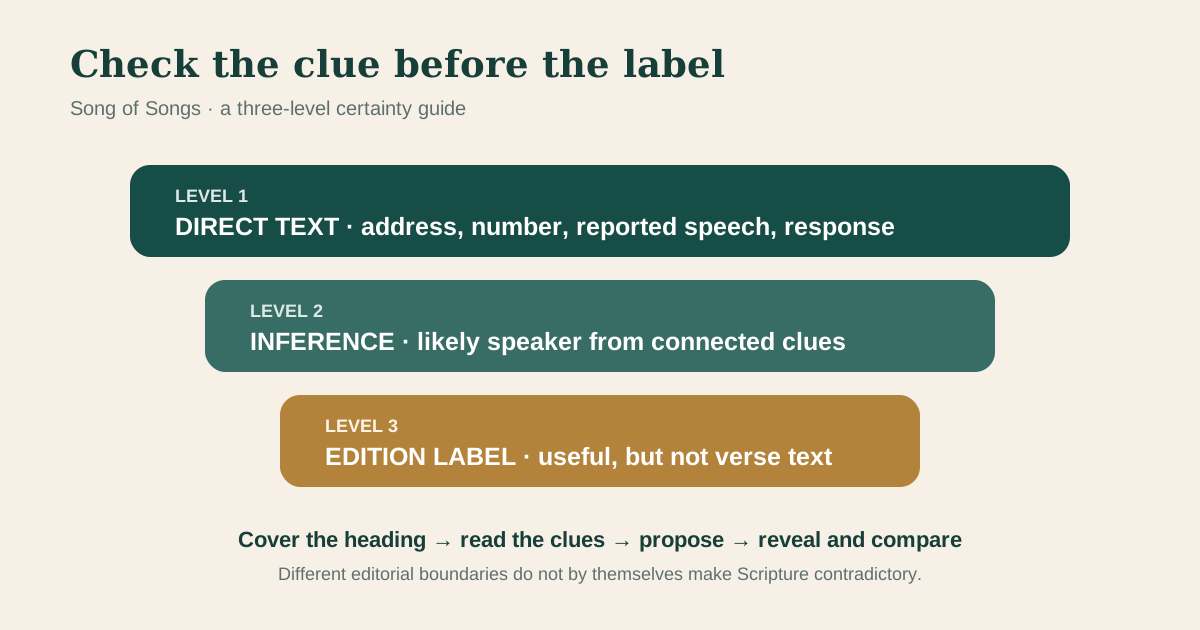
Three levels of certainty
| Level | What belongs here | Example of the method |
|---|---|---|
| Text directly identifies an addressee or quoted voice | A line names the daughters of Jerusalem, refers to a beloved person, or includes a voice within the narrated scene | Record the address or reported speech without yet assigning every surrounding line |
| Textual clues support an inference | Number shifts, terms of address, a question followed by a fitting answer, or a response from a group | State that a reading is likely and name the clue |
| Edition supplies a speaker label | A heading appears above the verse but is outside the numbered verse text | Record the edition’s choice and keep alternatives open where clues are limited |
An English-only worksheet cannot independently prove every underlying-language feature. It is honest to say when the visible English evidence is insufficient.
Sources: World English Bible — Song of Solomon 1 · World English Bible — Song of Solomon 5 · World English Bible — Song of Solomon 6
Reading guide · study guidance
Card 1: Song 1:2–4
The opening voice speaks about desired kisses and then addresses a loved person directly. The line moves between third-person and second-person references. Near the end of verse 4, a plural response speaks of rejoicing and praising the loved person’s love. The WEB places a Friends label before that plural response and then returns to Beloved.
Direct clues: a first-person desire, direct second-person address and a plural response.
Editorial choice: precisely where the group voice begins and where the individual voice resumes. The WEB headings make that choice visible, but the headings are not verse text.
Open point: a reader should not reconstruct a complete cast list or stage movement from these few lines alone.
Sources: World English Bible — Song of Solomon 1 · World English Bible — Song of Solomon 5 · World English Bible — Song of Solomon 6
Reading guide · study guidance
Card 2: Song 5:2–8
The passage presents a first-person speaker who is asleep while inwardly alert, recognizes the loved person’s voice at the door, delays, rises, finds him gone, searches and encounters the city watchmen. The speaker then addresses the daughters of Jerusalem with a request concerning the missing beloved.
The WEB labels the whole unit Beloved. The label fits the continuing first-person perspective and repeated references to the loved person. Yet the voice at the door belongs to another person within the speaker’s report. One label above the paragraph therefore does not mean one audible voice performs every line.
Direct clues: narrated first-person actions, an embedded quoted request and a closing address to the daughters of Jerusalem.
Limit: this is literary observation. It is not a diagnosis of a relationship, a safety plan or a command to copy the scene.
Sources: World English Bible — Song of Solomon 1 · World English Bible — Song of Solomon 5 · World English Bible — Song of Solomon 6
Reading guide · study guidance
Card 3: Song 5:9–6:3
At 5:9, a plural question asks why the beloved is exceptional. The next description answers in the first person and ends by addressing the daughters of Jerusalem. At 6:1, another plural question asks where the beloved has gone and offers help searching. Verses 2–3 answer in the first person.
The WEB alternates Friends and Beloved at these transitions. The question-and-answer flow and number changes support that division more strongly than a label standing alone. Even here, the evidence identifies discourse roles more securely than named historical individuals.
Sources: World English Bible — Song of Solomon 1 · World English Bible — Song of Solomon 5 · World English Bible — Song of Solomon 6
Reading guide · study guidance
How to audit a label
Cover the heading.
Mark first-person words, second-person address and plural responses.
Put a box around any speech quoted inside another speaker’s narration.
Note who is addressed by name or group description.
Propose a speaker only as specifically as the clues allow: individual voice, loved person, group response, or uncertain.
Reveal the edition label and compare. Agreement supports the editor’s choice; disagreement invites another look, not a claim that Scripture contradicts itself.
Sources: World English Bible — Song of Solomon 1 · World English Bible — Song of Solomon 5 · World English Bible — Song of Solomon 6
Reading guide · study guidance
Six speaker-label exercises
The printable version places the answer key after a fold line so the labels can remain hidden during the first pass.
In 1:2–4, what signals a move from an individual voice to a group voice?
Is the Friends heading in 1:4 part of numbered verse text on the WEB page?
In 5:2, does one paragraph label remove the second voice quoted at the door?
What clue links the voice of 5:8 with the answering question in 5:9?
What clues support a group question in 6:1 and an individual reply in 6:2–3?
If two editions divide a transition differently, what is the careful next step?
The worksheet and explained answers keep direct evidence, inference and editorial choice in separate columns. The exercise measures the support for a note, not the reader’s faith or relationship health.
Sources: World English Bible — Song of Solomon 1 · World English Bible — Song of Solomon 5 · World English Bible — Song of Solomon 6
Reading guide · study guidance
What this method cannot settle
Speaker tracking helps with literary flow, but it does not by itself decide the book’s authorship, date, full dramatic cast or the proper balance between literal, theological and allegorical interpretation. Christian and Jewish readers have offered different larger readings. This page does not present one as the only faithful approach.
It also does not treat the poem as personalized marriage counseling. People facing coercion, violence or abuse need appropriate real-world support; a poetic speaker chart cannot assess their safety.
After the label-free rereading, choose another reading in Plans or return to where to start reading the Bible.
Sources: World English Bible — Song of Solomon 1 · World English Bible — Song of Solomon 5 · World English Bible — Song of Solomon 6
Reading guide · study guidance
Sources and scope
World English Bible: Song 1, Song 5 and Song 6 — primary pages used to verify verse order, visible headings, address and response. The pages identify the updated WEB Protestant edition as public domain.
The three levels, cards and questions are Bibleward editorial aids. The WEB headings are described as edition labels and are not quoted as Scripture.
AI-assisted original reading resource. It is not Scripture, a universal interpretation of the poem, relationship counseling, or individual pastoral endorsement.
Sources: World English Bible — Song of Solomon 1 · World English Bible — Song of Solomon 5 · World English Bible — Song of Solomon 6
Original printable reading resource
Keep the worksheet beside your reading
Open the worksheet from the article link to read or print it in your browser. Download the same self-contained HTML file below to keep an offline copy, including the exercises and answer guidance.
- Download the complete printable worksheet (HTML)
Original questions, reference tables and answer guidance. Print from your browser or save as PDF; no account or online submission is needed.
Sources: World English Bible — Song of Solomon 1 · World English Bible — Song of Solomon 5 · World English Bible — Song of Solomon 6
Reading aid boundaries
How to use this reading aid
AI-assisted study guidance and automated review; no individual pastoral endorsement.
Beloved, Lover and Friends are identified as WEB editorial speaker headings, not quoted as Scripture.
Speaker inferences are labeled by certainty; the guide does not impose one complete interpretation of the poem.
Sources: World English Bible — Song of Solomon 1 · World English Bible — Song of Solomon 5 · World English Bible — Song of Solomon 6
Sources and further reading
- World English Bible — Song of Solomon 1
Full linked chapter page; verse text, sequence, editorial headings/footnotes and public-domain notice checked in this session.
- World English Bible — Song of Solomon 5
Full linked chapter page; verse text, sequence, editorial headings/footnotes and public-domain notice checked in this session.
- World English Bible — Song of Solomon 6
Full linked chapter page; verse text, sequence, editorial headings/footnotes and public-domain notice checked in this session.
Study guidance · not Scripture. AI-assisted writing and automated content review; no individual pastoral endorsement is claimed.