Reading guide · study guidance
Before you begin
Study guidance · not Scripture. AI-assisted writing and automated content review; no individual pastoral endorsement is claimed.
Sources: M’Cheyne Bible Reading Calendar, David F. Haslam edition
Reading guide · study guidance
Quick answer: follow one row across four reading slots
The M’Cheyne calendar has four daily reading slots, arranged as two Family readings and two Secret readings. In its historical vocabulary, Secret means private reading. These are four assignments in the original schedule, not four alternatives from which to choose one. This guide helps you find a row, preserve its references, and record what you actually read.
Keep the source calendar beside the original seven-day worksheet. You do not need to sign up, synchronize an account, or choose a new reading plan to use this paper exercise.
Sources: M’Cheyne Bible Reading Calendar, David F. Haslam edition
Reading guide · study guidance
Identify the edition before following its dates
This guide uses David F. Haslam’s edition, whose cover says January 2000. Its reproduced introduction ends December 1842. Those are different dates with different purposes; neither makes this a newly published 2026 plan. The PDF has sixteen pages: the cover, introduction, monthly calendar pages, and directions. January is PDF page 4; the directions are page 16. [Source: Haslam edition, pages 1–4 and 16.]
Record the edition and page on your worksheet before transcribing anything. An app or two-year adaptation may place the date elsewhere or redistribute the assignments. Check that provider’s instructions instead of assuming its screen is identical to this PDF. If you deliberately change the pace, label your own schedule as an adaptation and retain the original row beside it.
Sources: M’Cheyne Bible Reading Calendar, David F. Haslam edition
Reading guide · study guidance
Locate January 1 without losing a column
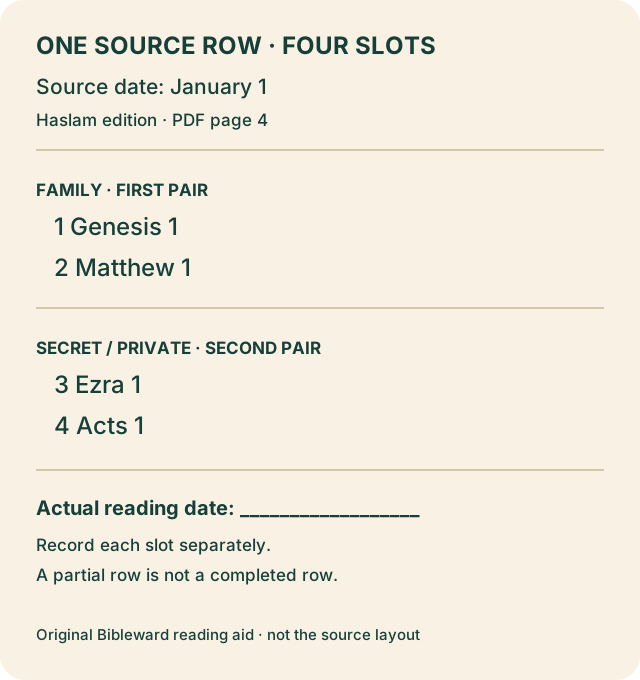
On page 4, find 1 in the central Date column. Read across that row. The four references are Genesis 1, Matthew 1, Ezra 1, and Acts 1. The first pair is under Family; the second pair is under Secret. “Book” and “Chapter” together identify one assignment: do not count those separate printed cells as separate readings.
Original Bibleward diagram. It reorganizes the January 1 references for legibility; it does not reproduce the PDF’s design or replace its schedule.
Now try January 2–7. Place a finger or blank sheet beneath one row while moving across it. Copy each reference before marking any reading complete. Then compare the result with the worksheet’s answer key. This is a location exercise: you can finish it without claiming to have read all the assigned chapters.
Sources: M’Cheyne Bible Reading Calendar, David F. Haslam edition
Reading guide · study guidance
Give every entry a source date and an actual date
Suppose you start with the source’s January 1 row on September 24. Write Source row: January 1 and Actual reading date: September 24, 2026. The source date identifies an assignment; the actual date records your session. Keeping both makes it possible to return to the same printed row tomorrow without rewriting the historical calendar.
Use a small legend of your own. The worksheet offers complete, partial, and paused. For a partial reading, add a precise return point. For a paused reading, leave an honest note about what remains unread. Do not use a single tick across the whole row if only one assignment is finished.
Here is a fictional example, not a reader’s testimony: someone finishes Genesis 1, reads Matthew 1:1–17, and leaves Ezra 1 and Acts 1 unopened. That row contains one completed assignment, one partial assignment, and two paused assignments. Nothing about the symbols measures the person’s faith, worth, or relationship with God.
Sources: M’Cheyne Bible Reading Calendar, David F. Haslam edition
Reading guide · study guidance
Read the four tracks as a yearly arrangement
The introduction describes coverage of the Old Testament once and the New Testament and Psalms twice over a year. In that description Psalms is the repeated exception within the Old Testament. The paired tracks put readers in several parts of Scripture; they are not four independent complete-Bible plans. [Source: PDF page 3, “The Advantages.”]
This guide explains the arrangement; it has not independently audited every assignment in the annual table. Use the original references, including any ranges, instead of extrapolating from January’s first week. Four slots do not promise four identical workloads or a fixed number of minutes. When an entry is unclear, mark it for checking rather than quietly substituting a chapter.
Sources: M’Cheyne Bible Reading Calendar, David F. Haslam edition
Reading guide · study guidance
Decide what you will return to next
At the end of a session, choose one practical return point: the next unread slot, the unfinished part of a chapter, or a question worth rereading. The worksheet is a personal record that you print or copy; it does not save to or synchronize with Bibleward’s reading progress.
If you want a smaller guided selection, browse Bibleward’s plans or try Mark 1:1–15. Bibleward offers eighty selected readings. Scripture text is free throughout; guided content and audio are free for Days 01–15, with paid access for later guided days and audio. This is a separate option, not an implementation of M’Cheyne’s calendar.
For help choosing a scope before beginning, use the reading-plan comparison worksheet. For this session, the next step is simpler: find one correct row, open one assigned passage, and leave a truthful return note.
Sources: M’Cheyne Bible Reading Calendar, David F. Haslam edition · Bibleward reading collections — eighty-reading release catalog
Reading guide · study guidance
Sources and scope
M’Cheyne calendar, David F. Haslam edition: cover and reproduced introduction, pages 1–3; January table, page 4; historical directions, page 16. Checked September 24, 2026. The diagram and worksheet are original reading aids; the modern PDF layout is not reproduced.
Bibleward plans: current selected-reading scope and access terms, checked September 24, 2026.
A blessing for your reading: May God bless you with patience to attend to what you read and freedom to return without shame.
Sources: M’Cheyne Bible Reading Calendar, David F. Haslam edition
Original printable reading resource
Keep the worksheet beside your reading
Open the worksheet from the article link to read or print it in your browser. Download the same self-contained HTML file below to keep an offline copy, including the exercises and answer guidance.
- Download the complete printable worksheet (HTML)
Original questions, reference tables and answer guidance. Print from your browser or save as PDF; no account or online submission is needed.
Sources: M’Cheyne Bible Reading Calendar, David F. Haslam edition
Sources and further reading
- M’Cheyne Bible Reading Calendar, David F. Haslam edition
PDF pages1–4,16; January1–7 visually read on rendered page4
- Bibleward plans
Live HTTP200 content retrieved; sixty selected readings; text free; guidance/audio access split after Day15
- Berean Standard Bible v5.9 corpus
Local pinned corpus SHA verified. Chapter/verse existence only; no Scripture quoted.
- Berean Bible terms
Public-domain dedication effective April30,2023. Live text read.
- Bibleward reading collections — eighty-reading release catalog
Release catalog checked against the three local roadmap registries: Meet Jesus, Days 01–30; Live the Way, Days 31–60; Walk in Wisdom, Days 61–80. Counts are 30 + 30 + 20 selected readings. This is local release evidence, not a claim that a fresh live HTTP retrieval already displayed the expansion.
Study guidance · not Scripture. AI-assisted writing and automated content review; no individual pastoral endorsement is claimed.