Reading guide · study guidance
Before you begin
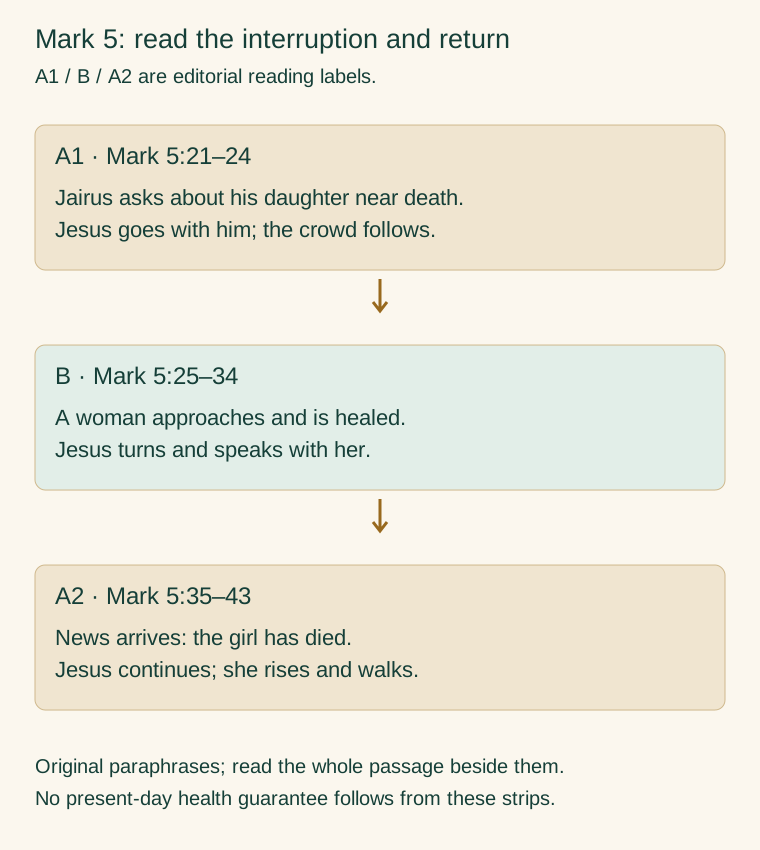
Mark begins Jairus's urgent request, turns to a woman who approaches Jesus, and then returns to Jairus after news of his daughter's death. Reading Mark 5:21–43 as A1 / B / A2 keeps both stories together. The interruption lets a reader compare their needs, Jesus' responses, and the movement between fear and trust; that comparison is a reading interpretation, not a hidden code.
Sources: Berean Standard Bible v5.9: verified canonical corpus · Berean Bible Free Licensing
Reading guide · study guidance
Read the complete unit before cutting it into strips
First read Mark 5:21–43 without stopping. Then divide a sheet of paper into three strips: 21–24, 25–34 and 35–43. A1 means “first part of the outer story”; B means “the story placed inside”; A2 means “return to the outer story.” The familiar label sandwich story, or intercalation, describes this arrangement.
These are our reading labels, not words added to the Gospel. They help you preserve the order in which the reader meets the events. They do not require imagining that Jairus disappears while Jesus speaks to the woman.
Sources: Berean Standard Bible v5.9: verified canonical corpus · Berean Bible Free Licensing
Reading guide · study guidance
Fill all three strips
| Strip | Need and movement | Speech to notice | What remains or changes |
|---|---|---|---|
| A1 — Mark 5:21–24 | Jairus, a synagogue leader, approaches Jesus about his daughter, who is near death. Jesus goes with him amid the crowd. | Jairus asks Jesus to come and lay hands on her (5:22–23). | The request is underway; the girl's recovery has not been narrated. |
| B — Mark 5:25–34 | A woman who has suffered bleeding for twelve years touches Jesus' clothing and is healed. Jesus turns and the encounter becomes a conversation. | Her expectation is given in 5:28; Jesus asks about the touch in 5:30; she tells what happened in 5:33; he addresses her in 5:34. | Her need receives attention while the outer journey has not yet reached Jairus's house. |
| A2 — Mark 5:35–43 | News arrives that Jairus's daughter has died. Jesus continues to the house and the girl rises and walks. | Messengers speak in 5:35; Jesus addresses Jairus in 5:36 and the girl in 5:41. | The situation is more severe than in A1. The ending includes instructions about privacy and giving her food (5:43). |
This is original paraphrase checked against the BSB. Keep your complete Bible beside the strips; the table is a map, not a replacement for the passage.
Sources: Berean Standard Bible v5.9: verified canonical corpus · Berean Bible Free Licensing
Reading guide · study guidance
Notice the hinge at verse 35
Place your finger at the end of 5:34, then read 5:35. The message from Jairus's household arrives while Jesus is still speaking. That hinge connects the woman's completed encounter with the renewed crisis in Jairus's story.
Observation: the opening request concerns a daughter near death; the return begins with a report of her death. Reading interpretation: the interruption increases the reader's sense of urgency and puts Jesus' response to the woman beside his response to Jairus. Mark does not supply a stopwatch or tell us that the time spent with the woman caused the death. Do not add either claim to your strip.
The interruption is also different from moving the main action backward to tell an earlier episode. Mark 5:25–26 does provide background about the woman's years of suffering, but her approach to Jesus belongs inside the ongoing journey. Keep the background sentences and the main scene's order distinct.
Sources: Berean Standard Bible v5.9: verified canonical corpus · Berean Bible Free Licensing
Reading guide · study guidance
Compare clues without turning them into a code
| Textual observation | References | A possible reading interpretation | What the observation does not establish |
|---|---|---|---|
| Jairus speaks of his daughter; Jesus addresses the woman with a daughter term; the messengers again refer to Jairus's daughter. | Mark 5:23, 34–35 | The language invites comparison between two recipients of Jesus' attention. | The woman is not identified as Jairus's biological daughter. |
| The woman has suffered for twelve years; the girl is twelve years old. | Mark 5:25, 42 | The two durations create a striking connection across the stories. | The passage does not give a secret numerical formula or a timetable for modern healing. |
| The woman comes trembling; Jesus speaks about her faith and then addresses Jairus about fear and belief. | Mark 5:33–36 | Fear and trust connect the two scenes without making their experiences identical. | We cannot measure either person's inner spiritual performance from these verses. |
| Jairus falls at Jesus' feet; the woman also falls before him. | Mark 5:22, 33 | Their different approaches reach a similar posture of encounter. | Their social circumstances, requests and dialogue are not interchangeable. |
The middle column is checkable directly in the passage. The interpretation column describes a supported reading, not the only interpretation every Christian must adopt.
Sources: Berean Standard Bible v5.9: verified canonical corpus · Berean Bible Free Licensing
Reading guide · study guidance
Three questions that reconnect the stories
What changes if you read 5:21–24 and immediately jump to 5:35? You still follow Jairus's request and the death report, but lose the woman's encounter, the juxtaposed responses about faith, and the transition while Jesus is speaking. Support a fuller answer from 5:25–36; another reader may emphasize a different connection.
Which repeated clue is strongest for you, and why? A defensible answer could pair the two mentions of twelve in 5:25 and 5:42, or the daughter language in 5:23, 34 and 35. Cite both sides before proposing what the pairing contributes. A numerical claim with no textual support is not an answer key.
Why keep the final verse on the A2 strip? Verse 43 records practical care and instructions about who should know, after the dramatic action in 5:41–42. Including it prevents a summary from stopping only at the spectacular moment. Other text-grounded observations about the ending are welcome.
These questions test whether your explanation has evidence, not whether your faith is strong enough.
Sources: Berean Standard Bible v5.9: verified canonical corpus · Berean Bible Free Licensing
Reading guide · study guidance
Keep application proportionate to the passage
A Christian reader may reflect on Jesus' attention to people in distress or on trust amid frightening news. Mark's narrative presents the woman's healing and the girl's restoration to life. This worksheet does not turn those narrated events into a guarantee that a particular person will recover today, a judgment on someone whose illness continues, or a reason to replace qualified medical care.
Try a modest reading application: before summarizing a biblical scene, ask whose story the interruption brings into view. Then return to the complete unit and check what you would otherwise have missed.
Sources: Berean Standard Bible v5.9: verified canonical corpus · Berean Bible Free Licensing
Reading guide · study guidance
Print the strips and read again
Open three filled story strips, the clue table, answer guidance and a blank set. Arrange A1, B and A2 in that order. Read their references aloud, then read the full passage again. Compare your second summary with the first; keep any correction the text requires.
Sources: Berean Standard Bible v5.9: verified canonical corpus · Berean Bible Free Licensing
Reading guide · study guidance
Sources and next steps
Berean Standard Bible: Mark 5 — biblical text checked against the checksum-verified BSB v5.9 corpus. Only the biblical passage is used here; web-page commentary is not our source of authority.
Berean Bible licensing — public-domain status; checked October 5, 2026. The guide and worksheet contain original paraphrases, not a reproduced passage.
Meet Jesus in Mark — continue reading connected passages in Mark.
Find narrative scene boundaries — practise the broader method after this particular interrupted-story example.
Bibleward reading plans — select a sustainable next passage.
AI-assisted study guidance; observations, literary interpretation and optional application are kept separate. No pastoral endorsement is claimed. May God bless your reading with patience, care and attention to each person in the story.
Sources: Berean Standard Bible v5.9: verified canonical corpus · Berean Bible Free Licensing
Original printable reading resource
Keep the worksheet beside your reading
Open the worksheet from the article link to read or print it in your browser. Download the same self-contained HTML file below to keep an offline copy, including the exercises and answer guidance.
- Download the complete printable worksheet (HTML)
Original questions, reference tables and answer guidance. Print from your browser or save as PDF; no account or online submission is needed.
Sources: Berean Standard Bible v5.9: verified canonical corpus · Berean Bible Free Licensing
Sources and further reading
- Berean Standard Bible v5.9: verified canonical corpus
Exact JSONL rows checked by canonical book, chapter and verse; corpus SHA-256 c13b98acc5b8d4dfdd61900e4beee4e3afb231ba8b664154b244354af38356d4
- Berean Bible Free Licensing
Official public-domain declaration read live.
Study guidance · not Scripture. AI-assisted writing and automated content review; no individual pastoral endorsement is claimed.