Reading guide · study guidance
Before you begin
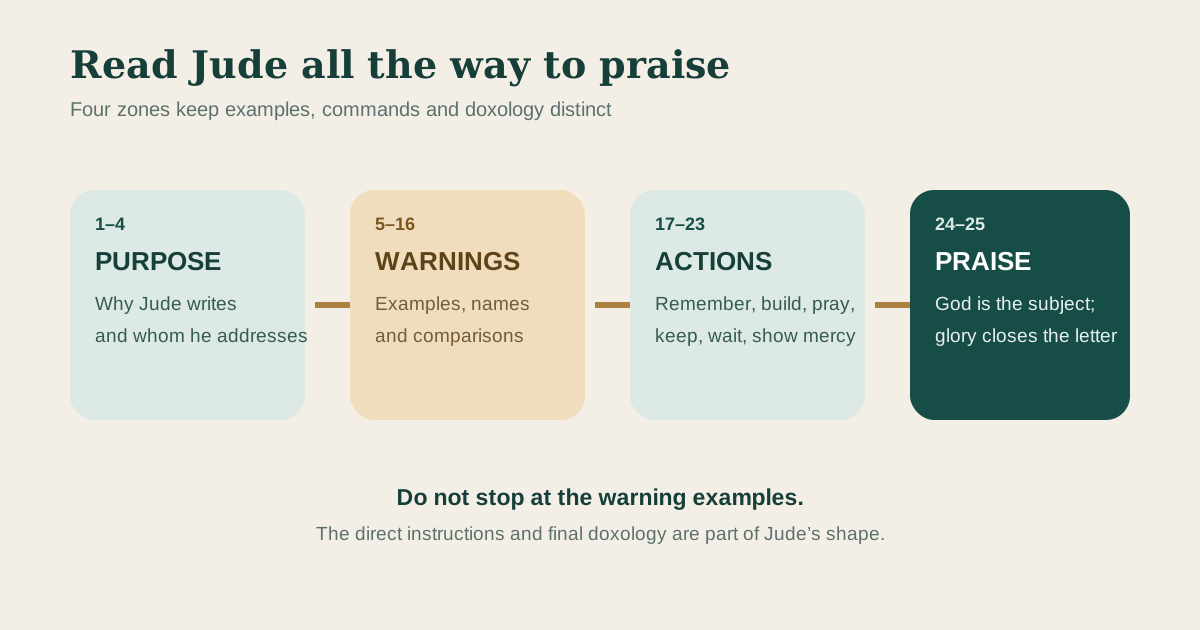
Read the whole letter in the World English Bible. Then use this four-zone map and the printable Jude worksheet. The guide paraphrases rather than reproduces the passage.
Sources: World English Bible — Jude
Reading guide · study guidance
A four-zone reading map
| Zone | Verses | Main function | A question to ask |
|---|---|---|---|
| Opening and purpose | 1–4 | Greeting, blessing and reason for writing | Why does Jude say he changed the focus of his letter? |
| Warnings and examples | 5–16 | Earlier judgments, named figures and a series of comparisons describe the intruders | Which details does Jude state, and which stories do I only recognize from elsewhere? |
| Remember and act | 17–23 | The beloved readers are told to remember, build, pray, keep, wait and respond to others with care and fear | Which verbs address the readers rather than describe the warned-about group? |
| Closing praise | 24–25 | Jude turns from reader actions to what God is able to do and to praise | Who is the subject of the closing ability and glory? |
The four zones are an editorial map. Modern headings can help navigation, but the verse sequence is the evidence for the map.
Sources: World English Bible — Jude
Reading guide · study guidance
Evidence-to-check table for verses 5–16
| Reference | Person, event or image Jude mentions | What this letter itself states | What needs another source before expansion |
|---|---|---|---|
| 5 | A people delivered from Egypt, followed by judgment on unbelief | Rescue and later judgment are used as a reminder | A complete Exodus chronology |
| 6 | Angels who left their proper place | They are kept for judgment | A complete account of their identity and actions |
| 7 | Sodom, Gomorrah and nearby cities | Their conduct and punishment function as an example | Every detail of those cities’ history |
| 9 | Michael and the devil disputing about Moses’ body | Michael does not issue an abusive judgment but leaves rebuke to the Lord | Where the dispute came from or all that occurred |
| 11 | Cain, Balaam and Korah | Their way, error or rebellion supplies a warning comparison | Full biographies or the claim that all three cases are identical |
| 12–13 | Reefs, self-feeding shepherds, waterless clouds, fruitless trees, wild waves and wandering stars | The images describe danger, emptiness, shame and judgment | A one-to-one code assigning every image to a modern person |
| 14–15 | Enoch and a judgment announcement | Jude attributes the saying to Enoch and uses it against ungodliness | A complete history or canon judgment about every Enoch tradition |
This table deliberately marks details that need another source. Recognition is not the same as evidence. Jude often alludes rather than retells.
Sources: World English Bible — Jude
Reading guide · study guidance
Recover the reader actions in verses 17–23
The change begins when verse 17 turns directly to the beloved readers. The direct actions can be arranged like this:
Remember what the apostles had already said about mockers (17–19).
Build yourselves up on the readers’ holy faith (20).
Pray in the Holy Spirit (20).
Keep yourselves in God’s love (21).
Wait for the mercy of Jesus Christ leading to eternal life (21).
Show mercy or act to save with careful fear toward people in differing situations (22–23).
This exercise follows the WEB page’s rendering of verses 22–23. It stays with the broad contrast between responses and does not build a rigid three-class pastoral system from one English layout.
The commands also do not authorize readers to label an unpopular contemporary person as Cain, Balaam or Korah. Jude is addressing a particular danger in the letter. Modern identification would require evidence and pastoral care beyond resemblance to one phrase.
Sources: World English Bible — Jude
Reading guide · study guidance
Do not stop before verses 24–25
The letter’s final movement is praise. The readers have been told to keep themselves in God’s love, yet the closing sentence praises God as able to guard and present people before divine glory with joy. The two statements have different grammatical subjects and functions: one is instruction to the readers, and the other declares God’s ability and gives glory to God.
The doxology does not erase the warnings or the instructions. It changes the final focus from the intruders to God. A complete one-sentence summary of Jude should therefore contain all three: danger, faithful response and closing praise.
Sources: World English Bible — Jude
Reading guide · study guidance
Six classification questions
Classify each as warning example, reader instruction, or closing praise.
Remember the apostles’ earlier words.
Waterless clouds carried along by winds.
Keep yourselves in God’s love while waiting for mercy.
Glory, majesty, dominion and power belong to God.
Cain, Balaam and Korah are named in one warning line.
God is able to keep and present.
The worksheet answer key explains each classification and includes eight short reading cards. Marking a note as needing rereading is useful, not a spiritual score.
Sources: World English Bible — Jude
Reading guide · study guidance
One-session reading plan
Read verses 1–4 and write Jude’s stated purpose. Read 5–16 and record only what Jude says beside each named example. Read 17–23 twice, circling direct-address verbs. End with 24–25 and name the subject of each action. If a background question remains, place it in the research box instead of filling it from memory.
Continue with another reading plan, or see a beginner route through the Bible.
Sources: World English Bible — Jude
Reading guide · study guidance
Sources and scope
World English Bible, Jude — primary text used for sequence, examples, direct address and closing praise. The source identifies the updated WEB Protestant edition as public domain.
The four-zone map, evidence table and classifications are Bibleward editorial organization. This page does not identify present-day people with Jude’s warning figures or settle questions about Jude’s external allusions.
AI-assisted original reading resource. It is not Scripture, a judgment on a named person, or individual pastoral endorsement.
Sources: World English Bible — Jude
Original printable reading resource
Keep the worksheet beside your reading
Open the worksheet from the article link to read or print it in your browser. Download the same self-contained HTML file below to keep an offline copy, including the exercises and answer guidance.
- Download the complete printable worksheet (HTML)
Original questions, reference tables and answer guidance. Print from your browser or save as PDF; no account or online submission is needed.
Sources: World English Bible — Jude
Reading aid boundaries
How to use this reading aid
AI-assisted study guidance and automated review; no individual pastoral endorsement.
The four-zone map is editorial organization; modern headings are not treated as verse text.
Warning figures are not assigned to present-day people or groups.
Sources: World English Bible — Jude
Sources and further reading
- World English Bible — Jude
Full linked chapter page; verse text, sequence, editorial headings/footnotes and public-domain notice checked in this session.
Study guidance · not Scripture. AI-assisted writing and automated content review; no individual pastoral endorsement is claimed.