Reading guide · study guidance
Begin with one pair, not every symbol
Read Genesis 37:5–11 first. A sheaf is a bundle of cut grain. Record the bundles and the bowing before writing what you think they mean. Then notice that the brothers and father respond in their own words. The story lets us hear those responses without requiring us to turn them into a complete symbol dictionary.
The tables use original summaries, checked against the World English Bible chapters linked below. These are reading cards, not Scripture quotations. If your Bible uses a different name for an object or official, keep its wording in your notes rather than blending translations.
Sources: Genesis 37, Updated World English Bible, Protestant Edition · Genesis 40, Updated World English Bible, Protestant Edition · Genesis 41, Updated World English Bible, Protestant Edition · Genesis 42, Updated World English Bible, Protestant Edition · Genesis 45, Updated World English Bible, Protestant Edition · World English Bible copyright and public-domain notice · Berean Standard Bible v5.9: selected canonical records · Berean Bible terms
Reading guide · study guidance
Pair 1: Joseph and his family
| Dream card | Dreamer and pictured scene | What this chapter gives us |
|---|---|---|
| 1 · Genesis 37:5–8 | Joseph: his bundle of cut grain stands upright; his brothers’ bundles surround it and bow. | His brothers ask whether he will rule them and hate him more. Their response is recorded speech, not a narrator’s complete interpretation. |
| 2 · Genesis 37:9–11 | Joseph: the sun, moon and eleven stars bow to him. | His father rebukes him with a question about the family bowing. His brothers are jealous; his father keeps the matter in mind. |
Both dreams disturb the family, but chapter 37 does not give a separate narrator’s explanation of every image. The father’s question belongs in a “character response” field. It should not silently become our own final answer about each family member. Later scenes will return to the dreams; keep space for them.
Sources: Genesis 37, Updated World English Bible, Protestant Edition · Genesis 40, Updated World English Bible, Protestant Edition · Genesis 41, Updated World English Bible, Protestant Edition · Genesis 42, Updated World English Bible, Protestant Edition · Genesis 45, Updated World English Bible, Protestant Edition · World English Bible copyright and public-domain notice · Berean Standard Bible v5.9: selected canonical records · Berean Bible terms
Reading guide · study guidance
Pair 2: Two prisoners, different outcomes
| Dream card | Dreamer and pictured scene | Joseph’s interpretation and the reported outcome |
|---|---|---|
| 3 · Genesis 40:9–15 | The chief cupbearer: three vine branches grow grapes; he presses them into Pharaoh’s cup and serves it. | Joseph interprets three branches as three days and predicts restoration to office. Pharaoh restores the cupbearer on the third day (40:20–21). |
| 4 · Genesis 40:16–22 | The chief baker: three bread baskets sit on his head; birds eat the food in the top basket. | Joseph interprets three baskets as three days and predicts the baker’s death. The narrative reports his execution on the third day (40:20, 22). |
A cupbearer serves the ruler’s drink. The two officials dream on the same night in prison (40:5). Joseph attributes interpretation to God before hearing their reports (40:8). Three branches and three baskets are both explained as three days, yet the outcomes differ. The text does not teach that matching numbers always mean matching futures.
There is another unfinished thread: Joseph asks the cupbearer to remember him, but the chapter ends by saying the cupbearer forgets (40:14, 23). Do not skip that ending just because the interpretations have been followed by their stated outcomes.
Sources: Genesis 37, Updated World English Bible, Protestant Edition · Genesis 40, Updated World English Bible, Protestant Edition · Genesis 41, Updated World English Bible, Protestant Edition · Genesis 42, Updated World English Bible, Protestant Edition · Genesis 45, Updated World English Bible, Protestant Edition · World English Bible copyright and public-domain notice · Berean Standard Bible v5.9: selected canonical records · Berean Bible terms
Reading guide · study guidance
Pair 3: Pharaoh, two pictures of one coming crisis
| Dream card | Dreamer and pictured scene | Joseph’s interpretation in the same chapter |
|---|---|---|
| 5 · Genesis 41:1–4, 17–21 | Pharaoh: seven thin, ugly cattle eat seven healthy cattle; in his retelling they still look thin. | Joseph identifies seven years of plenty followed by seven years of famine (41:25–31). |
| 6 · Genesis 41:5–7, 22–24 | Pharaoh: seven thin, wind-damaged grain heads swallow seven full heads. | Joseph says the two dreams concern the same coming event. He explains the repetition as confirmation of what God will soon do (41:25–32). |
The repetition here receives an explicit explanation from Joseph. That differs from chapter 37’s family responses and from chapter 40’s two separate personal outcomes. A good comparison keeps those differences visible.
Sources: Genesis 37, Updated World English Bible, Protestant Edition · Genesis 40, Updated World English Bible, Protestant Edition · Genesis 41, Updated World English Bible, Protestant Edition · Genesis 42, Updated World English Bible, Protestant Edition · Genesis 45, Updated World English Bible, Protestant Edition · World English Bible copyright and public-domain notice · Berean Standard Bible v5.9: selected canonical records · Berean Bible terms
Reading guide · study guidance
Follow interpretation into a plan and then action
| Track | What the passage says | Keep distinct |
|---|---|---|
| Interpretation · 41:25–32 | Joseph explains seven abundant years followed by seven famine years. | This identifies the coming problem; it is not yet the grain-storage plan. |
| Plan and authority · 41:33–44 | Joseph proposes a wise administrator, overseers, a fifth of the produce during plenty, and city stores. Pharaoh approves and appoints Joseph over Egypt, retaining his own supreme position. | Joseph suggests; Pharaoh authorizes. The dream images do not themselves list warehouses or job appointments. |
| Implementation · 41:46–57 | Joseph travels through Egypt, gathers and stores food during the abundant years, then opens stores and sells grain during the famine. Pharaoh directs the people to Joseph. | These are later narrated actions, not merely a prediction or an intention. |
This is where the Joseph famine-planning story becomes more concrete than a motivational slogan. The text names the problem, the proposal, the authorization and the work. Joseph does not simply wake up with full storehouses. Nor does the chapter say that confidence alone makes famine harmless. It describes food being collected before the crisis and distributed through sales when the crisis arrives.
Our three tracks are an editorial way to read the sequence. They are not a modern agricultural, financial or dream-prediction method.
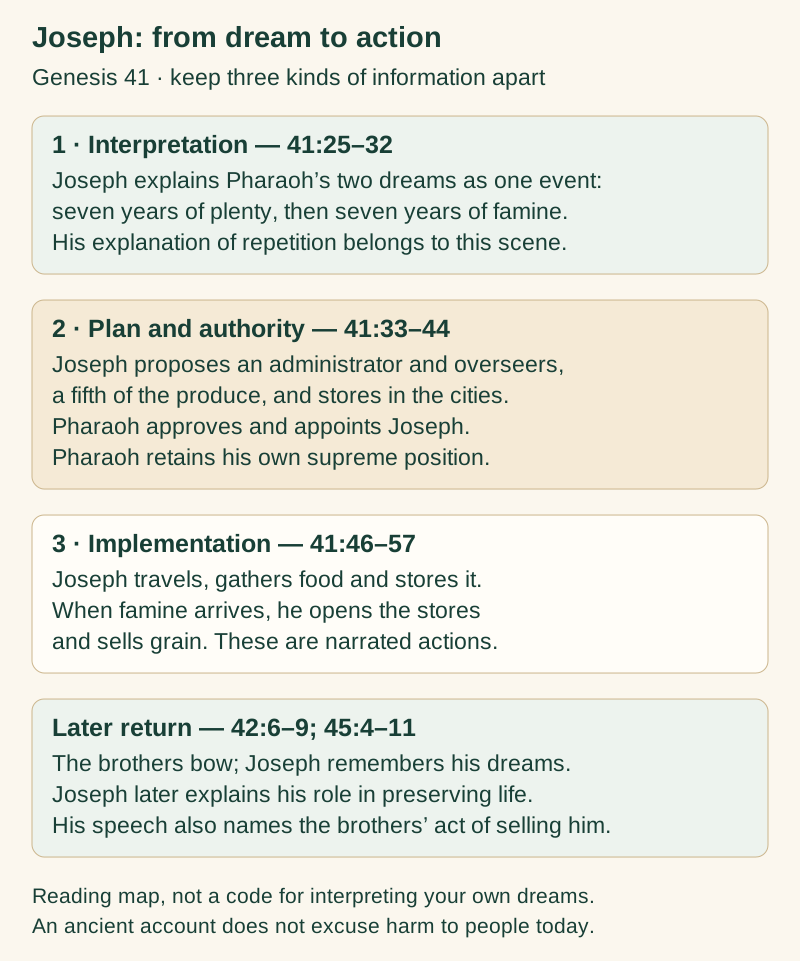
Sources: Genesis 37, Updated World English Bible, Protestant Edition · Genesis 40, Updated World English Bible, Protestant Edition · Genesis 41, Updated World English Bible, Protestant Edition · Genesis 42, Updated World English Bible, Protestant Edition · Genesis 45, Updated World English Bible, Protestant Edition · World English Bible copyright and public-domain notice · Berean Standard Bible v5.9: selected canonical records · Berean Bible terms
Reading guide · study guidance
Keep the dates that the story actually gives
| Marker | What follows in the text |
|---|---|
| Joseph is seventeen · 37:2 | His dreams and his family’s responses appear in chapter 37. |
| Both officers dream in one night · 40:5 | Joseph hears their reports and interprets them. |
| Third day · 40:20–23 | Different outcomes occur; the cupbearer forgets Joseph. |
| Two full years later · 41:1, 9–14 | Pharaoh dreams; the cupbearer remembers Joseph, who is brought to Pharaoh. |
| Joseph is thirty · 41:46 | He begins the narrated work across Egypt. |
| Seven years of plenty end · 41:53–57 | Famine begins; grain is sold from the stores. |
| Two famine years have passed · 45:6 | Joseph tells his brothers that five remain. |
The sequence contains waiting as well as action. Genesis 42:6–9 then places the brothers before Joseph to buy grain: they bow, and he remembers his dreams. That connection is explicit. It is still narrower than claiming this scene individually explains every sun, moon or star in chapter 37.
In Genesis 45:4–8, Joseph identifies himself and looks back on being sold into Egypt. He speaks of God sending him ahead to preserve life. Record this as Joseph’s explanation in the scene. It does not erase his statement that his brothers sold him, and it does not authorize us to tell a harmed person today that their suffering was necessary or good. The story’s backward look belongs with its concrete next step: bringing the household near and providing during the remaining famine years (45:9–11).
Sources: Genesis 37, Updated World English Bible, Protestant Edition · Genesis 40, Updated World English Bible, Protestant Edition · Genesis 41, Updated World English Bible, Protestant Edition · Genesis 42, Updated World English Bible, Protestant Edition · Genesis 45, Updated World English Bible, Protestant Edition · World English Bible copyright and public-domain notice · Berean Standard Bible v5.9: selected canonical records · Berean Bible terms
Reading guide · study guidance
Six evidence checks
Use four kinds of note: narrated event, character’s speech or interpretation, reader’s inference, and not supplied. Then mark your answer supported, needs rereading, or text not supplied. These labels assess a reading claim, not your faith.
“Joseph’s brothers ask whether he will rule them.” Is this narrator-reported speech, a final interpretation supplied by the narrator, or our inference?
“The cupbearer and baker receive the same outcome because both dreams contain three objects.” What does the outcome report support?
“Pharaoh’s two dreams concern one coming event.” Who gives that explanation, and where?
“A fifth of the produce appears as an image inside Pharaoh’s dream.” Is that in the dream or in the later proposal?
“Joseph’s brothers bow in Egypt, and Joseph remembers his dreams.” Is this connection explicit or merely something a modern reader invents?
“Any reader who dreams about grain can use these chapters to predict their own next seven years.” Which part of that rule is actually supplied?
Sources: Genesis 37, Updated World English Bible, Protestant Edition · Genesis 40, Updated World English Bible, Protestant Edition · Genesis 41, Updated World English Bible, Protestant Edition · Genesis 42, Updated World English Bible, Protestant Edition · Genesis 45, Updated World English Bible, Protestant Edition · World English Bible copyright and public-domain notice · Berean Standard Bible v5.9: selected canonical records · Berean Bible terms
Reading guide · study guidance
Check the source of each claim
Reported character speech — supported (37:8). The narrator tells us what the brothers ask. Treating their question as a complete, final explanation of every dream detail would be our added inference.
Needs rereading (40:20–22). The narrator reports different outcomes: the cupbearer is restored and the baker is executed. A repeated number does not establish the same outcome.
Joseph’s interpretation — supported (41:25–32). Joseph explains the two dreams as one. Preserve the speaker rather than presenting the statement as a rule we independently discovered.
Needs rereading (41:33–35). The fifth belongs to Joseph’s proposal, after his interpretation. The narrated dream images in 41:1–7 contain cattle and grain heads, not that collection instruction.
Narrated connection — supported (42:6–9). The brothers bow, and the text explicitly says Joseph remembers his dreams. This does not mean the scene supplies a separate fulfillment for every image in chapter 37.
Text not supplied. These chapters give particular dreams, interpretations and events within Joseph’s story. A prediction rule for the reader’s dreams is an added claim, not a conclusion established by these passages.
Sources: Genesis 37, Updated World English Bible, Protestant Edition · Genesis 40, Updated World English Bible, Protestant Edition · Genesis 41, Updated World English Bible, Protestant Edition · Genesis 42, Updated World English Bible, Protestant Edition · Genesis 45, Updated World English Bible, Protestant Edition · World English Bible copyright and public-domain notice · Berean Standard Bible v5.9: selected canonical records · Berean Bible terms
Reading guide · study guidance
Keep a place to resume
Open the printable six-card worksheet. It includes all three paired tables, the action tracks, timeline and explained answers. Stop after one pair if that is enough for today. Put your next passage on the blank card before closing the page.
A useful open question is: “What changes when the story returns to a dream much later?” Follow that question into chapters 42 and 45. This resource does not diagnose a reader’s dreams or claim a personal message from God.
Sources: Genesis 37, Updated World English Bible, Protestant Edition · Genesis 40, Updated World English Bible, Protestant Edition · Genesis 41, Updated World English Bible, Protestant Edition · Genesis 42, Updated World English Bible, Protestant Edition · Genesis 45, Updated World English Bible, Protestant Edition · World English Bible copyright and public-domain notice · Berean Standard Bible v5.9: selected canonical records · Berean Bible terms
Reading guide · study guidance
Sources and next reading
World English Bible: Genesis 37, 40 and 41 for the six dreams, speakers and outcomes.
Genesis 42 and 45 for the later remembrance and Joseph’s retrospective explanation.
World English Bible rights: the source text is public domain; the summaries and diagrams here are original study tools.
Bibleward reading plans and where to start reading the Bible for your next manageable passage.
Study guidance · not Scripture. AI-assisted writing and automated content review; no individual pastoral endorsement is claimed. May God bless you with patience to follow the whole story and wisdom to leave unsupported conclusions open.
Sources: Genesis 37, Updated World English Bible, Protestant Edition · Genesis 40, Updated World English Bible, Protestant Edition · Genesis 41, Updated World English Bible, Protestant Edition · Genesis 42, Updated World English Bible, Protestant Edition · Genesis 45, Updated World English Bible, Protestant Edition · World English Bible copyright and public-domain notice · Berean Standard Bible v5.9: selected canonical records · Berean Bible terms
Original printable reading resource
Keep the worksheet beside your reading
Open the worksheet from the article link to read or print it in your browser. Download the same self-contained HTML file below to keep an offline copy, including the exercises and answer guidance.
- Download the complete printable worksheet (HTML)
Original questions, reference tables and answer guidance. Print from your browser or save as PDF; no account or online submission is needed.
Sources: Genesis 37, Updated World English Bible, Protestant Edition · Genesis 40, Updated World English Bible, Protestant Edition · Genesis 41, Updated World English Bible, Protestant Edition · Genesis 42, Updated World English Bible, Protestant Edition · Genesis 45, Updated World English Bible, Protestant Edition · World English Bible copyright and public-domain notice · Berean Standard Bible v5.9: selected canonical records · Berean Bible terms
Sources and further reading
- Genesis 37, Updated World English Bible, Protestant Edition
Complete chapter 37; Scripture text, speaker order and verse numbering. Editorial footnotes or headings are not treated as original Scripture.
- Genesis 40, Updated World English Bible, Protestant Edition
Complete chapter 40; Scripture text, speaker order and verse numbering. Editorial footnotes or headings are not treated as original Scripture.
- Genesis 41, Updated World English Bible, Protestant Edition
Complete chapter 41; Scripture text, speaker order and verse numbering. Editorial footnotes or headings are not treated as original Scripture.
- Genesis 42, Updated World English Bible, Protestant Edition
Complete chapter 42; Scripture text, speaker order and verse numbering. Editorial footnotes or headings are not treated as original Scripture.
- Genesis 45, Updated World English Bible, Protestant Edition
Complete chapter 45; Scripture text, speaker order and verse numbering. Editorial footnotes or headings are not treated as original Scripture.
- World English Bible copyright and public-domain notice
Public-domain dedication and permission for all uses; trademark notice means original paraphrases are identified as study aids, not a revised WEB edition.
- Berean Standard Bible v5.9: selected canonical records
Supplemental check of selected exact canonical records listed in source-checks; WEB controls published numbering and terminology.
- Berean Bible terms
Public-domain dedication effective April 30, 2023.
Study guidance · not Scripture. AI-assisted writing and automated content review; no individual pastoral endorsement is claimed.