Reading guide · study guidance
Before you begin
Read Ezekiel 1 in four passes: living creatures, wheels, the expanse above their heads, and the throne with the figure above it. Mark words such as like, likeness, and appearance as you go. They help you follow the vision's description without treating every comparison as a precise construction drawing.
Study guidance · not Scripture. AI-assisted writing and automated content review; no individual pastoral endorsement is claimed.
Sources: Berean Standard Bible v5.9 checksum-verified canonical corpus · Ezekiel 1, Berean Standard Bible · Berean Bible Terms and Conditions · Ezekiel 1, NABRE
Reading guide · study guidance
Begin beside the river, not inside an imagined machine
Ezekiel 1:1–3 places the opening among exiles by the Kebar River and introduces visions of God. Then the description moves through storm, cloud, fire, and brightness before introducing the living creatures (1:4–5). Read those sentences before studying an illustration. They establish what kind of account you are entering.
Editorial reading method: A first reading does not have to produce a detailed mental picture. In one short sitting, mark the verses about the four creatures and write one question. On your next visit, resume with the wheels. Keep a place for what the text describes and a different place for what you still cannot picture.
Sources: Berean Standard Bible v5.9 checksum-verified canonical corpus · Ezekiel 1, Berean Standard Bible · Berean Bible Terms and Conditions · Ezekiel 1, NABRE
Reading guide · study guidance
Four layers for reading Ezekiel's vision
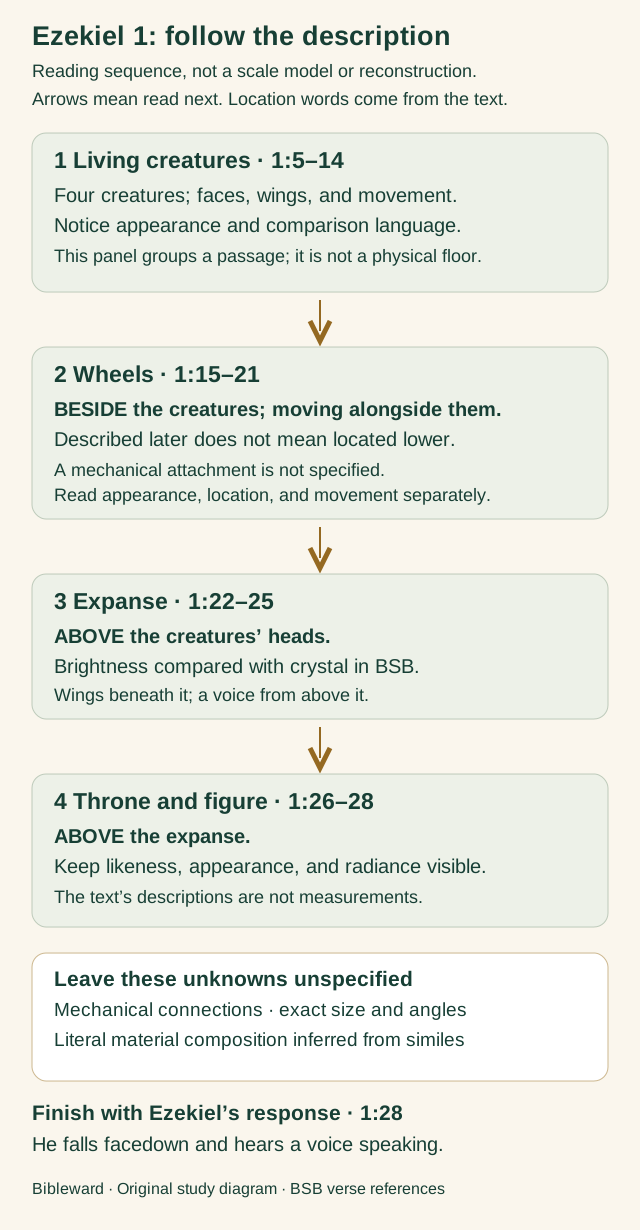
Scripture observation: The layers below group paragraphs for study. They are not four separate floors in a building. In particular, the wheels are beside the living creatures, not on an invented level below them (1:15, 19–21).
Living creatures — 1:5–14. Note their number, described forms, wings, movement, and the comparisons attached to their appearance.
Wheels — 1:15–21. Track location and coordinated movement. Record the appearance language before deciding what you think a wheel within a wheel would look like.
Expanse — 1:22–25. This is above the creatures' heads. The description includes brightness, wings beneath it, their sound, and a voice from above it.
Throne and figure — 1:26–28. Above the expanse, the account describes a throne likeness and a figure with a human likeness, surrounded by radiance. Ezekiel identifies this as the appearance of the likeness of the LORD's glory, then falls facedown.
The diagram deliberately uses labeled boxes. Its arrows mean read next. Only the written location labels describe spatial relationships supplied by the passage. It does not reconstruct the vision or supply an image of God.
Sources: Berean Standard Bible v5.9 checksum-verified canonical corpus · Ezekiel 1, Berean Standard Bible · Berean Bible Terms and Conditions · Ezekiel 1, NABRE
Reading guide · study guidance
Locate twelve selected appearance markers
This table follows the Berean Standard Bible (BSB). These are twelve selected occurrences, not a claim that the chapter contains only twelve. Repeated words in a single verse are identified by their subject. Another translation may use a different word or gemstone name; check its wording separately rather than combining versions.
| Selected occurrence | BSB marker to locate | What the description compares or qualifies |
|---|---|---|
| 1. Ezekiel 1:4 | like | The radiance within the fire is compared with amber. |
| 2. Ezekiel 1:5 | appearance | The four living creatures are described with a human form. |
| 3. Ezekiel 1:7, feet | like | The feet are compared with a calf's hooves. |
| 4. Ezekiel 1:7, gleam | like | Their gleam is compared with polished bronze. |
| 5. Ezekiel 1:13 | appearance | The appearance among the creatures is compared with glowing coals or torches. |
| 6. Ezekiel 1:14 | as quickly as | Their movement is compared with lightning. |
| 7. Ezekiel 1:16, gleam | looked like | The wheels' workmanship is compared with the gleam of beryl. |
| 8. Ezekiel 1:16, arrangement | looked like | A wheel within a wheel describes their arrangement. |
| 9. Ezekiel 1:22, expanse | likeness | The expanse above the creatures' heads is introduced. |
| 10. Ezekiel 1:22, brightness | like | The expanse's appearance is compared with crystal. |
| 11. Ezekiel 1:26, throne | likeness | A throne above the expanse is described. |
| 12. Ezekiel 1:28, radiance | like | The surrounding light is compared with a rainbow in a rain cloud. |
Editorial reading method: Circle the marker, underline what is being described, and write the comparison beside it. For 1:7, for example, make separate notes for the shape of the feet and their gleam. A calf-hoof comparison and a bronze comparison answer different descriptive questions.
Appearance language does not make the account unimportant or meaningless. It does place a limit on our drawings: a comparison can communicate brilliance, movement, or resemblance without giving all the details an artist needs. Preserve those limits instead of treating an imaginative addition as part of the verse.
Sources: Berean Standard Bible v5.9 checksum-verified canonical corpus · Ezekiel 1, Berean Standard Bible · Berean Bible Terms and Conditions · Ezekiel 1, NABRE
Reading guide · study guidance
Three things a diagram should leave unspecified
Mechanical connections. The wheels and creatures move together, but Ezekiel 1 does not provide an axle, hinge, or coupling design (1:19–21).
Exact dimensions and angles. Counts, directions, and positions appear; the measurements for a scale model do not (1:6, 15–18, 22, 26).
Physical composition inferred from similes. Amber, bronze, beryl, crystal, and sapphire help describe what is seen. The comparisons alone do not establish that the vision consists of those ordinary materials (1:4, 7, 16, 22, 26–27).
These are boundaries of this reading exercise, not a claim that every interpretive question has been settled. Nor does resemblance to a device in a modern drawing establish a prediction of that device. This passage supplies no modern machine name or engineering plan.
Sources: Berean Standard Bible v5.9 checksum-verified canonical corpus · Ezekiel 1, Berean Standard Bible · Berean Bible Terms and Conditions · Ezekiel 1, NABRE
Reading guide · study guidance
Six location questions and two drawing limits
Answer with a verse and a short phrase. When the text does not give the requested information, write not stated. That is a valid result.
Where is Ezekiel among the exiles when the opening vision is introduced? Find the location in 1:1–3.
How many living creatures appear, and where are their wings in relation to their bodies? Use 1:5–6, 11.
Where does the text place the wheels relative to the creatures? Compare 1:15 and 1:19–21.
What is above the creatures' heads, and what is described above that? Use 1:22, 26.
In 1:16 and 1:22, which short wording signals comparison rather than a list of measured materials?
How does Ezekiel respond at the end of the chapter, and what does he hear? Use 1:28.
If someone asks you to draw the mechanical attachment between wheel and creature, what should the diagram leave blank?
If someone asks for a scale drawing showing exact dimensions and angles, what should remain unfilled?
Sources: Berean Standard Bible v5.9 checksum-verified canonical corpus · Ezekiel 1, Berean Standard Bible · Berean Bible Terms and Conditions · Ezekiel 1, NABRE
Reading guide · study guidance
Explanatory answers
By the Kebar River, among the exiles (1:1–3). Record that setting before attempting to draw the vision; do not invent a date conversion from this exercise.
Four creatures, each with four wings. Two wings extend toward neighboring creatures and two cover the body (1:5–6, 11). These details still do not provide a complete drawing specification.
Beside the creatures. A wheel appears on the ground beside each creature, and the wheels move or rise alongside them (1:15, 19–21). A reading chart must not place them on a separate lower floor simply because wheels are described later.
An expanse is above their heads, and a throne likeness is above the expanse (1:22, 26). Above the throne is a figure described with a human likeness. Preserve the comparison language when summarizing.
“Looked like” in 1:16 and “likeness” or “like” in 1:22. BSB uses these markers to describe appearance. They do not provide laboratory identification or engineering measurements.
He falls facedown and hears a voice speaking (1:28), after describing the appearance of the LORD's glory. The scene ends in response and address, not a completed machine drawing.
Leave the supposed axle, hinge, or other mechanism unspecified. The coordinated movement is described in 1:19–21; the chapter does not specify an assembly connecting the parts.
Leave exact size, scale, and angular measurements unspecified. Ezekiel 1 gives counts and relationships, but not the measurements needed for that plan. A blank records a real limit, not a failure to understand.
Sources: Berean Standard Bible v5.9 checksum-verified canonical corpus · Ezekiel 1, Berean Standard Bible · Berean Bible Terms and Conditions · Ezekiel 1, NABRE
Reading guide · study guidance
Finish with the whole scene
Return to 1:28 before closing the chapter. Ezekiel's final response is to fall facedown; a voice speaks. An exercise about wheels that never reaches this response would leave the chapter unfinished.
Optional reflection: Which comparison helped you keep reading, and which detail can you leave unresolved for now? You do not need to identify every shape before you can attend to the scene as a whole.
Open the printable vision worksheet. It includes the four reading layers, all twelve marker locations, eight questions with explanations, three unknowns, and a blank observation card. The separate reading diagram can also be opened for a larger view.
For another manageable passage, use Bibleward's reading plans. If you are choosing a starting point, return to where to start reading the Bible.
Sources: Berean Standard Bible v5.9 checksum-verified canonical corpus · Ezekiel 1, Berean Standard Bible · Berean Bible Terms and Conditions · Ezekiel 1, NABRE
Reading guide · study guidance
Sources and scope
Ezekiel 1, Berean Standard Bible: the translation used for the selected marker list and answer key.
Ezekiel 1, USCCB NABRE: a separately identified translation for comparison.
Berean Bible terms: the publisher's public-domain statement.
The full chapter was checked against the checksum-verified BSB v5.9 text. The diagram and exercises are original study tools. They do not claim to reconstruct the vision, establish a prophetic timetable, or settle later Christian interpretations of its imagery.
Sources: Berean Standard Bible v5.9 checksum-verified canonical corpus · Ezekiel 1, Berean Standard Bible · Berean Bible Terms and Conditions · Ezekiel 1, NABRE
Original printable reading resource
Keep the worksheet beside your reading
Open the worksheet from the article link to read or print it in your browser. Download the same self-contained HTML file below to keep an offline copy, including the exercises and answer guidance.
- Download the complete printable worksheet (HTML)
Original questions, reference tables and answer guidance. Print from your browser or save as PDF; no account or online submission is needed.
Sources: Berean Standard Bible v5.9 checksum-verified canonical corpus · Ezekiel 1, Berean Standard Bible · Berean Bible Terms and Conditions · Ezekiel 1, NABRE
Sources and further reading
- Berean Standard Bible v5.9 checksum-verified canonical corpus
Full assigned chapter read from pinned JSONL; exact canonical references recorded per claim
- Ezekiel 1, Berean Standard Bible
Primary Scripture section only
- Berean Bible Terms and Conditions
All-use public-domain dedication
- Ezekiel 1, NABRE
Official chapter text; separately attributed translation comparison
Study guidance · not Scripture. AI-assisted writing and automated content review; no individual pastoral endorsement is claimed.