Historical context and textual observation
First name the kingdom and its center
A page headed Kings can move between two royal lines. Begin by writing the king’s name, the kingdom named beside it, and the city in view. Similar names do not make Israel and Judah interchangeable. In 1 Kings 12:16–24, Jeroboam becomes king over Israel while Rehoboam retains rule in Judah; Jerusalem is Rehoboam’s point of return.
Samaria belongs on the northern track, with a qualification: it is a later royal center. First Kings 16:23–24 places Omri at Tirzah before describing his purchase and building of Samaria. Do not move Samaria back into the opening scene of the split. Your note can say northern Israel—later centered on Samaria without pretending the capital never changed.
This key is for the divided-kingdom passages. Do not automatically give the name Israel that narrow political meaning in every book. Let the surrounding sentences tell you who is meant, especially when a later passage speaks about a returning community.
| Track | Political center to recognize | Textual starting point |
|---|---|---|
| Northern kingdom: Israel | Samaria later in the story; earlier centers also occur | 1 Kings 12:20; 16:23–24 |
| Southern kingdom: Judah | Jerusalem | 1 Kings 12:21–24 |
Sources: 1 Kings 12 — Berean Standard Bible · 1 Kings 16 — Berean Standard Bible · Ezra 1 — Berean Standard Bible
Textual observation
Follow four changes, reading down both tracks
Read the table from top to bottom. Empty space on a track is intentional: it means this small guide is not supplying a parallel event there. It does not mean nobody lived there or that every part of the region shared one experience. The rows are chapter checkpoints, not equally spaced years.
At the second checkpoint, circle Assyria and Samaria. At the third, circle Babylon and Jerusalem. Those two pairs prevent a common reading mistake: making the northern and southern deportations one event. At the fourth, notice that Cyrus is identified as king of Persia; a new imperial setting has entered the account.
Exile also needs a careful sentence. Second Kings 25:11–12 describes deportation but also people left to work the land. Write that the chapter reports people being taken away; do not turn that into a claim that every inhabitant left. A simple map should make the next reading clearer without erasing those who remained.
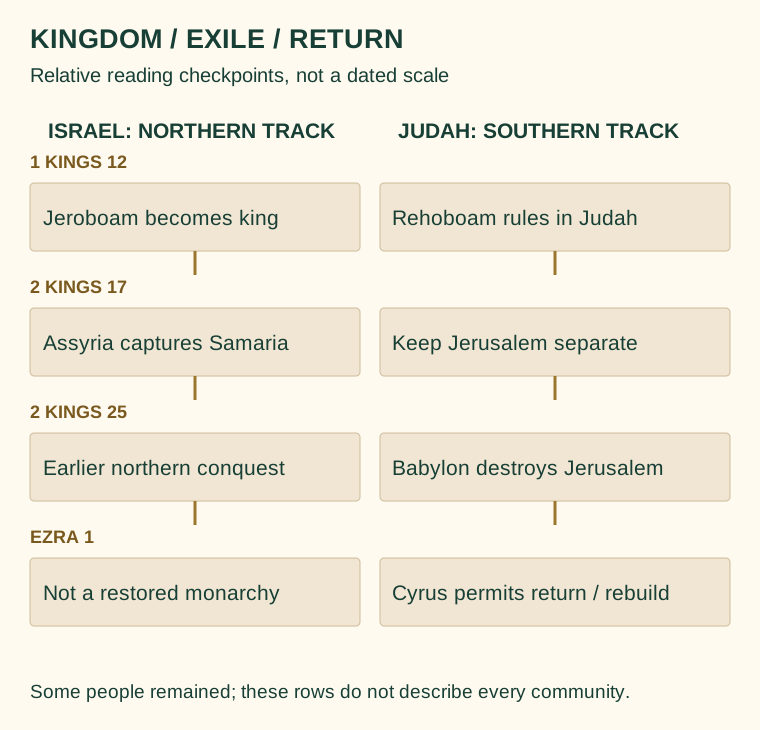
| Checkpoint | Northern track: Israel | Southern track: Judah / Jerusalem | Look for |
|---|---|---|---|
| 1. Kingdom divides — 1 Kings 12:16–24 | Jeroboam is made king | Rehoboam rules in Judah | Two royal lines |
| 2. Samaria captured — 2 Kings 17:5–6 | Assyria captures Samaria and deports Israelites | A separate kingdom; do not substitute Jerusalem for Samaria | Assyria + Samaria |
| 3. Jerusalem destroyed — 2 Kings 25:1–12 | The earlier northern conquest is a different checkpoint | Babylonian forces burn the temple and deport people; some remain | Babylon + Jerusalem |
| 4. Return authorized — Ezra 1:1–5 | Do not label this a restoration of the northern monarchy | Cyrus of Persia permits return to Jerusalem and rebuilding | Persian ruler + return + rebuilding |
Sources: 1 Kings 12 — Berean Standard Bible · 2 Kings 17 — Berean Standard Bible · 2 Kings 25 — Berean Standard Bible · Ezra 1 — Berean Standard Bible
Editorial exercise grounded in named passages
Put six cards in order and explain your choices
Copy the six card names onto separate slips, hide the examples, and order them. You do not need to memorize dates. Use the references to find an actor, a place, or a changed condition that makes the order reasonable. Rebuilding here means completion of the temple, not every later repair in Jerusalem.
Answer key: B → D → F → A → C → E. This follows the broad sequence represented by these particular passages. A decree, a journey, a completed building, and a public reading are distinct moments. The exercise does not claim that a single crowd experienced them all or that the chapters form a complete account of every intervening year.
Sources: 1 Kings 12 — Berean Standard Bible · 2 Kings 17 — Berean Standard Bible · 2 Kings 25 — Berean Standard Bible · Ezra 1 — Berean Standard Bible · Ezra 6 — Berean Standard Bible · Nehemiah 8 — Berean Standard Bible
Worked example and reading boundary
Fill an Ezra location card
Worked reading note for Ezra 1:1–5: scene under a Persian king; destination Jerusalem in Judah; immediate action a proclamation and preparations to rebuild; earlier checkpoint the destruction described in 2 Kings 25. This locates the opening without adding dialogue, exact travel dates, or a claim that every exile returned.
A book’s title does not mean its named figure acts in the first scene. Ezra’s own journey is introduced in Ezra 7:1–10, under Artaxerxes. Keep the chapter 1 return setting separate from that later entrance. The book can cover events before the named person arrives.
Now make your own card: passage ___; named ruler ___; place ___; earlier checkpoint ___; new action ___; unanswered question ___. If you cannot fill a field from the chapter, leave it open. A blank is more useful than an attractive detail borrowed from an unrelated period.
Sources: Ezra 1 — Berean Standard Bible · Ezra 7 — Berean Standard Bible · 2 Kings 25 — Berean Standard Bible
Historical context and limits
Know what the timeline does not settle
Historical dating and narrative location are different tasks. Crossway’s ESV Historical Books Timeline uses 586 BC for Jerusalem’s destruction. Rodger C. Young’s 2006 Jewish Bible Quarterly article argues for 587 BCE. BC and BCE use the same year numbering; the one-year difference here concerns chronology. This guide shows the shared relative order and does not adjudicate that debate.
The era of an event is also different from the date when a book was written or edited. Neither the position of Ezra after Kings in your contents page nor this worksheet establishes a composition date. Questions about the arrangement and chronology of Ezra–Nehemiah deserve a fuller introduction and comparison of scholarly arguments.
For your next session, choose one checkpoint and read its whole paragraph in a named Bible translation. Write one observation about what changes. Then return to your current plan with that location note; you do not have to finish an entire historical survey before reading attentively.
Sources: Historical Books Timeline · Seder Olam and the Sabbaticals Associated with the Two Destructions of Jerusalem, Part II · Ezra 7 — Berean Standard Bible
Sources and further reading
- 1 Kings 12 — Berean Standard Bible
1 Kings 12:16–25: divided rule, Rehoboam and Jeroboam, Jerusalem and Shechem.
- 1 Kings 16 — Berean Standard Bible
1 Kings 16:23–24: Omri, Tirzah, purchase and building of Samaria.
- 2 Kings 17 — Berean Standard Bible
2 Kings 17:1–6, 18–24: Samaria, Assyria, deportation, Judah distinguished.
- 2 Kings 25 — Berean Standard Bible
2 Kings 25:1, 8–12: Babylon, Jerusalem, burning and deportation, people remaining.
- Ezra 1 — Berean Standard Bible
Ezra 1:1–5, 7–11: Cyrus of Persia, proclamation, preparations and return.
- Ezra 6 — Berean Standard Bible
Ezra 6:13–16: temple completion in Darius’s reign and dedication.
- Nehemiah 8 — Berean Standard Bible
Nehemiah 8:1–8: public reading by Ezra at the Water Gate.
- Ezra 7 — Berean Standard Bible
Ezra 7:1–10: Ezra’s later arrival under Artaxerxes.
- Historical Books Timeline
Entries for divided kingdoms, destruction of Samaria, destruction of Jerusalem, return and rebuilding. This publisher adopts 586 BC for Jerusalem.
- Seder Olam and the Sabbaticals Associated with the Two Destructions of Jerusalem, Part II
Jewish Bible Quarterly 34(4), 2006; PDF page 3 Table 1 and page 7 note 7 argue for 587 BCE. Cited to identify a differing proposal, not endorse every argument.
Reading aid · AI-assisted writing and automated content review; no individual pastoral or denominational endorsement is claimed.