Reading guide · study guidance
Before you begin
Study guidance · not Scripture. AI-assisted writing and automated content review; no individual pastoral endorsement is claimed.
Sources: Updated World English Bible: Ephesians 6 · Berean Standard Bible: Ephesians 6 · World English Bible information and permissions · Berean Bible Terms and Conditions · Updated World English Bible: Ephesians 1
Reading guide · study guidance
Choose a complete reading unit
Open Ephesians 6. Begin at verse 10 and continue to verse 20 before making an equipment list. Verse 21 moves toward Tychicus and news about the writer's circumstances. That makes verse 20 a useful pause for this exercise, while the letter continues beyond it.
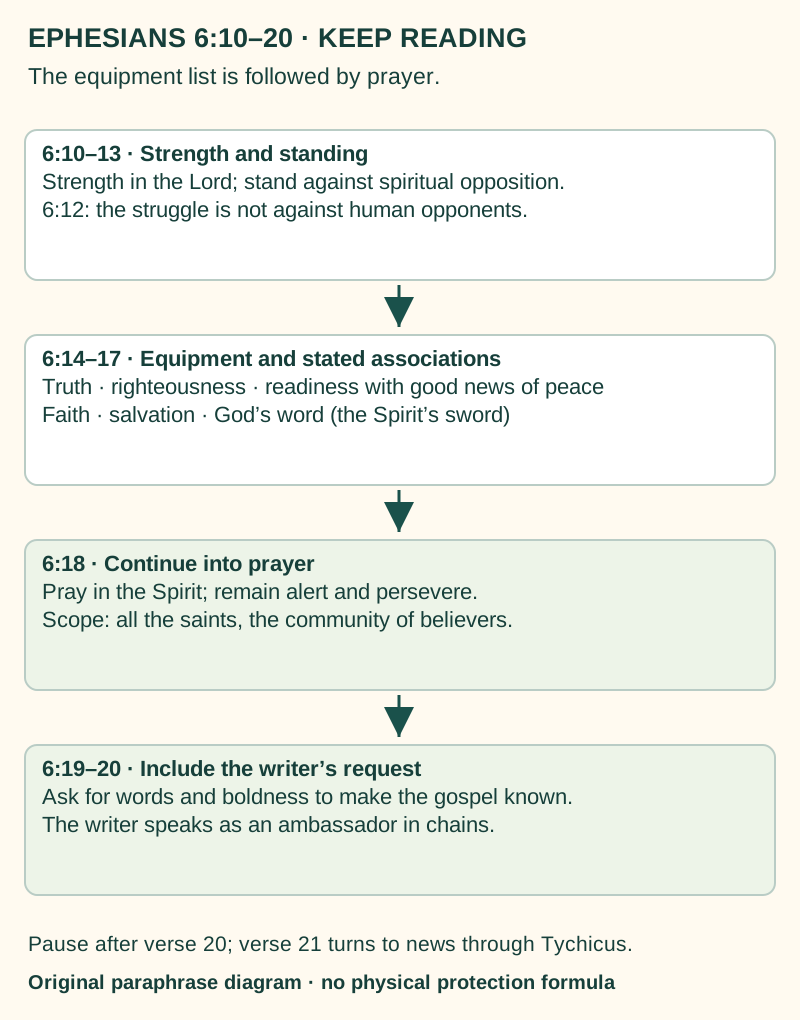
Scripture observation: Verses 10–13 call the readers to draw strength from the Lord, take up God's armor, and stand. The reasons include opposition described in spiritual terms. Verses 14–17 develop the equipment imagery. Verses 18–20 continue with prayer and a request for the writer's speech. The order matters because the last part gives the reader more to do than remember six objects.
Sources: Updated World English Bible: Ephesians 6 · Berean Standard Bible: Ephesians 6 · World English Bible information and permissions · Berean Bible Terms and Conditions · Updated World English Bible: Ephesians 1
Reading guide · study guidance
Follow the paragraph from strength to prayer
Editorial reading method: This diagram groups the unit into four reading movements. Its arrows follow the written order; they are not a sequence of rituals or a formula for obtaining protection.
Mark repeated instructions to stand in verses 11, 13, and 14. Then mark prayer and watchfulness in verse 18 and the particular request in verses 19–20. You can see the progression with a pencil; you do not need to invent a meaning for every detail of a soldier's equipment.
Sources: Updated World English Bible: Ephesians 6 · Berean Standard Bible: Ephesians 6 · World English Bible information and permissions · Berean Bible Terms and Conditions · Updated World English Bible: Ephesians 1
Reading guide · study guidance
Pair each image with the text's own association
| Equipment image | Association supplied by the text | What the image does not establish |
|---|---|---|
| Belt, 6:14 | Truth. | A special physical belt, color, or material that protects a wearer. |
| Breastplate, 6:14 | Righteousness. | An assessment that an injured person lacked righteousness. |
| Prepared feet, 6:15 | Readiness or preparation associated with the good news of peace. | A named shoe design or a command to identify a human group as an enemy. |
| Shield, 6:16 | Faith, pictured as extinguishing the evil one's flaming projectiles. | A guarantee that a believer will never suffer physical harm. |
| Helmet, 6:17 | Salvation. | A literal object that determines a reader's salvation status. |
| Sword of the Spirit, 6:17 | God's word. | Permission to threaten or attack people, or a hidden sequence of words that guarantees an outcome. |
The table is a reading aid, not a substitute set of spiritual instructions. For example, the shield is connected to faith in the text. The passage does not tell a reader to buy an object, name a special material, or calculate a protective effect. Likewise, the sword association in verse 17 must stay beside the boundary on human opponents in verse 12.
Interpretive scope: This exercise follows the associations stated in the passage. It does not adjudicate different Christian traditions' accounts of spiritual warfare, salvation, or how prayer works. A fuller theological discussion should identify its sources and tradition rather than turn an illustration into an agreed mechanism.
Sources: Updated World English Bible: Ephesians 6 · Berean Standard Bible: Ephesians 6 · World English Bible information and permissions · Berean Bible Terms and Conditions · Updated World English Bible: Ephesians 1
Reading guide · study guidance
Keep the boundary on opponents visible
Verse 12 distinguishes this struggle from one against flesh and blood. That is part of the paragraph, not a minor exception. A reading that uses the armor to mark ordinary people or whole communities as spiritual targets has dropped a limit the text itself supplies.
The passage's language about spiritual forces is not a diagnostic tool for deciding that someone is possessed or that a disagreement reveals a hidden enemy. Nor does refusing such labels mean ignoring harm or wrongdoing. This guide is about reading the passage's scope; it gives no authority to threaten another person.
Sources: Updated World English Bible: Ephesians 6 · Berean Standard Bible: Ephesians 6 · World English Bible information and permissions · Berean Bible Terms and Conditions · Updated World English Bible: Ephesians 1
Reading guide · study guidance
Continue into prayer for believers and for the writer
At 6:18 the prayer extends to all the saints. The letter's address calls its believing recipients saints at 1:1; here the term does not mean only people later formally recognized with that title. Keep the broad community of believers in view. The verse also emphasizes continuing prayer, alertness, and perseverance.
Verse 19 then adds a particular person: the writer asks for words to make the gospel known boldly. Verse 20 places that request in the circumstances of an ambassador in chains. He asks for the speech he ought to give. The request printed here is not an explicit request for release, though it would be unwarranted to infer that he never sought release elsewhere.
The prayer request belongs beside the armor imagery: the voice asking for boldness is still speaking from hardship. Turning the passage into a guarantee that believers cannot be injured or confined would add an outcome the unit does not promise.
Sources: Updated World English Bible: Ephesians 6 · Berean Standard Bible: Ephesians 6 · World English Bible information and permissions · Berean Bible Terms and Conditions · Updated World English Bible: Ephesians 1
Reading guide · study guidance
Answer six questions about scope and connection
Use the complete printable worksheet or answer beside your Bible. Read a verse again when necessary. Mark an answer text-supported, reread needed, or not specified; do not translate the result into a judgment about your faith.
Why does this reading continue through 6:20 instead of ending with the equipment in 6:17?
What limitation does 6:12 place on identifying opponents?
What does 6:15 associate with prepared feet, and what modern equipment specification does it supply?
Who is included in the requests at 6:18, and how does 6:19 add to that focus?
What is requested for the writer in 6:19–20? Does this particular request explicitly ask for release from prison?
How does the writer's situation in 6:20 test a summary that promises physical immunity to people who use the armor imagery?
Sources: Updated World English Bible: Ephesians 6 · Berean Standard Bible: Ephesians 6 · World English Bible information and permissions · Berean Bible Terms and Conditions · Updated World English Bible: Ephesians 1
Reading guide · study guidance
Read the explained answers
Verses 18–20 continue into prayer, watchfulness, perseverance, and a particular request for the writer. Ending at 17 would leave those connected actions unread. Verse 21 then turns toward Tychicus and news of the writer's circumstances, providing a sensible pause after 20.
The struggle is explicitly distinguished from a struggle against flesh and blood. The verse names spiritual opposition, so the passage is not a warrant to label a neighbor, nationality, political party, or religious community as the enemy to attack.
Preparation associated with the good news of peace. The verse supplies no modern brand, design, or material. A drawn shoe can be an illustration; it is not an additional revelation about equipment.
Verse 18 calls for prayer for all the saints; verse 19 adds the writer. Here the saints are believers, as the letter's address in 1:1 helps show. Keep that actual scope rather than changing the verse into a different instruction. This observation does not forbid praying for other people.
Words and boldness to make the gospel known. The writer describes himself as an ambassador in chains and asks to speak as he ought. Release is not the request expressed in these two verses; that does not prove he never wanted or prayed for release elsewhere.
The request is voiced from confinement. The text includes both trust and hardship. A promise of guaranteed physical immunity would therefore go beyond this unit, not summarize it.
Sources: Updated World English Bible: Ephesians 6 · Berean Standard Bible: Ephesians 6 · World English Bible information and permissions · Berean Bible Terms and Conditions · Updated World English Bible: Ephesians 1
Reading guide · study guidance
Write one context-respecting reading note
The filled example below separates an observation from an optional response. It is one possible way to use the passage, not a command spoken by God to an individual reader.
| Note field | Filled example | Your reading note |
|---|---|---|
| Passage and scope | Ephesians 6:10–20; I read through the prayer requests. | I read ________ through ________. |
| Text observation | Verses 19–20 ask for words and boldness while the writer is in chains. | The passage says ________ at verse ________. |
| Connection | Prayer belongs with standing firm; the equipment list is not the final instruction. | This connects to ________ because ________. |
| Optional personal response | I can pray for a believer who needs courage to speak honestly and kindly. | I may respond by ________. |
| Limit to keep | I am not promised freedom from harm or given a human group to attack. | I should not infer ________. |
Complete-reading stop: Finish when you can connect one image to its textual association, state the limit on human opponents, and describe both prayer scopes in verses 18–20. Reading a familiar list carefully is worthwhile even if you leave a larger theological question for another day.
You can choose another passage in Plans or return to where to start reading the Bible.
May God bless your reading with steadiness, care for others, and courage shaped by peace.
Sources: Updated World English Bible: Ephesians 6 · Berean Standard Bible: Ephesians 6 · World English Bible information and permissions · Berean Bible Terms and Conditions · Updated World English Bible: Ephesians 1
Reading guide · study guidance
Sources and translation notes
Read Ephesians 6 in the Updated World English Bible: 6:10–20 is the exercise; 6:21–22 shows the following transition.
Read the letter's address in Ephesians 1:1: helps identify the believers described as saints.
Compare Ephesians 6 in the Berean Standard Bible: the same complete unit, with some different English wording.
World English Bible information and permissions and Berean Bible permissions: public-domain texts. The guide, diagram, tables, and reading notes are original study guidance.
Sources: Updated World English Bible: Ephesians 6 · Berean Standard Bible: Ephesians 6 · World English Bible information and permissions · Berean Bible Terms and Conditions · Updated World English Bible: Ephesians 1
Original printable reading resource
Keep the worksheet beside your reading
Open the worksheet from the article link to read or print it in your browser. Download the same self-contained HTML file below to keep an offline copy, including the exercises and answer guidance.
- Download the complete printable worksheet (HTML)
Original questions, reference tables and answer guidance. Print from your browser or save as PDF; no account or online submission is needed.
Sources: Updated World English Bible: Ephesians 6 · Berean Standard Bible: Ephesians 6 · World English Bible information and permissions · Berean Bible Terms and Conditions · Updated World English Bible: Ephesians 1
Sources and further reading
- Updated World English Bible: Ephesians 6
Ephesians 6 full chapter; primary biblical text, not footnote labels or secondary commentary
- Berean Standard Bible: Ephesians 6
Primary BSB Scripture section only, corroborated against checksum-verified v5.9 corpus
- World English Bible information and permissions
About the World English Bible; public-domain text, free print/electronic publication and name-use limits
- Berean Bible Terms and Conditions
Public-domain dedication; all uses permitted; derivative naming guidance
- Updated World English Bible: Ephesians 1
EPH.1.1 and immediate chapter context
Study guidance · not Scripture. AI-assisted writing and automated content review; no individual pastoral endorsement is claimed.