Reading guide · study guidance
Before you begin
First Corinthians 13 belongs within Paul's discussion of spiritual gifts and the life of the church. Chapter 12 presents different gifts within one body; chapter 13 shows that impressive abilities and costly actions are empty without love; chapter 14 returns to gifts and asks how speech can help the gathered community. Reading all three chapters makes the love chapter's role much easier to see.
If you first heard chapter 13 at a wedding, you already have a familiar starting point. Applying its teaching to marriage need not erase its original community setting. This guide helps you recover that setting before making an application. Use the three-column context card and four reading questions with your Bible.
Sources: Berean Standard Bible v5.9: checksum-verified corpus · Berean Bible Terms and Conditions · Bibleward reading plans · 1 Corinthians12, Berean Standard Bible · 1 Corinthians13, Berean Standard Bible · 1 Corinthians14, Berean Standard Bible · Modern-Day Prophecy · Report of the Committee on the Baptism and Gifts of the Holy Spirit
Reading guide · study guidance
Cross the two chapter boundaries
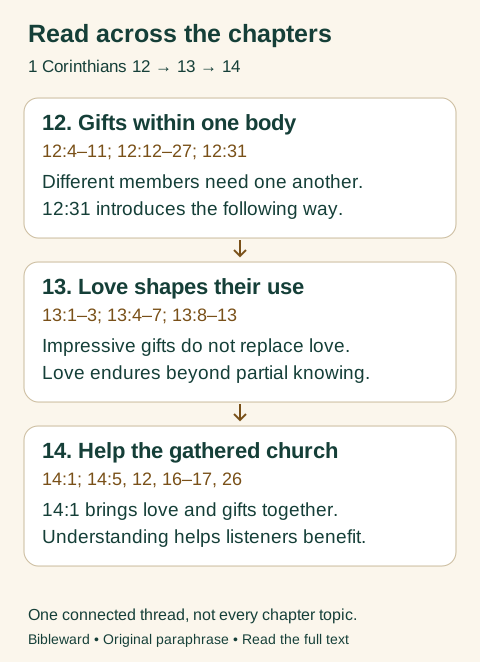
Scripture observation. First read 12:27–31, then continue straight into 13:1–3. Paul has been naming gifts and asking whether everyone has the same role. At 12:31, he introduces a better way; the next paragraph repeatedly imagines gifted activity without love. Then read 13:13 straight into 14:1: love remains central as Paul resumes his instructions about gifts.
| Reading stop | What to notice | Link across the boundary |
|---|---|---|
| Chapter 12 | Different gifts serve a shared good; the many members form one body. | 12:31 introduces the way that chapter 13 develops. |
| Chapter 13 | Tongues, prophecy, knowledge, faith, and costly giving do not make love unnecessary. | 13:13 and 14:1 keep love in view as the discussion moves back to gifts. |
| Chapter 14 | Speech in the gathering should be understandable and build others up. | 14:12 and 14:26 turn attention to the good of the church. |
Read the primary text in chapter 12, chapter 13, and chapter 14. The diagram summarizes selected connections; it does not replace those chapters or claim to outline every issue they contain.
Sources: Berean Standard Bible v5.9: checksum-verified corpus · Berean Bible Terms and Conditions · Bibleward reading plans · 1 Corinthians12, Berean Standard Bible · 1 Corinthians13, Berean Standard Bible · 1 Corinthians14, Berean Standard Bible · Modern-Day Prophecy · Report of the Committee on the Baptism and Gifts of the Holy Spirit
Reading guide · study guidance
Notice the body before focusing on one gift
Scripture observation. At 12:4–11, Paul distinguishes gifts, service, and activity while emphasizing their common source. Verse 7 gives a shared purpose: benefit beyond the individual recipient. The body picture at 12:12–27 then makes dependence concrete. A foot does not stop belonging because it is not a hand; an eye cannot dismiss the hand as unnecessary (12:15–21).
The paragraph also attends to members who seem weaker and to shared suffering and honor (12:22–26). That prepares a useful reading question: when chapter 13 describes love, how might those descriptions matter among people tempted to compare their roles? This question is an editorial inference drawn from the sequence, not an additional sentence from Paul.
Bibleward's Day 28 Scripture reading selects 12:12–27. This resource extends that body passage into the neighboring chapters so that its references to community are not left behind.
Sources: Berean Standard Bible v5.9: checksum-verified corpus · Berean Bible Terms and Conditions · Bibleward reading plans · 1 Corinthians12, Berean Standard Bible · 1 Corinthians13, Berean Standard Bible · 1 Corinthians14, Berean Standard Bible · Modern-Day Prophecy · Report of the Committee on the Baptism and Gifts of the Holy Spirit
Reading guide · study guidance
Read what love changes in the argument
Scripture observation. In 13:1–3, Paul uses first-person conditional examples. He imagines remarkable speech, understanding, faith, and generosity without love, then denies that those achievements are enough. These are rhetorical examples, not an invitation for the reader to diagnose another person's spiritual standing.
Verses 4–7 describe love through conduct: patient kindness, freedom from jealous rivalry and self-promotion, and a relation to truth rather than wrongdoing. Verses 8–12 contrast love's enduring character with partial knowledge and prophecy; verse 13 names faith, hope, and love. Keep the whole movement in view instead of turning the chapter into a checklist for proving that you are a good Christian.
Editorial inference. In this sequence, love functions as a way of evaluating the exercise of gifts, not as a decorative pause between two unrelated chapters. A reader can test that explanation by asking whether the same concern for others reappears in chapter 14.
Sources: Berean Standard Bible v5.9: checksum-verified corpus · Berean Bible Terms and Conditions · Bibleward reading plans · 1 Corinthians12, Berean Standard Bible · 1 Corinthians13, Berean Standard Bible · 1 Corinthians14, Berean Standard Bible · Modern-Day Prophecy · Report of the Committee on the Baptism and Gifts of the Holy Spirit
Reading guide · study guidance
Follow love back into understandable speech
Scripture observation. Chapter 14 begins by joining the pursuit of love to the desire for gifts (14:1). It contrasts speech that others can understand with speech that needs interpretation. Verse 5 explicitly includes interpretation as the way tongues can benefit the gathered church; leaving that qualification out would distort the comparison.
Paul's musical examples in 14:7–9 ask how anyone can respond to indistinct sounds. Later, 14:16–17 asks how an uninstructed listener can join the thanksgiving without understanding. Verses 26–33 discuss contributions, interpretation, turn-taking, and weighing what is said. Here building up, sometimes translated edification, means helping the community grow or be strengthened, rather than constructing a building.
This guide follows that thread. Chapter 14 also contains difficult material, including 14:34–35; the three-column card is not a complete account of every instruction or a ruling on church leadership.
Sources: Berean Standard Bible v5.9: checksum-verified corpus · Berean Bible Terms and Conditions · Bibleward reading plans · 1 Corinthians12, Berean Standard Bible · 1 Corinthians13, Berean Standard Bible · 1 Corinthians14, Berean Standard Bible · Modern-Day Prophecy · Report of the Committee on the Baptism and Gifts of the Holy Spirit
Reading guide · study guidance
Fill a context card before drawing an application
| Current topic: chapter 12 | Chapter 13's role | Continuing concern: chapter 14 |
|---|---|---|
| Members with different gifts belong to one body and need each other (12:12–27). | Gifted speech and knowledge without love are inadequate (13:1–2); love is not self-promoting (13:4–5). | Speech should help the listeners; interpretation matters if they are to understand and benefit (14:5, 12, 16–17). |
One possible application, not a quotation: In a group discussion, I can explain an unfamiliar term and leave room for another person to speak. That is a modest response to the reading; it is not proof that I possess a particular gift.
The worksheet gives four text-location questions, checked answers, and a reusable blank card. Try the questions before reading the key; each answer should include a verse, not only an impression.
Sources: Berean Standard Bible v5.9: checksum-verified corpus · Berean Bible Terms and Conditions · Bibleward reading plans · 1 Corinthians12, Berean Standard Bible · 1 Corinthians13, Berean Standard Bible · 1 Corinthians14, Berean Standard Bible · Modern-Day Prophecy · Report of the Committee on the Baptism and Gifts of the Holy Spirit
Reading guide · study guidance
Distinguish this reading task from a gifts debate
Tradition comparison. Christians differ over the continuation of certain gifts. The Assemblies of God (USA) affirms prophecy as a gift for the church today and requires it to be weighed by the community. An Orthodox Presbyterian Church committee report argues that prophecy and tongues belonged to the apostolic era and ceased with it. The OPC identifies that document as a study report, not a constitutional statement. These are two named accounts, not exhaustive descriptions of Pentecostals or Reformed Christians. Assemblies of God position paper; OPC committee report.
The card does not settle that disagreement or decide the meaning of every image in 13:8–12. It helps readers locate the shared passage before examining a tradition's argument. Nor does an AI-written guide deliver prophecy, identify your gift, or claim authority over your church.
For another letter, use the argument-reading guide. For your next manageable reading, choose a passage from the reading plans. Scripture text is free; current labels explain guided and audio access.
A blessing for your reading: May God bless you with a love that listens carefully and makes room for the good of others.
AI-assisted study guidance, original diagram, and worksheet; automated source and Christian-content review. No individual pastoral endorsement is claimed. Scripture descriptions are paraphrases checked against BSB v5.9; named tradition positions remain attributed.
Sources: Berean Standard Bible v5.9: checksum-verified corpus · Berean Bible Terms and Conditions · Bibleward reading plans · 1 Corinthians12, Berean Standard Bible · 1 Corinthians13, Berean Standard Bible · 1 Corinthians14, Berean Standard Bible · Modern-Day Prophecy · Report of the Committee on the Baptism and Gifts of the Holy Spirit
Original printable reading resource
Keep the worksheet beside your reading
Open the worksheet from the article link to read or print it in your browser. Download the same self-contained HTML file below to keep an offline copy, including the exercises and answer guidance.
- Download the complete printable worksheet (HTML)
Original questions, reference tables and answer guidance. Print from your browser or save as PDF; no account or online submission is needed.
Sources: Berean Standard Bible v5.9: checksum-verified corpus · Berean Bible Terms and Conditions · Bibleward reading plans · 1 Corinthians12, Berean Standard Bible · 1 Corinthians13, Berean Standard Bible · 1 Corinthians14, Berean Standard Bible · Modern-Day Prophecy · Report of the Committee on the Baptism and Gifts of the Holy Spirit
Sources and further reading
- Berean Standard Bible v5.9: checksum-verified corpus
Canonical references checked against pinned BSB v5.9 JSONL
- Berean Bible Terms and Conditions
Public-domain dedication and all-use permission effective April 30, 2023
- Bibleward reading plans
Day28 1 Corinthians12:12–27, Day54 Acts15:1–21, free Scripture and labeled guided/audio access
- 1 Corinthians12, Berean Standard Bible
Primary Scripture text, especially12:4–31
- 1 Corinthians13, Berean Standard Bible
Primary Scripture text,13:1–13
- 1 Corinthians14, Berean Standard Bible
Primary Scripture text, especially14:1–19,26–40
- Modern-Day Prophecy
Summary and Judging Prophecies; adopted August4–5,2025
- Report of the Committee on the Baptism and Gifts of the Holy Spirit
1978 reportIV.F; introductory notice that report is not constitutional
Study guidance · not Scripture. AI-assisted writing and automated content review; no individual pastoral endorsement is claimed.