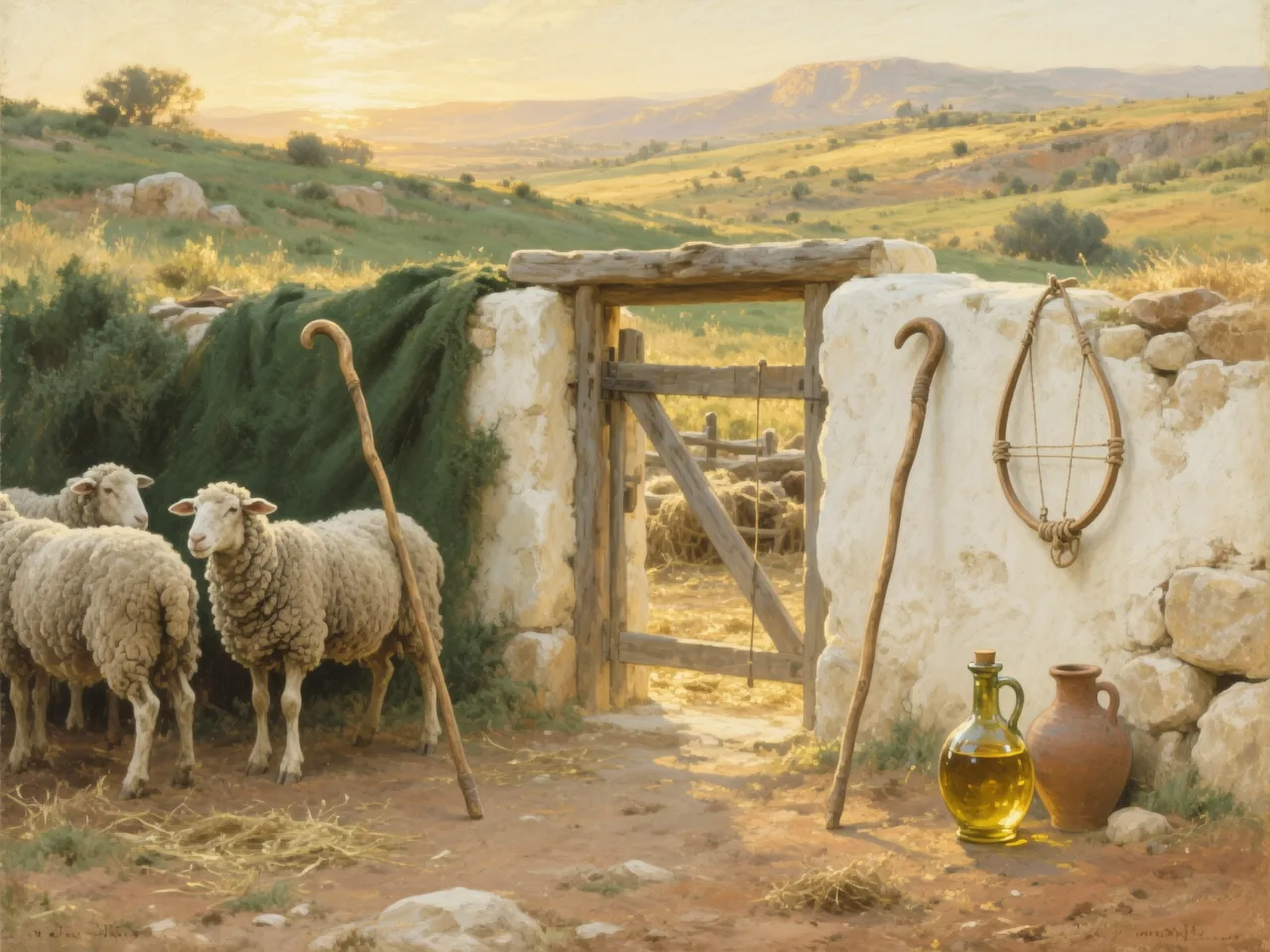
Day 20 · John 10:1–18 · Berean Standard Bible
John 10 explained: the good shepherd and the gate
John 10:1–18 uses the images of a gate and a shepherd to describe Jesus' care and authority. The contrast is not between impressive and unimpressive leaders, but between those who exploit or abandon the sheep and the shepherd who gives His life. Pay attention to each image rather than combining every detail into one literal scene.
The Scripture text and this public explanation are free. Guided audio and the complete guided steps require Plus or a Journey Pass covering this day.
Jesus does not picture His followers as a crowd He can use. He knows them, leads them, protects them, and gives Himself for them. His voice is not recognized by volume, fear, or spiritual pressure but by the character disclosed in this passage: He brings life rather than destruction and does not abandon the flock when danger comes. His mention of other sheep also points beyond a closed circle toward one gathered flock.
John 10:1–18
1 “Truly, truly, I tell you, whoever does not enter the sheepfold by the gate, but climbs in some other way, is a thief and a robber.
2 But the one who enters by the gate is the shepherd of the sheep.
3 The gatekeeper opens the gate for him, and the sheep listen for his voice. He calls his own sheep by name and leads them out.
4 When he has brought out all his own, he goes on ahead of them, and his sheep follow him because they know his voice.
5 But they will never follow a stranger; in fact, they will flee from him because they do not recognize his voice.”
6 Jesus spoke to them using this illustration, but they did not understand what He was telling them.
7 So He said to them again, “Truly, truly, I tell you, I am the gate for the sheep.
8 All who came before Me were thieves and robbers, but the sheep did not listen to them.
9 I am the gate. If anyone enters through Me, he will be saved. He will come in and go out and find pasture.
10 The thief comes only to steal and kill and destroy. I have come that they may have life, and have it in all its fullness.
11 I am the good shepherd. The good shepherd lays down His life for the sheep.
12 The hired hand is not the shepherd, and the sheep are not his own. When he sees the wolf coming, he abandons the sheep and runs away. Then the wolf pounces on them and scatters the flock.
13 The man runs away because he is a hired servant and is unconcerned for the sheep.
14 I am the good shepherd. I know My sheep and My sheep know Me,
15 just as the Father knows Me and I know the Father. And I lay down My life for the sheep.
16 I have other sheep that are not of this fold. I must bring them in as well, and they will listen to My voice. Then there will be one flock and one shepherd.
17 The reason the Father loves Me is that I lay down My life in order to take it up again.
18 No one takes it from Me, but I lay it down of My own accord. I have authority to lay it down and authority to take it up again. This charge I have received from My Father.”
Study guide · not Scripture
Meaning & context
Literary context · John 10:1–18
A speech beside the story of the healed man
John 10 follows the account of a man healed of blindness and conflict over his testimony in chapter 9. The USCCB notes read the shepherd speech in that setting of contested leadership. This helps explain why questions about recognition, care, and exclusion matter here. The image is more pointed than a peaceful landscape with animals.
Sources: Berean Standard Bible: John 10 · USCCB: John 10 commentary
Scripture observation · John 10:1–6
1. Knowing the shepherd leads to following
The sheep respond to a familiar voice and refuse a stranger. Verse 6 then says the listeners do not understand the illustration. That pause matters: Jesus continues explaining. The description is not a technique for identifying every inner thought as a divine instruction, and Bibleward's narrator is not the shepherd's voice.
Sources: Berean Standard Bible: John 10
Scripture observation · John 10:7–10
2. The gate image points toward life
Jesus contrasts destructive entry with access, pasture, and life. The language of fullness belongs to this contrast with stealing, killing, and destroying. It should not be converted into a guarantee of wealth, status, uninterrupted health, or success. Those promises are not listed in the passage.
Sources: Berean Standard Bible: John 10
Scripture observation · John 10:11–18
3. The shepherd does not abandon the sheep
The hired hand runs when danger comes, while Jesus describes knowing His sheep and laying down His life. He also speaks of other sheep and one flock. The ending joins His willing self-giving to the Father's charge. The repeated focus is His action for the sheep, not their ability to earn His attention.
Sources: Berean Standard Bible: John 10
Interpretive limits · John 10:11–18
The image does not give leaders unchecked power
A religious leader cannot simply claim the shepherd's status and demand that others surrender judgment, money, or safety. This passage identifies Jesus and measures care against abandonment and exploitation. The identity of the other sheep has received different explanations; this guide does not turn that phrase into a confident roster of modern denominations.
Sources: Berean Standard Bible: John 10 · USCCB: John 10 commentary · Bibleward editorial method and reading itinerary
Optional pastoral application · John 10:11–15
Two questions to carry with you
What does the shepherd do that the hired hand will not? Where does the passage locate the cost of that care? An optional response is to notice one dependable act of care in your community. You do not need to disclose private experiences or ignore warning signs in order to take the language of trust seriously.
Sources: Berean Standard Bible: John 10 · Bibleward editorial method and reading itinerary
Sources & review
Bibleward · AI-assisted study guide
Study guidance · not Scripture. AI-assisted writing and automated content review; no individual pastoral endorsement is claimed.
- Berean Standard Bible: John 10 — Exact BSB v5.9 local corpus and verified extraction; JHN.10. Public link is a reading aid, not the imported Scripture source.
- USCCB: John 10 commentary — John 10:1–21 note and notes on 10:6–10; literary connection to John 9 and the changing gate imagery.
- Bibleward editorial method and reading itinerary — Local publication manifest, canonical roadmaps, review labels, and free-through-Day15 access rules. Product facts and editorial choices, not independent theological authority.
- Berean Bible: Licensing and Terms — Public-domain dedication effective April 30, 2023; no third-party commentary, images or recordings reproduced.
Scripture is the Berean Standard Bible (BSB), dedicated to the public domain. Exact Scripture remains separate from these original AI-assisted Bibleward explanations. Linked commentary is cited and summarized, not reproduced; no permission to reuse third-party prose or artwork is implied.
Report a content concernReflection, prayer, and reading progress stay in this browser; they are not synced to an account.