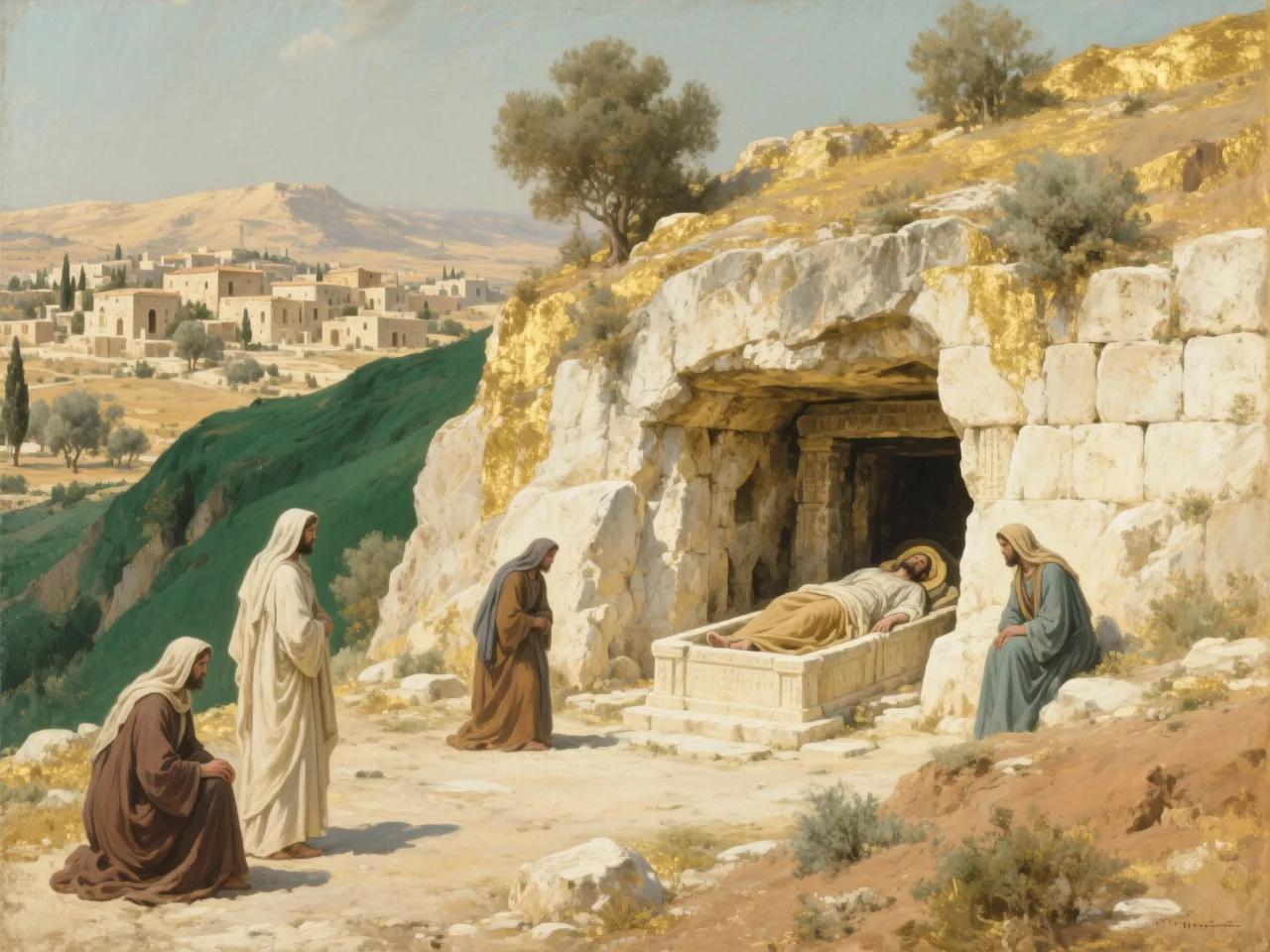
Day 21 · John 11:17–44 · Berean Standard Bible
John 11 explained: Jesus, Martha, and Lazarus
John 11:17–44 brings Jesus' claim to be resurrection and life into a grieving household. Martha speaks, Mary weeps, mourners ask questions, and Lazarus is called from the tomb. The story holds tears and hope together. It is not a formula that guarantees a particular outcome whenever a grieving person believes strongly enough.
The Scripture text and this public explanation are free. Guided audio and the complete guided steps require Plus or a Journey Pass covering this day.
Jesus does not shame Martha or Mary for grieving, questioning, or weeping. He meets each sister, speaks hope, and shares their tears. Then He calls Lazarus from the tomb, a sign that points to His claim to be the resurrection and the life. This story does not make grief a failure of faith; it places grief in the presence of Jesus and resurrection hope.
John 11:17–44
17 When Jesus arrived, He found that Lazarus had already spent four days in the tomb.
18 Now Bethany was near Jerusalem, a little less than two miles away,
19 and many of the Jews had come to Martha and Mary to console them in the loss of their brother.
20 So when Martha heard that Jesus was coming, she went out to meet Him, but Mary stayed at home.
21 Martha said to Jesus, “Lord, if You had been here, my brother would not have died.
22 But even now I know that God will give You whatever You ask of Him.”
23 “Your brother will rise again,” Jesus told her.
24 Martha replied, “I know that he will rise again in the resurrection at the last day.”
25 Jesus said to her, “I am the resurrection and the life. Whoever believes in Me will live, even though he dies.
26 And everyone who lives and believes in Me will never die. Do you believe this?”
27 “Yes, Lord,” she answered, “I believe that You are the Christ, the Son of God, who was to come into the world.”
28 After Martha had said this, she went back and called her sister Mary aside to tell her, “The Teacher is here and is asking for you.”
29 And when Mary heard this, she got up quickly and went to Him.
30 Now Jesus had not yet entered the village, but was still at the place where Martha had met Him.
31 When the Jews who were in the house consoling Mary saw how quickly she got up and went out, they followed her, supposing she was going to the tomb to mourn there.
32 When Mary came to Jesus and saw Him, she fell at His feet and said, “Lord, if You had been here, my brother would not have died.”
33 When Jesus saw her weeping, and the Jews who had come with her also weeping, He was deeply moved in spirit and troubled.
34 “Where have you put him?” He asked. “Come and see, Lord,” they answered.
35 Jesus wept.
36 Then the Jews said, “See how He loved him!”
37 But some of them asked, “Could not this man who opened the eyes of the blind also have kept Lazarus from dying?”
38 Jesus, once again deeply moved, came to the tomb. It was a cave with a stone laid across the entrance.
39 “Take away the stone,” Jesus said. “Lord, by now he stinks,” said Martha, the sister of the dead man. “It has already been four days.”
40 Jesus replied, “Did I not tell you that if you believed, you would see the glory of God?”
41 So they took away the stone. Then Jesus lifted His eyes upward and said, “Father, I thank You that You have heard Me.
42 I knew that You always hear Me, but I say this for the benefit of the people standing here, so they may believe that You sent Me.”
43 After Jesus had said this, He called out in a loud voice, “Lazarus, come out!”
44 The man who had been dead came out with his hands and feet bound in strips of linen, and his face wrapped in a cloth. “Unwrap him and let him go,” Jesus told them.
Study guide · not Scripture
Meaning & context
Literary context · John 11:17–44
A sign that does not skip mourning
John places the arrival after Lazarus has already been in the tomb four days. The scene develops through separate encounters with Martha and Mary before moving to the tomb. Read the chapter's surrounding narrative as well: the raising is not the end of the Gospel, and the responses after it move the story toward conflict over Jesus.
Sources: Berean Standard Bible: John 11
Scripture observation · John 11:20–27
1. Martha names both loss and hope
Martha says that her brother would not have died if Jesus had been there. She also expresses trust and speaks about resurrection at the last day. Jesus' reply directs attention to Himself, and she confesses Him as the Christ. Her grief is part of the conversation, not something the narrator requires her to conceal first.
Sources: Berean Standard Bible: John 11
Scripture observation · John 11:28–37
2. Jesus' tears belong in the account
Mary repeats the painful statement about Jesus' absence. Jesus sees her and the other mourners weeping, is deeply moved, and weeps. The observers respond in different ways: some notice His love, while others question why He did not prevent the death. Do not flatten these distinct voices into a single response.
Sources: Berean Standard Bible: John 11
Scripture observation · John 11:38–44
3. The command is addressed to Lazarus
At the tomb, Martha mentions the four days and the reality of death. Jesus prays in relation to the people listening, calls Lazarus out, and tells others to remove his grave clothes. The story describes a particular sign. It does not instruct readers to repeat the command over every death or assign blame when someone is not restored.
Sources: Berean Standard Bible: John 11
Pastoral limits · John 11:25–35
Grief is not a failed faith test
The passage presents resurrection hope without depicting Jesus as indifferent to sorrow. It cannot responsibly be used to promise that a loved one will recover on a reader's timetable. Nor does it establish why a particular person died. A short study guide cannot answer an individual's grief or replace the presence of trusted people and appropriate professional care.
Sources: Berean Standard Bible: John 11 · Bibleward editorial method and reading itinerary
Optional pastoral application · John 11:20–35
Two questions to carry with you
Which voice in the story helps you notice something you previously passed over? How do the tears affect your reading of the promise of life? It is all right to pause instead of writing an answer. If this reading touches recent loss, choose support and a pace that feels manageable; no public testimony is required.
Sources: Berean Standard Bible: John 11 · Bibleward editorial method and reading itinerary
Sources & review
Bibleward · AI-assisted study guide
Study guidance · not Scripture. AI-assisted writing and automated content review; no individual pastoral endorsement is claimed.
- Berean Standard Bible: John 11 — Exact BSB v5.9 local corpus and verified extraction; JHN.11. Public link is a reading aid, not the imported Scripture source.
- Bibleward editorial method and reading itinerary — Local publication manifest, canonical roadmaps, review labels, and free-through-Day15 access rules. Product facts and editorial choices, not independent theological authority.
- Berean Bible: Licensing and Terms — Public-domain dedication effective April 30, 2023; no third-party commentary, images or recordings reproduced.
Scripture is the Berean Standard Bible (BSB), dedicated to the public domain. Exact Scripture remains separate from these original AI-assisted Bibleward explanations. Linked commentary is cited and summarized, not reproduced; no permission to reuse third-party prose or artwork is implied.
Report a content concernReflection, prayer, and reading progress stay in this browser; they are not synced to an account.