Day 22 · Luke 24:13–35 · Berean Standard Bible
Luke 24:13–35 explained: the road to Emmaus
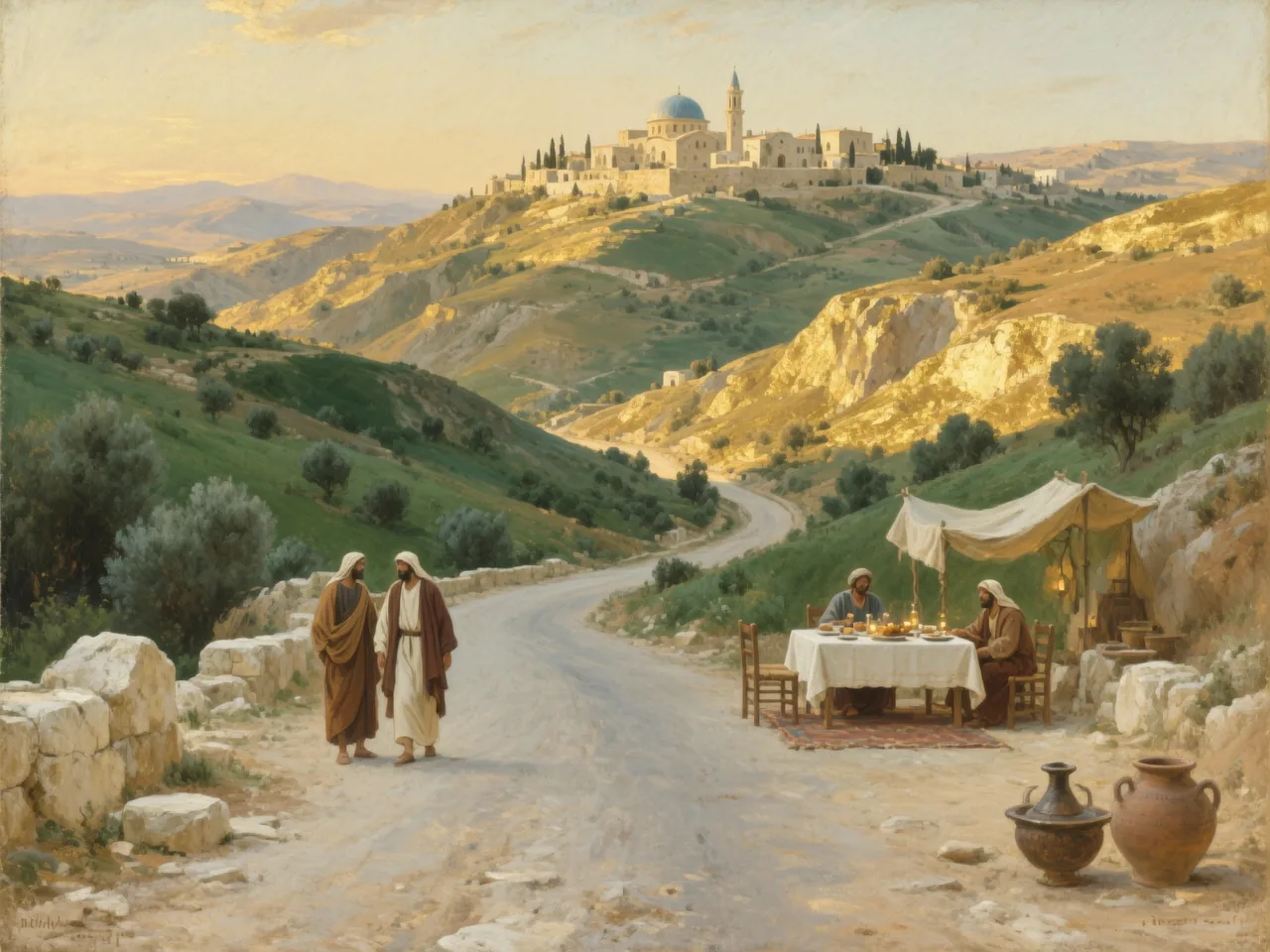
The road to Emmaus begins with two disciples who know reports about Jesus but have not recognized what has happened. Luke 24:13–35 moves from a conversation on the road to a meal and a return to Jerusalem. Understanding grows through this sequence, not through a single feeling or a secret message hidden in the scenery.
The Scripture text and this public explanation are free. Guided audio and the complete guided steps require Plus or a Journey Pass covering this day.
The two disciples know many facts about Jesus but cannot yet see how the cross and the resurrection belong together. Jesus does not mock their confusion. He walks with them, asks questions, and opens the Scriptures. Recognition comes at the table, and their disappointment turns into a return journey to the community. Christian understanding grows through Scripture, hospitality, shared worship, and witness—not through secret knowledge supplied by an AI.
Luke 24:13–35
13 That same day two of them were going to a village called Emmaus, about seven miles from Jerusalem.
14 They were talking with each other about everything that had happened.
15 And as they talked and deliberated, Jesus Himself came up and walked along with them.
16 But their eyes were kept from recognizing Him.
17 He asked them, “What are you discussing so intently as you walk along?” They stood still, with sadness on their faces.
18 One of them, named Cleopas, asked Him, “Are You the only visitor to Jerusalem who does not know the things that have happened there in recent days?”
19 “What things?” He asked.“The events involving Jesus of Nazareth,” they answered. “This man was a prophet, powerful in speech and action before God and all the people.
20 Our chief priests and rulers delivered Him up to the sentence of death, and they crucified Him.
21 But we were hoping He was the One who would redeem Israel. And besides all this, it is the third day since these things took place.
22 Furthermore, some of our women astounded us. They were at the tomb early this morning,
23 but they did not find His body. They came and told us they had seen a vision of angels, who said that Jesus was alive.
24 Then some of our companions went to the tomb and found it just as the women had described. But Him they did not see.”
25 Then Jesus said to them, “O foolish ones, and slow of heart to believe all that the prophets have spoken!
26 Was it not necessary for the Christ to suffer these things and then to enter His glory?”
27 And beginning with Moses and all the Prophets, He explained to them what was written in all the Scriptures about Himself.
28 As they approached the village where they were headed, He seemed to be going farther.
29 But they pleaded with Him, “Stay with us, for it is nearly evening and the day is almost over.” So He went in to stay with them.
30 While He was reclining at the table with them, He took bread, spoke a blessing and broke it, and gave it to them.
31 Then their eyes were opened and they recognized Jesus — and He disappeared from their sight.
32 They asked each other, “Were not our hearts burning within us as He spoke with us on the road and opened the Scriptures to us?”
33 And they got up that very hour and returned to Jerusalem. There they found the Eleven and those with them, gathered together
34 and saying, “The Lord has indeed risen and has appeared to Simon!”
35 Then the two told what had happened on the road, and how they had recognized Jesus in the breaking of the bread.
Study guide · not Scripture
Meaning & context
Literary context · Luke 24:13–35
Continue the resurrection morning story
The opening words connect this journey to the day of the empty-tomb reports. Marilyn Salmon's Working Preacher commentary emphasizes that connection: the road scene continues rather than replaces the earlier account. One traveler is named Cleopas; the other is not named. This guide leaves that person unidentified instead of filling the gap with a confident biography.
Sources: Berean Standard Bible: Luke 24 · Marilyn Salmon: Commentary on Luke 24:13–35
Scripture observation · Luke 24:17–24
1. The travelers explain their disappointed hope
Jesus asks what they are discussing, and the travelers describe His ministry, death, and the reports from the tomb. They had hoped He would redeem Israel. Their account is not empty of facts, but it does not yet lead them to recognize their companion. Notice the difference between possessing information and knowing how to understand it.
Sources: Berean Standard Bible: Luke 24
Scripture observation · Luke 24:25–27
2. Jesus opens Scripture around suffering and glory
Jesus challenges their understanding and interprets the Scriptures concerning Himself. Luke gives the broad scope, beginning with Moses and the Prophets, but not a transcript of every passage He discussed. A modern list of predicted verses can be a study proposal; it should not be presented as Luke's unrecorded lecture notes.
Sources: Berean Standard Bible: Luke 24
Scripture observation · Luke 24:28–35
3. Recognition leads back to the community
The travelers invite Jesus to stay, recognize Him at the breaking of bread, and return to Jerusalem to tell what happened. They also look back on the conversation on the road. The story does not finish with a private experience preserved only for them: it ends in shared testimony among other disciples.
Sources: Berean Standard Bible: Luke 24
Interpretive limits · Luke 24:30–35
Meaning is not measured by a sensation
Christians have read the meal in relation to Communion, but the account is not a complete explanation of sacramental practice. Likewise, the travelers' description of their hearts does not establish a required physical sensation for genuine faith. Read the story's recognition, Scripture, and sharing together; no particular mood certifies that an interpretation is correct.
Sources: Berean Standard Bible: Luke 24 · Marilyn Salmon: Commentary on Luke 24:13–35 · Bibleward editorial method and reading itinerary
Optional pastoral application · Luke 24:17–35
Two questions to carry with you
Where does the travelers' understanding change, and what remains unexplained? Try retelling the journey in three moments: road, table, return. You may bring one unresolved question into conversation with someone you trust. Hospitality can take safe, ordinary forms; the narrative is not an instruction to abandon personal boundaries with strangers.
Sources: Berean Standard Bible: Luke 24 · Bibleward editorial method and reading itinerary
Sources & review
Bibleward · AI-assisted study guide
Study guidance · not Scripture. AI-assisted writing and automated content review; no individual pastoral endorsement is claimed.
- Berean Standard Bible: Luke 24 — Exact BSB v5.9 local corpus and verified extraction; LUK.24. Public link is a reading aid, not the imported Scripture source.
- Marilyn Salmon: Commentary on Luke 24:13–35 — Marilyn Salmon, Working Preacher, April 7, 2013: opening connection to the empty-tomb account and the unnamed traveler.
- Bibleward editorial method and reading itinerary — Local publication manifest, canonical roadmaps, review labels, and free-through-Day15 access rules. Product facts and editorial choices, not independent theological authority.
- Berean Bible: Licensing and Terms — Public-domain dedication effective April 30, 2023; no third-party commentary, images or recordings reproduced.
Scripture is the Berean Standard Bible (BSB), dedicated to the public domain. Exact Scripture remains separate from these original AI-assisted Bibleward explanations. Linked commentary is cited and summarized, not reproduced; no permission to reuse third-party prose or artwork is implied.
Report a content concernReflection, prayer, and reading progress stay in this browser; they are not synced to an account.