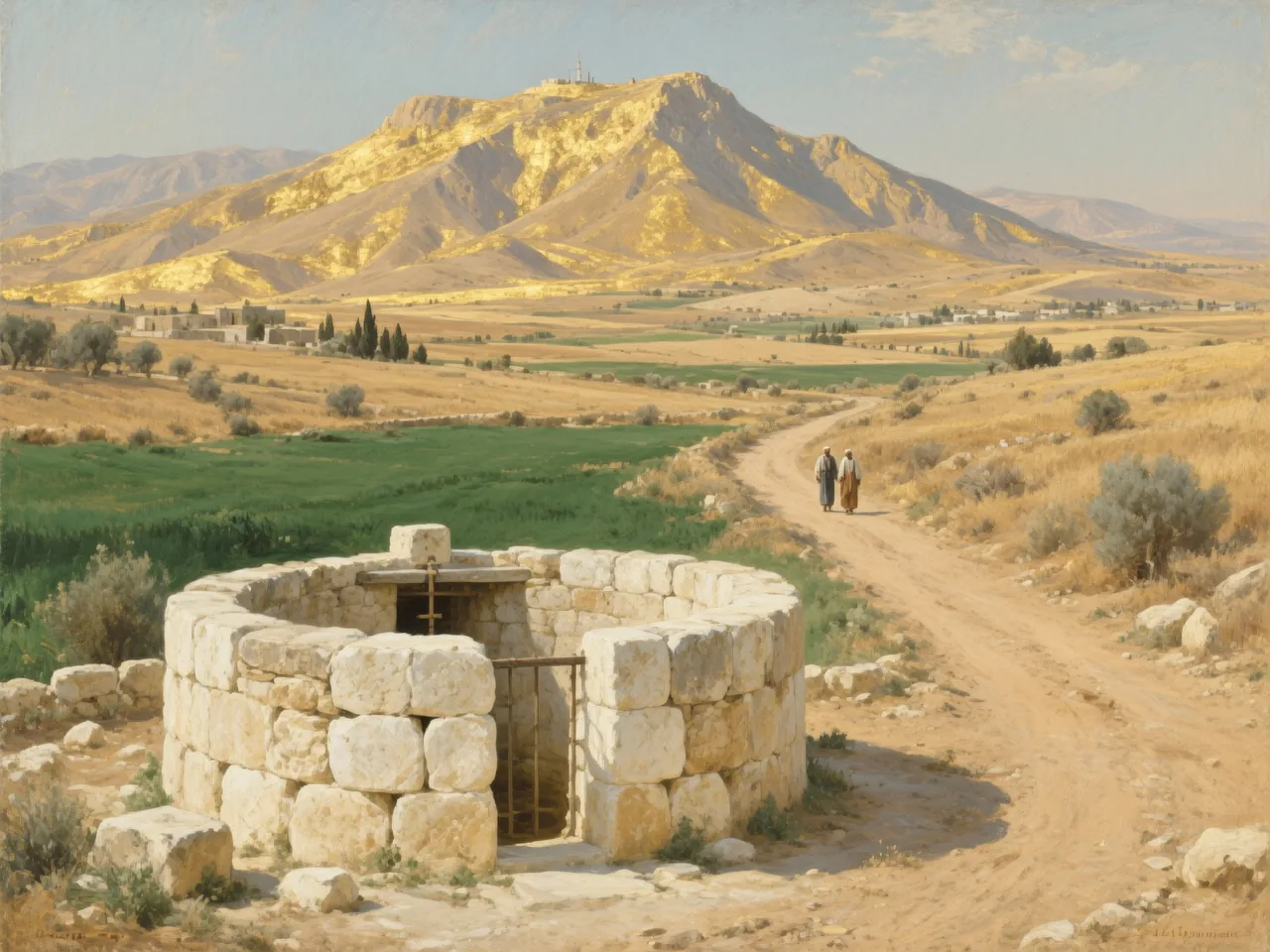
Day 17 · John 4:4–26 · Berean Standard Bible
John 4 explained: Jesus and the woman at the well
The woman at the well meets Jesus in an ordinary conversation about water that opens into questions about eternal life and worship. John 4:4–26 gives her an active speaking role: she questions, responds, and names her hopes. Read her words as carefully as Jesus' replies instead of reducing her to a cautionary example.
The Scripture text and this public explanation are free. Guided audio and the complete guided steps require Plus or a Journey Pass covering this day.
Jesus is tired, thirsty, and willing to receive water from someone His society taught Him to avoid. He offers living water, knows the woman's complicated history, and takes her theological questions seriously. The conversation moves from a disputed location toward worship in spirit and truth, and Jesus identifies Himself as Messiah. Being fully known does not make her disposable; the larger story will show her becoming a witness.
John 4:4–26
4 Now He had to pass through Samaria.
5 So He came to a town of Samaria called Sychar, near the plot of ground that Jacob had given to his son Joseph.
6 Since Jacob’s well was there, Jesus, weary from His journey, sat down by the well. It was about the sixth hour.
7 When a Samaritan woman came to draw water, Jesus said to her, “Give Me a drink.”
8 (His disciples had gone into the town to buy food.)
9 “You are a Jew,” said the woman. “How can You ask for a drink from me, a Samaritan woman?” (For Jews do not associate with Samaritans.)
10 Jesus answered, “If you knew the gift of God and who is asking you for a drink, you would have asked Him, and He would have given you living water.”
11 “Sir,” the woman replied, “You have nothing to draw with and the well is deep. Where then will You get this living water?
12 Are You greater than our father Jacob, who gave us this well and drank from it himself, as did his sons and his livestock?”
13 Jesus said to her, “Everyone who drinks this water will be thirsty again.
14 But whoever drinks the water I give him will never thirst. Indeed, the water I give him will become in him a fount of water springing up to eternal life.”
15 The woman said to Him, “Sir, give me this water so that I will not get thirsty and have to keep coming here to draw water.”
16 Jesus told her, “Go, call your husband and come back.”
17 “I have no husband,” the woman replied. Jesus said to her, “You are correct to say that you have no husband.
18 In fact, you have had five husbands, and the man you now have is not your husband. You have spoken truthfully.”
19 “Sir,” the woman said, “I see that You are a prophet.
20 Our fathers worshiped on this mountain, but you Jews say that the place where one must worship is in Jerusalem.”
21 “Believe Me, woman,” Jesus replied, “a time is coming when you will worship the Father neither on this mountain nor in Jerusalem.
22 You worship what you do not know; we worship what we do know, for salvation is from the Jews.
23 But a time is coming and has now come when the true worshipers will worship the Father in spirit and in truth, for the Father is seeking such as these to worship Him.
24 God is Spirit, and His worshipers must worship Him in spirit and in truth.”
25 The woman said, “I know that Messiah” (called Christ) “is coming. When He comes, He will explain everything to us.”
26 Jesus answered, “I who speak to you am He.”
Study guide · not Scripture
Meaning & context
Literary context · John 4:4–26
A well, a boundary, and a misunderstanding
John places the encounter in Samaria, beside Jacob's well, while the disciples are away buying food. The woman herself names the Jewish–Samaritan boundary. The USCCB notes describe the double sense of living water: ordinary flowing water and the life Jesus offers. The misunderstanding develops the conversation; it is not evidence that she is unintelligent.
Sources: Berean Standard Bible: John 4 · USCCB: John 4 commentary
Scripture observation · John 4:6–12
1. Jesus begins by asking for a drink
The scene includes Jesus' weariness and a request for water. The woman notices who is speaking to whom, then asks how someone without drawing equipment can offer water from a deep well. These concrete details matter: the conversation starts with bodies, a place, and a real need before it develops its larger claims.
Sources: Berean Standard Bible: John 4
Scripture observation · John 4:13–19
2. Living water leads toward eternal life
Jesus contrasts water that leaves a person thirsty again with the gift He describes as a spring within. The conversation then touches the woman's household history. The text names five husbands but does not explain why those marriages ended. It does not supply a biography from which readers can confidently infer her motives or blame.
Sources: Berean Standard Bible: John 4
Scripture observation · John 4:20–26
3. Worship and Jesus' identity belong together
The woman raises a dispute about where to worship. Jesus speaks about worshiping the Father in spirit and truth, and the exchange ends with her expectation of Messiah and His reply. Do not stop at a general lesson about being sincere: the passage asks who Jesus is and what He reveals about the Father.
Sources: Berean Standard Bible: John 4
Interpretive limits · John 4:16–26
Do not invent the woman's reputation
A common retelling imagines a community that excludes her because of sexual misconduct. That explanation is not stated in this selected passage. Likewise, the worship discussion should not become contempt for Jewish or Samaritan people, or an unsupported declaration that Christian communal worship no longer matters. Keep the narrative's claims distinct from later applications.
Sources: Berean Standard Bible: John 4 · USCCB: John 4 commentary · Bibleward editorial method and reading itinerary
Optional pastoral application · John 4:7–26
Two questions to carry with you
What does the woman actually ask, and what have you previously heard someone assume about her? Try listing those separately. You might then consider one way to listen more carefully to a person whose experience differs from yours. No one owes a group their relationship history in order to participate in this reading.
Sources: Berean Standard Bible: John 4 · Bibleward editorial method and reading itinerary
Sources & review
Bibleward · AI-assisted study guide
Study guidance · not Scripture. AI-assisted writing and automated content review; no individual pastoral endorsement is claimed.
- Berean Standard Bible: John 4 — Exact BSB v5.9 local corpus and verified extraction; JHN.4. Public link is a reading aid, not the imported Scripture source.
- USCCB: John 4 commentary — John 4:4–26; notes on 4:10 and 4:20, limited to the water imagery and worship locations.
- Bibleward editorial method and reading itinerary — Local publication manifest, canonical roadmaps, review labels, and free-through-Day15 access rules. Product facts and editorial choices, not independent theological authority.
- Berean Bible: Licensing and Terms — Public-domain dedication effective April 30, 2023; no third-party commentary, images or recordings reproduced.
Scripture is the Berean Standard Bible (BSB), dedicated to the public domain. Exact Scripture remains separate from these original AI-assisted Bibleward explanations. Linked commentary is cited and summarized, not reproduced; no permission to reuse third-party prose or artwork is implied.
Report a content concernReflection, prayer, and reading progress stay in this browser; they are not synced to an account.