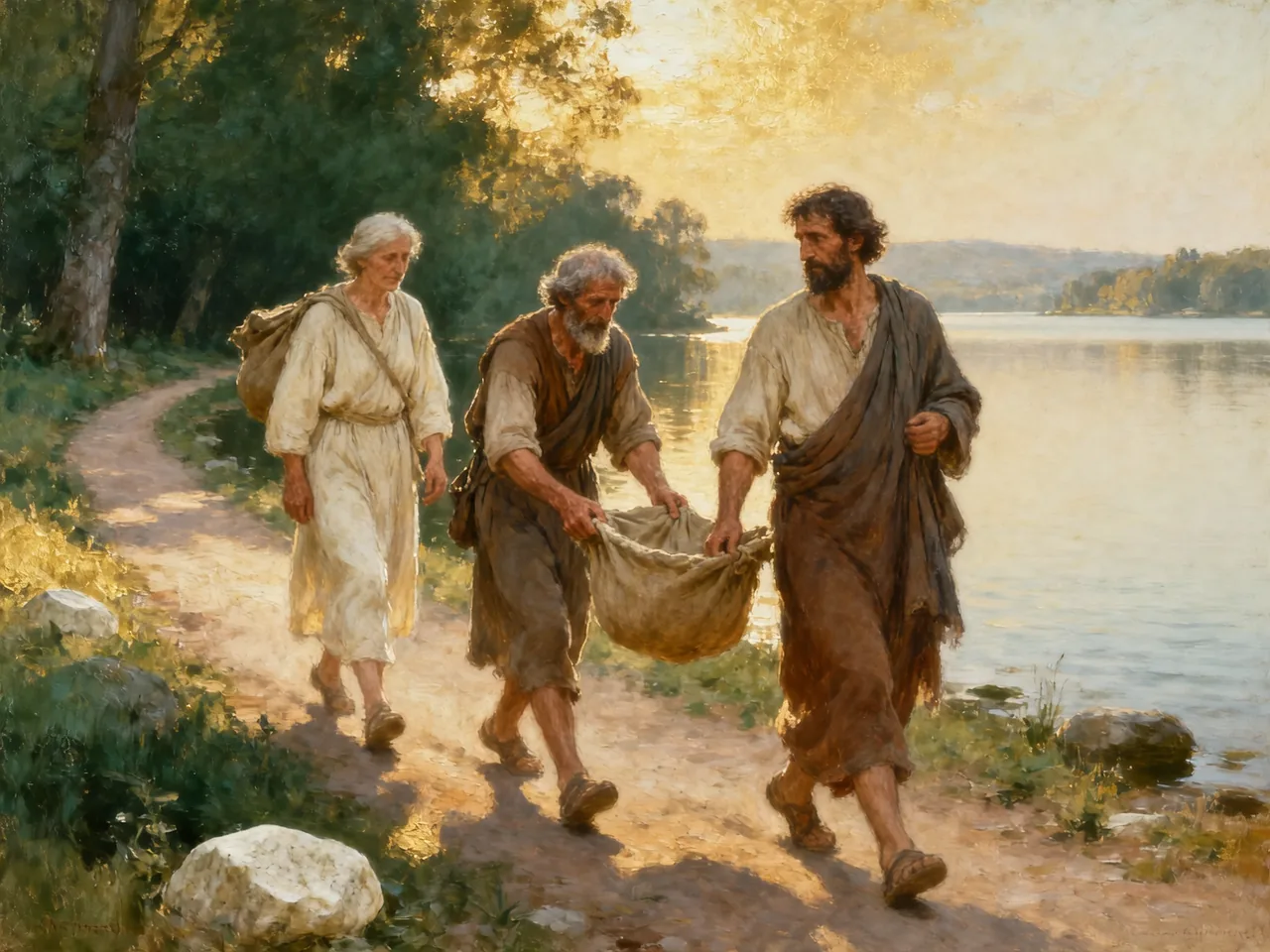
Day 45 · Luke 10:25–37 · Berean Standard Bible
The Good Samaritan explained: Luke 10:25–37
The Good Samaritan answers a question about the limits of loving a neighbor by showing someone acting as a neighbor. In Luke 10:25–37, Jesus tells of an injured traveler and an unexpected helper whose mercy becomes practical care. The ending turns attention from defining who qualifies for love to how the questioner will respond.
The Scripture text and this public explanation are free. Guided audio and the complete guided steps require Plus or a Journey Pass covering this day.
Jesus does not answer by drawing a smaller circle around the people we must love. He tells a story in which mercy crosses a hostile boundary and becomes practical: approaching, treating wounds, transporting, paying, and arranging follow-up care. The parable does not give us the priest's or Levite's motives, so readers should not invent excuses or use them to attack Judaism. Nor does 'go and do likewise' require reckless solo intervention; wise mercy can include emergency services, safeguarding, teamwork, money, advocacy, and sustained care.
Luke 10:25–37
25 One day an expert in the law stood up to test Him. “Teacher,” he asked, “what must I do to inherit eternal life?”
26 “What is written in the Law?” Jesus replied. “How do you read it?”
27 He answered, “‘Love the Lord your God with all your heart and with all your soul and with all your strength and with all your mind’ and ‘Love your neighbor as yourself.’”
28 “You have answered correctly,” Jesus said. “Do this and you will live.”
29 But wanting to justify himself, he asked Jesus, “And who is my neighbor?”
30 Jesus took up this question and said, “A man was going down from Jerusalem to Jericho when he fell into the hands of robbers. They stripped him, beat him, and went away, leaving him half dead.
31 Now by chance a priest was going down the same road, but when he saw him, he passed by on the other side.
32 So too, when a Levite came to that spot and saw him, he passed by on the other side.
33 But a Samaritan on a journey came upon him, and when he saw him, he had compassion.
34 He went to him and bandaged his wounds, pouring on oil and wine. Then he put him on his own animal, brought him to an inn, and took care of him.
35 The next day he took out two denarii and gave them to the innkeeper. ‘Take care of him,’ he said, ‘and on my return I will repay you for any additional expense.’
36 Which of these three do you think was a neighbor to the man who fell into the hands of robbers?”
37 “The one who showed him mercy,” replied the expert in the law. Then Jesus told him, “Go and do likewise.”
Study guide · not Scripture
Meaning & context
Literary context · Luke 10:25–29
Why does Jesus tell the Good Samaritan story?
The conversation begins before the injured traveler appears. An expert in the law tests Jesus with a question about inheriting eternal life. Jesus asks what the Law says and how the expert reads it. The expert answers with love for God and neighbor, and Jesus affirms the answer. The story is therefore not a rejection of Scripture or a replacement for reading it.
In her Working Preacher commentary, Jeannine K. Brown identifies the paired commands with Deuteronomy 6:5 and Leviticus 19:18. Luke then says the expert wants to justify himself and asks who his neighbor is. That follow-up question frames the parable. Removing the dialogue would leave a general lesson about kindness but miss the question Jesus is addressing.
Sources: Berean Standard Bible: Luke 10 · Jeannine K. Brown: Commentary on Luke 10:25–37
Scripture observation · Luke 10:30
Who is the person lying beside the road?
Jesus describes a man traveling from Jerusalem to Jericho who is robbed, stripped, beaten, and left half dead. Luke does not give him a name or explicitly identify his ethnicity, religious practice, or moral character. The need is made visible without supplying a biography that could qualify him for help.
Keeping the man unnamed matters. A reader does not first learn whether he would make a grateful friend or repay the expense. We should also distinguish the parable from a documented rescue report: it is a story Jesus tells within a conversation. Details beyond the account should not be presented as though an eyewitness supplied them.
Sources: Berean Standard Bible: Luke 10
Scripture observation and interpretive limit · Luke 10:27–32
Why did the priest and Levite pass by?
The passage says both see the man and pass on the other side. It does not state their reasons. Fear, ritual concerns, haste, or a suspicion of danger may appear in retellings, but Luke does not give access to their thoughts here. A possible explanation must not become a fact that the reader is expected to find in the verse.
Their failure also does not justify condemning Jewish people or Judaism as uncaring. The love commands have just been affirmed within a conversation about the Law. The contrast concerns these figures’ responses to the man, not an ethnic ranking. The story’s force is weakened, not strengthened, when it becomes a stereotype about an entire religious community.
Sources: Berean Standard Bible: Luke 10
Attributed historical context · Luke 10:33; Luke 10:36–37
Why is a Samaritan the unexpected helper?
The Samaritan sees the man and is moved by compassion. Brown explains the surprise against the background of conflict between Jewish and Samaritan communities: the helper would not fit the audience’s easiest expectation of who would do right. This historical context helps explain the contrast; it does not mean every individual in either community had identical feelings or behavior.
The text does not call the Samaritan a Christian, and it does not say he changes communities before helping. His action is the focus. The expert’s answer at the end identifies the neighbor by mercy. That choice directs attention back to what has happened beside the road rather than asking the reader to admire a label.
Sources: Berean Standard Bible: Luke 10 · Jeannine K. Brown: Commentary on Luke 10:25–37
Scripture observation · Luke 10:33–35
What does the Samaritan actually do?
Follow the verbs in verses 33–35. He comes near, attends to the wounds, provides transport, brings the man to an inn, and cares for him. The next day he gives money to the innkeeper and undertakes to cover further expense when he returns. Compassion is not left as a feeling; the account traces a response over time.
The details include both personal involvement and arranging help through someone else. The Samaritan does not merely express concern, but neither does the story say he must become the sole provider forever. These are observations about the sequence, not a fixed budget or a universal care plan. The oil and wine belong to the story’s actions, not to medical instructions for readers today.
Sources: Berean Standard Bible: Luke 10
Scripture observation and interpretation · Luke 10:29; Luke 10:36–37
How does Jesus change the neighbor question?
The initial question asks which person counts as a neighbor. Jesus’ closing question asks which of the three acted as a neighbor to the injured man. The law expert recognizes the one who showed mercy, and Jesus directs him toward corresponding action. Comparing verses 29 and 36 is the simplest way to see the movement for yourself.
That movement makes the parable more demanding than a slogan about being nice. The reader must consider a response to someone’s need, including when the likely helper is not the expected one. The point is not that differences are imaginary, but that identifying a boundary is no substitute for the mercy the conversation calls for.
Sources: Berean Standard Bible: Luke 10
Doctrinal framing and pastoral boundary · Luke 10:25–37
What should we not make this passage prove?
Keep the opening question about eternal life and Jesus’ call to action together. The passage does not supply a numerical quota of good deeds or a way for Bibleward to certify someone’s salvation. Christian accounts of grace and obedience involve more Scripture than this short dialogue. Avoid turning the story either into a salvation scorecard or into an excuse to make practical mercy unimportant.
Helping does not require entering an unsafe situation, accepting abuse, or acting beyond your competence. A present-day response may involve trained help or reliable local services. That is a pastoral application, not a detail Luke narrates. Neither the parable nor a reading app replaces emergency assistance when a person is in danger.
Sources: Berean Standard Bible: Luke 10 · Bibleward editorial method
Optional pastoral application · Luke 10:30–37
How can I respond without making this abstract?
Ask two questions: Where do I use a category to avoid noticing a person’s need? What is one safe, realistic form of help I could offer or help arrange? A practical example might be asking a neighbor whether a meal or an errand would be useful, and respecting their answer. It is an illustration, not an obligation to solve every need you encounter.
Then return to the text. Compare the three people’s actions rather than inventing their motives, and notice the care after the first moment of rescue. You can carry that observation into the love-in-practice readings linked here. There is no requirement to record another person’s story, donate through Bibleward, or disclose a private experience to complete the reading.
Sources: Berean Standard Bible: Luke 10 · Bibleward editorial method
Sources & review
Bibleward · AI-assisted study guide
Study guidance · not Scripture. AI-assisted writing and automated content review; no individual pastoral endorsement is claimed.
- Berean Standard Bible: Luke 10 — Local BSB v5.9: Luke 10:25–37; unnamed traveler, unstated motives, care sequence, and comparison of verses 29 and 36.
- Jeannine K. Brown: Commentary on Luke 10:25–37 — July 10, 2022: Torah commands, the unexpected Samaritan amid communal conflict, and the closing neighbor question. The traveler's ethnicity is not stated in Luke and is not imported from this commentary.
- Bibleward editorial method — First-party editorial boundaries and optional reading practices; not external theological authority or human pastoral endorsement.
- Berean Bible: Terms and Conditions — Public-domain dedication effective April 30, 2023. Does not license third-party commentary, recordings, or illustrations.
Scripture is the Berean Standard Bible (BSB), dedicated to the public domain. Exact Scripture remains separate from these original AI-assisted Bibleward explanations. Linked commentary is cited and summarized, not reproduced; no permission to reuse third-party prose or artwork is implied.
Report a content concernReflection, prayer, and reading progress stay in this browser; they are not synced to an account.