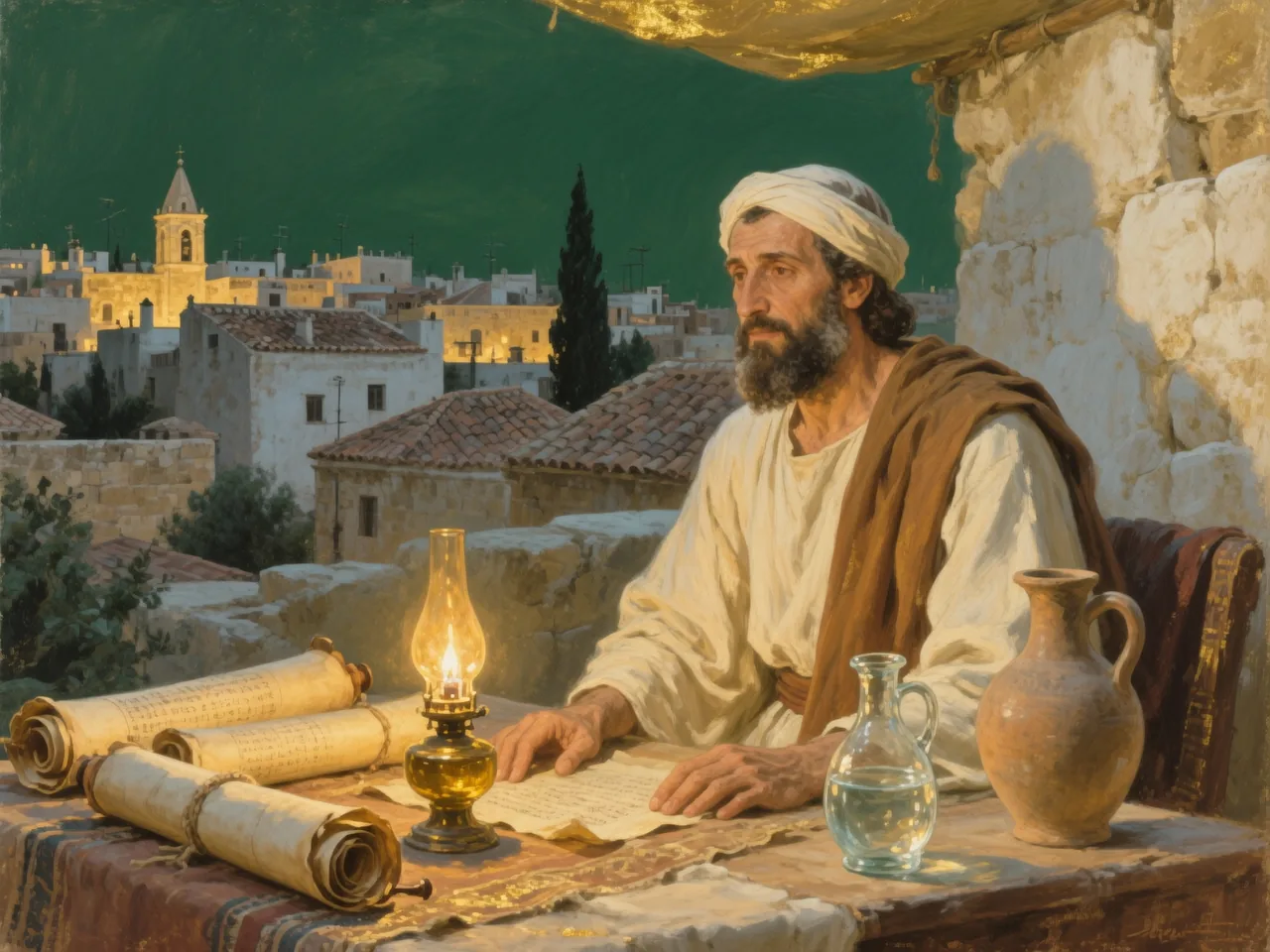
Day 16 · John 3:1–21 · Berean Standard Bible
John 3:16 in context: Nicodemus and new birth
John 3:16 belongs to a conversation about receiving life from God, not a stand-alone slogan. Nicodemus begins with questions about Jesus' signs. The passage moves through new birth, the Son being lifted up, and a contrast between light and darkness. Read the whole movement before isolating its best-known verse.
The Scripture text and this public explanation are free. Guided audio and the complete guided steps require Plus or a Journey Pass covering this day.
Nicodemus has religious knowledge and status, yet Jesus tells him that life in God's kingdom begins with a birth he cannot produce for himself. The Spirit's work is free and mysterious. Jesus then points toward His being lifted up and explains God's purpose as love and rescue rather than a mission of condemnation. Coming into the light means bringing life honestly before God, not pretending to be flawless.
John 3:1–21
1 Now there was a man of the Pharisees named Nicodemus, a leader of the Jews.
2 He came to Jesus at night and said, “Rabbi, we know that You are a teacher who has come from God. For no one could perform the signs You are doing if God were not with him.”
3 Jesus replied, “Truly, truly, I tell you, no one can see the kingdom of God unless he is born again.”
4 “How can a man be born when he is old?” Nicodemus asked. “Can he enter his mother’s womb a second time to be born?”
5 Jesus answered, “Truly, truly, I tell you, no one can enter the kingdom of God unless he is born of water and the Spirit.
6 Flesh is born of flesh, but spirit is born of the Spirit.
7 Do not be amazed that I said, ‘You must be born again.’
8 The wind blows where it wishes. You hear its sound, but you do not know where it comes from or where it is going. So it is with everyone born of the Spirit.”
9 “How can this be?” Nicodemus asked.
10 “You are Israel’s teacher,” said Jesus, “and you do not understand these things?
11 Truly, truly, I tell you, we speak of what we know, and we testify to what we have seen, and yet you people do not accept our testimony.
12 If I have told you about earthly things and you do not believe, how will you believe if I tell you about heavenly things?
13 No one has ascended into heaven except the One who descended from heaven— the Son of Man.
14 Just as Moses lifted up the snake in the wilderness, so the Son of Man must be lifted up,
15 that everyone who believes in Him may have eternal life.
16 For God so loved the world that He gave His one and only Son, that everyone who believes in Him shall not perish but have eternal life.
17 For God did not send His Son into the world to condemn the world, but to save the world through Him.
18 Whoever believes in Him is not condemned, but whoever does not believe has already been condemned, because he has not believed in the name of God’s one and only Son.
19 And this is the verdict: The Light has come into the world, but men loved the darkness rather than the Light because their deeds were evil.
20 Everyone who does evil hates the Light, and does not come into the Light for fear that his deeds will be exposed.
21 But whoever practices the truth comes into the Light, so that it may be seen clearly that what he has done has been accomplished in God.”
Study guide · not Scripture
Meaning & context
Literary context · John 3:1–21
A conversation that moves beyond signs
The previous chapter ends with people responding to Jesus' signs. Nicodemus then visits at night and recognizes a teacher from God, but Jesus directs him toward a new beginning he cannot produce for himself. The USCCB notes explain that the word behind new birth can mean both again and from above; Nicodemus hears it as another physical birth.
Sources: Berean Standard Bible: John 3 · USCCB: John 3 commentary
Scripture observation · John 3:1–10
1. Nicodemus is allowed to ask questions
Nicodemus asks how an older person could be born again and then asks how these things can happen. Jesus' answer distinguishes physical birth from the Spirit's work. The conversation is not about becoming younger or gaining a second biological beginning. Follow the repeated questions rather than treating uncertainty as an interruption to the story.
Sources: Berean Standard Bible: John 3
Scripture observation · John 3:14–18
2. God's gift comes before the response
Verses 14–18 connect the Son being lifted up with God's love and the invitation to believe. Verse 17 describes the Son's saving purpose; verse 18 also speaks seriously about judgment. Keeping both in view avoids making the passage either a threat detached from love or a reassurance with no call to respond.
Sources: Berean Standard Bible: John 3
Scripture observation · John 3:19–21
3. The ending brings belief into the light
The final verses discuss deeds, exposure, and practicing truth. John does not end at a private opinion about Jesus. The imagery asks how people respond to the light, while verse 21 locates what is good in God's work. This is an observation about the passage, not a tool for diagnosing someone else's faith.
Sources: Berean Standard Bible: John 3
Interpretive limits · John 3:3–8
New birth is not a website milestone
The phrase about water and the Spirit has a history of differing interpretations. This introductory guide does not settle baptismal theology or prescribe a conversion timetable. Start with what the passage explicitly joins: new life, the Spirit, and trust in the Son. Signing up, buying access, or finishing this reading cannot certify that someone has been born again.
Sources: Berean Standard Bible: John 3 · USCCB: John 3 commentary · Bibleward editorial method and reading itinerary
Optional pastoral application · John 3:16–21
Two questions to carry with you
Which question from Nicodemus would you like to ask? Which detail changes when you read verse 16 with verses 17–21? You can keep those questions in a private notebook or discuss them with a trusted teacher. These are optional study prompts, not a demand to disclose your spiritual history or prove a particular emotional experience.
Sources: Berean Standard Bible: John 3 · Bibleward editorial method and reading itinerary
Sources & review
Bibleward · AI-assisted study guide
Study guidance · not Scripture. AI-assisted writing and automated content review; no individual pastoral endorsement is claimed.
- Berean Standard Bible: John 3 — Exact BSB v5.9 local corpus and verified extraction; JHN.3. Public link is a reading aid, not the imported Scripture source.
- USCCB: John 3 commentary — John 3:1–21 and notes on 3:3 and 3:8; the ambiguity of new birth and wind/Spirit, not a claim that this source speaks for every tradition.
- Bibleward editorial method and reading itinerary — Local publication manifest, canonical roadmaps, review labels, and free-through-Day15 access rules. Product facts and editorial choices, not independent theological authority.
- Berean Bible: Licensing and Terms — Public-domain dedication effective April 30, 2023; no third-party commentary, images or recordings reproduced.
Scripture is the Berean Standard Bible (BSB), dedicated to the public domain. Exact Scripture remains separate from these original AI-assisted Bibleward explanations. Linked commentary is cited and summarized, not reproduced; no permission to reuse third-party prose or artwork is implied.
Report a content concernReflection, prayer, and reading progress stay in this browser; they are not synced to an account.