Day 24 · Acts 2:1–21 · Berean Standard Bible
Acts 2 explained: what happens at Pentecost?
Acts 2:1–21 describes the Holy Spirit coming upon Jesus' followers and a diverse crowd hearing God's wonders in their own languages. Peter interprets the event through Joel. Pentecost is therefore both an event and an explanation: read what people hear, what they ask, and how Peter answers, not only the wind and fire imagery.
The Scripture text and this public explanation are free. Guided audio and the complete guided steps require Plus or a Journey Pass covering this day.
Pentecost does not erase language or culture. The Spirit enables people from many places to hear God's mighty works, and Peter explains the event through Scripture rather than private excitement alone. Christians share the confession that the Holy Spirit gives life and empowers witness, while traditions differ about whether tongues or a later crisis experience should be expected in the same way for every believer.
Acts 2:1–21
1 When the day of Pentecost came, they were all together in one place.
2 Suddenly a sound like a mighty rushing wind came from heaven and filled the whole house where they were sitting.
3 They saw tongues like flames of fire that separated and came to rest on each of them.
4 And they were all filled with the Holy Spirit and began to speak in other tongues as the Spirit enabled them.
5 Now there were dwelling in Jerusalem God-fearing Jews from every nation under heaven.
6 And when this sound rang out, a crowd came together in bewilderment, because each one heard them speaking his own language.
7 Astounded and amazed, they asked, “Are not all these who are speaking Galileans?
8 How is it then that each of us hears them in his own native language?
9 Parthians, Medes, and Elamites; residents of Mesopotamia, Judea and Cappadocia, Pontus and Asia,
10 Phrygia and Pamphylia, Egypt and the parts of Libya near Cyrene; visitors from Rome,
11 both Jews and converts to Judaism; Cretans and Arabs— we hear them declaring the wonders of God in our own tongues!”
12 Astounded and perplexed, they asked one another, “What does this mean?”
13 But others mocked them and said, “They are drunk on new wine!”
14 Then Peter stood up with the Eleven, lifted up his voice, and addressed the crowd: “Men of Judea and all who dwell in Jerusalem, let this be known to you, and listen carefully to my words.
15 These men are not drunk, as you suppose. It is only the third hour of the day!
16 No, this is what was spoken by the prophet Joel:
17 ‘In the last days, God says, I will pour out My Spirit on all people. Your sons and daughters will prophesy, your young men will see visions, your old men will dream dreams.
18 Even on My menservants and maidservants I will pour out My Spirit in those days, and they will prophesy.
19 I will show wonders in the heavens above and signs on the earth below, blood and fire and billows of smoke.
20 The sun will be turned to darkness, and the moon to blood, before the coming of the great and glorious Day of the Lord.
21 And everyone who calls on the name of the Lord will be saved.’
Study guide · not Scripture
Meaning & context
Literary context · Acts 2:1–21
The promised gift becomes a public event
Day 23 ends with the promise of the Spirit; this chapter narrates its arrival in Jerusalem. The USCCB commentary notes that Acts 2 includes the event, Peter's wider speech, and the crowd's response. Today's selection ends at verse 21, before the whole speech is finished. Its ending is a stopping place for study, not the conclusion of Pentecost.
Sources: Berean Standard Bible: Acts 2 · USCCB: Acts 2 commentary
Scripture observation · Acts 2:1–4
1. The language describes what witnesses perceive
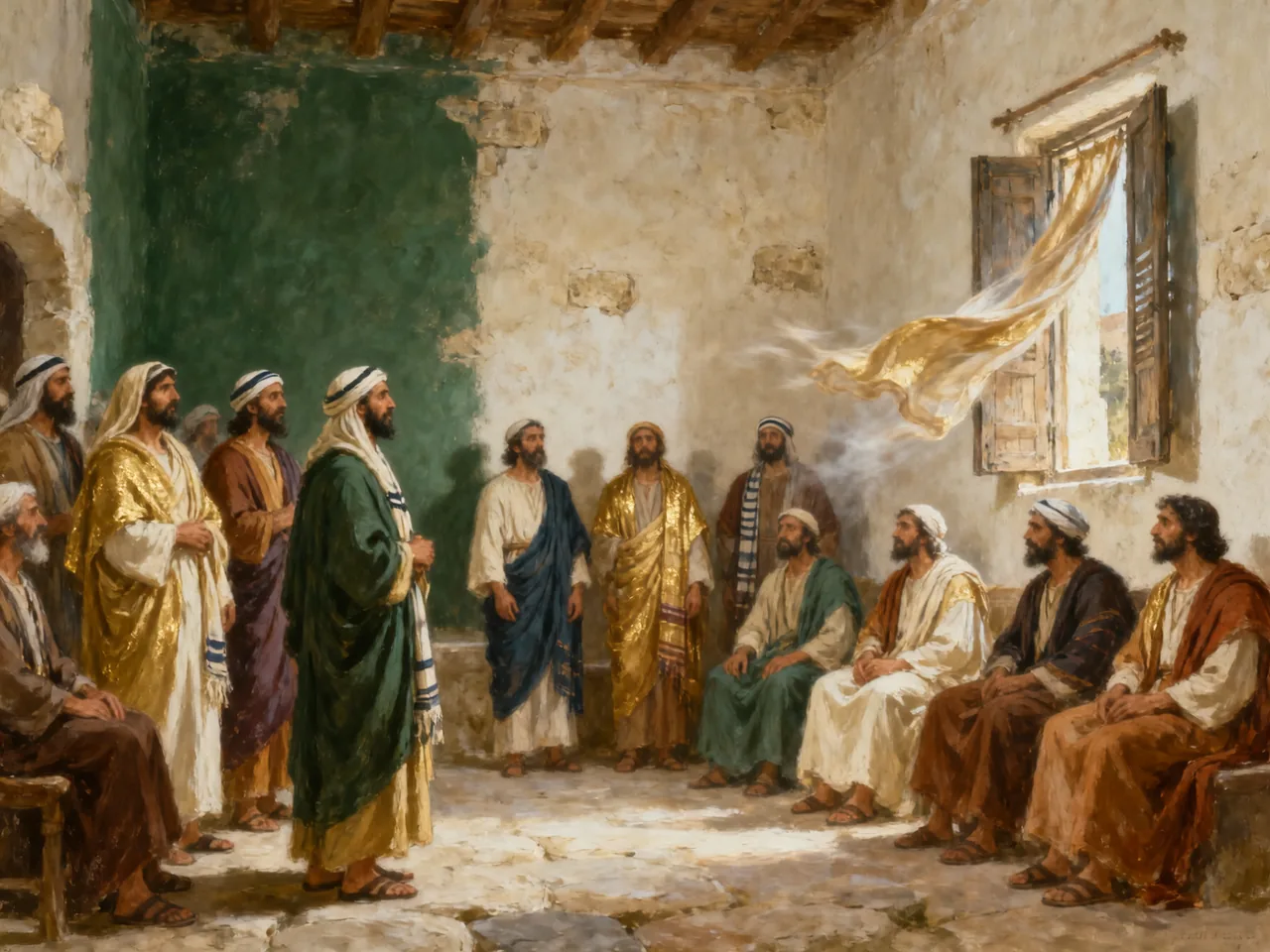
The account speaks of a sound like rushing wind and tongues like fire. Keep those comparisons intact when describing the scene. The central action is the Spirit filling the people and enabling speech. An illustration of flames may help a reader imagine the account, but it is not additional evidence about what happened.
Sources: Berean Standard Bible: Acts 2
Scripture observation · Acts 2:5–13
2. The crowd hears across language boundaries
The list of places expands the scene beyond one local audience. Hearers are surprised that Galileans speak in languages they recognize. Some ask what it means; others mock. The passage records both reactions rather than claiming that a dramatic event automatically produces understanding or agreement in everyone who encounters it.
Sources: Berean Standard Bible: Acts 2
Scripture observation · Acts 2:14–21
3. Peter turns the question toward Scripture
Peter answers the accusation of drunkenness and brings forward Joel's language about God's Spirit. Sons, daughters, young, old, and servants appear in that citation. Read its breadth before making the event a symbol of one privileged social group. Peter's fuller testimony about Jesus continues after today's selected passage.
Sources: Berean Standard Bible: Acts 2
Interpretive limits · Acts 2:4–21
Do not turn Pentecost into an individual scorecard
Churches interpret the relationship between Pentecost and present-day spiritual gifts differently. This guide describes this account without declaring that every believer must reproduce it or that contemporary gifts are impossible. Dreams, impressive speech, and intense experiences should not make an AI answer or a human claim immune from careful examination.
Sources: Berean Standard Bible: Acts 2 · USCCB: Acts 2 commentary · Bibleward editorial method and reading itinerary
Optional pastoral application · Acts 2:6–17
Two questions to carry with you
Who can understand the message in this scene, and who is named in Peter's citation? Consider one way to make a conversation more understandable and welcoming without putting someone on the spot. An accent, language barrier, quiet temperament, or absence of unusual experiences is not a measure of a person's spiritual worth.
Sources: Berean Standard Bible: Acts 2 · Bibleward editorial method and reading itinerary
Sources & review
Bibleward · AI-assisted study guide
Study guidance · not Scripture. AI-assisted writing and automated content review; no individual pastoral endorsement is claimed.
- Berean Standard Bible: Acts 2 — Exact BSB v5.9 local corpus and verified extraction; ACT.2. Public link is a reading aid, not the imported Scripture source.
- USCCB: Acts 2 commentary — Acts 2:1–41 note: event, speech, and response; this public guide covers only 2:1–21.
- Bibleward editorial method and reading itinerary — Local publication manifest, canonical roadmaps, review labels, and free-through-Day15 access rules. Product facts and editorial choices, not independent theological authority.
- Berean Bible: Licensing and Terms — Public-domain dedication effective April 30, 2023; no third-party commentary, images or recordings reproduced.
Scripture is the Berean Standard Bible (BSB), dedicated to the public domain. Exact Scripture remains separate from these original AI-assisted Bibleward explanations. Linked commentary is cited and summarized, not reproduced; no permission to reuse third-party prose or artwork is implied.
Report a content concernReflection, prayer, and reading progress stay in this browser; they are not synced to an account.