Day 08 · Matthew 5:1–16 · Berean Standard Bible
Matthew 5:1–16 explained: the Beatitudes, salt, and light
Matthew 5:1–16 opens the Sermon on the Mount with blessings, then describes Jesus' followers as salt and light. The passage puts mercy, peacemaking, and righteousness at the center of life in God's kingdom. It does not equate being blessed with being wealthy, comfortable, or admired.
This guided day and both English narrators are free. No account is needed.
Jesus begins by naming as blessed people the world can overlook: the poor in spirit, mourners, the meek, the merciful, peacemakers, and those who suffer for doing right. These sayings are not a ladder for becoming impressive. They reveal the shape of life under God's reign and the hope Jesus gives. He then calls His followers salt and light: their lives are meant to preserve what is good, make truth visible, and direct praise toward the Father.
Matthew 5:1–16
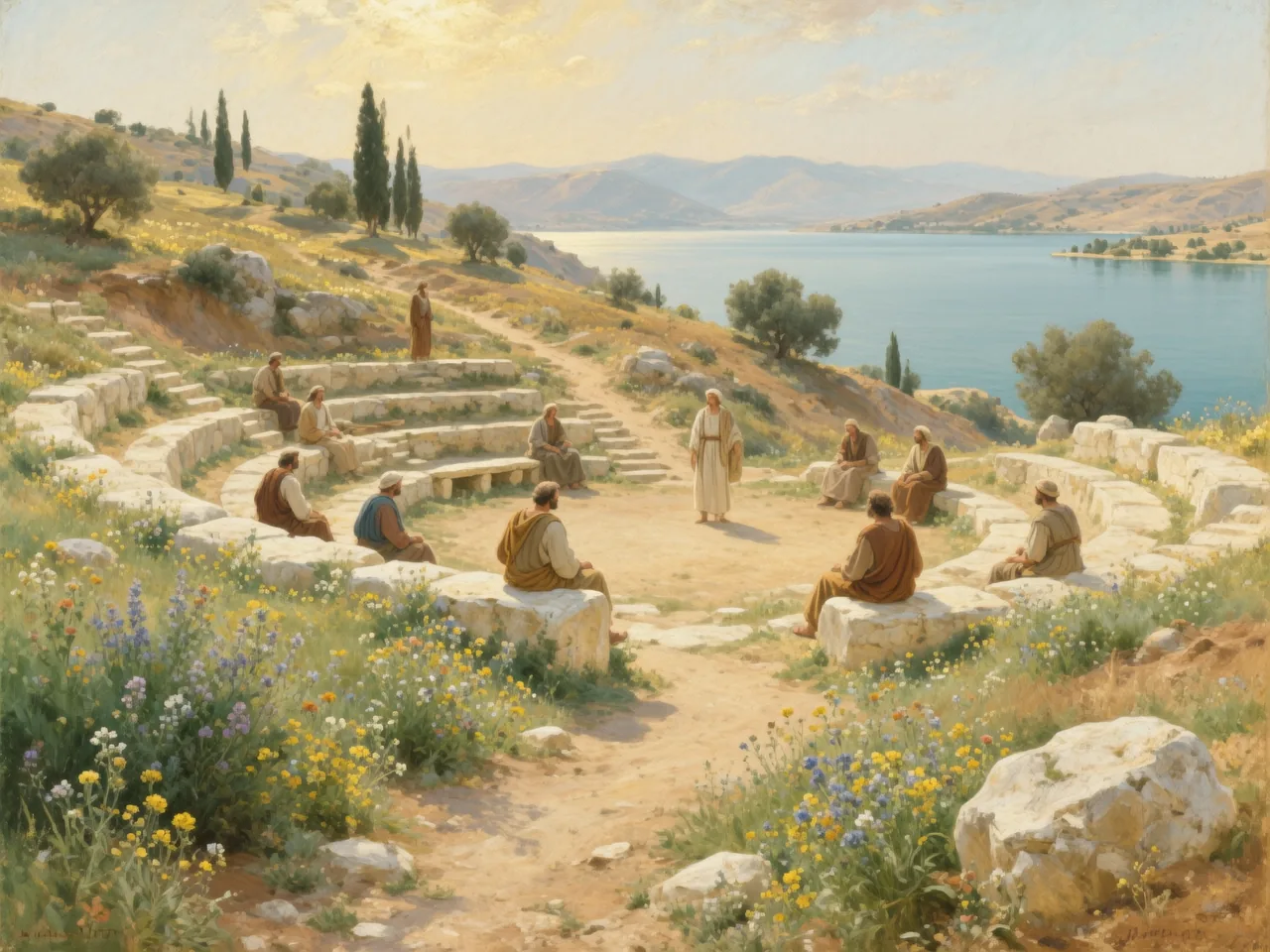
1 When Jesus saw the crowds, He went up on the mountain and sat down. His disciples came to Him,
2 and He began to teach them, saying:
3 “Blessed are the poor in spirit, for theirs is the kingdom of heaven.
4 Blessed are those who mourn, for they will be comforted.
5 Blessed are the meek, for they will inherit the earth.
6 Blessed are those who hunger and thirst for righteousness, for they will be filled.
7 Blessed are the merciful, for they will be shown mercy.
8 Blessed are the pure in heart, for they will see God.
9 Blessed are the peacemakers, for they will be called sons of God.
10 Blessed are those who are persecuted because of righteousness, for theirs is the kingdom of heaven.
11 Blessed are you when people insult you, persecute you, and falsely say all kinds of evil against you because of Me.
12 Rejoice and be glad, because great is your reward in heaven, for in the same way they persecuted the prophets before you.
13 You are the salt of the earth. But if the salt loses its savor, how can it be made salty again? It is no longer good for anything, except to be thrown out and trampled by men.
14 You are the light of the world. A city on a hill cannot be hidden.
15 Neither do people light a lamp and put it under a basket. Instead, they set it on a stand, and it gives light to everyone in the house.
16 In the same way, let your light shine before men, that they may see your good deeds and glorify your Father in heaven.
Study guide · not Scripture
Meaning & context
Historical & literary context · Matthew 5:1–16
Where the Sermon on the Mount begins
Jesus sits on a mountain, and his disciples come to hear him. Raj Nadella reads the Beatitudes within Matthew's introduction of a new community. This helps us read them as more than isolated inspirational sayings. Day 08 continues beyond the blessings into the salt and light images; keep verses 13–16 attached to what comes before.
Sources: Matthew 5 — Berean Standard Bible · Commentary on Matthew 5:1–12
Scripture observation · Matthew 5:3–6
1. Blessing meets people in need
The blessings include people who are poor in spirit, mourning, or meek, and people seeking righteousness. Here, righteousness concerns what is right before God. The promises look beyond present circumstances toward God's kingdom, comfort, and restoration. Notice that mourners receive a promise of comfort, not an instruction to pretend they are happy.
Sources: Matthew 5 — Berean Standard Bible
Scripture observation · Matthew 5:7–12
2. Mercy and peacemaking belong together
Verses 7–9 name mercy, purity of heart, and peacemaking. The next verses speak about opposition connected with righteousness and allegiance to Jesus. That connection matters: the passage does not say that every disagreement or every criticism of a religious person is persecution.
Sources: Matthew 5 — Berean Standard Bible
Scripture observation · Matthew 5:13–16
3. Salt and light turn attention outward
Salt that loses its character becomes useless, while a lamp is placed where it can illuminate a house. Jesus links light with visible good deeds whose purpose is to honor the Father. The movement is from receiving blessing to a life that benefits others, rather than cultivating a public religious image.
Sources: Matthew 5 — Berean Standard Bible
Editorial reading boundary · Matthew 5:3–12
Blessing is not a reason to preserve suffering
Nadella emphasizes that the Beatitudes announce a reversal of suffering rather than celebrate suffering itself. Bibleward therefore does not use this passage to tell someone to remain in danger or to judge grief as weak faith. In its Catholic pastoral statement on domestic violence, the USCCB puts safety before possible restoration of a relationship.
Sources: Commentary on Matthew 5:1–12 · When I Call for Help: A Pastoral Response to Domestic Violence Against Women
Pastoral application · Matthew 5:1–16
Read a blessing alongside a concrete action
Which blessing challenges your usual picture of a successful life? What small act of mercy or peacemaking could be safe and appropriate in your circumstances? You may reflect privately; this is an invitation, not a requirement to disclose pain or prove that you are blessed.
Sources: Matthew 5 — Berean Standard Bible
Sources & review
Bibleward · AI-assisted study guide
Reviewed 2026-09-14. AI-assisted writing and automated content review; not individual pastoral approval. Scripture observations, interpretation, and application are labelled separately.
- Matthew 5 — Berean Standard Bible — Matthew 5; selected verses and notes checked against the local BSB v5.9 corpus. Linked supplementary commentary is not used.
- Commentary on Matthew 5:1–12 — November 1, 2020; opening paragraphs on the new community and reversal rather than glorification of suffering. Disputed linguistic derivations are not adopted.
- When I Call for Help: A Pastoral Response to Domestic Violence Against Women — The Church Responds: Scripture and Church Teachings; First Responders. Safety and accountability precede possible restoration. Historical statistics and contact schedules are not reused.
- Berean Bible: Licensing and Terms — Public-domain dedication effective April 30, 2023. No commentary, recordings or third-party artwork are reproduced.
Scripture is the Berean Standard Bible (BSB), dedicated to the public domain. Exact Scripture remains separate from these original AI-assisted Bibleward explanations. Linked commentary is cited and summarized, not reproduced; no permission to reuse third-party prose or artwork is implied.
Report a content concernReflection, prayer, and reading progress stay in this browser; they are not synced to an account.