Day 07 · Mark 15:33–39; Mark 16:1–8 · Berean Standard Bible
Mark 15:33–39 and 16:1–8 explained: cross and empty tomb
Day 07 holds two readings together: Jesus' death in Mark 15:33–39 and the empty tomb in Mark 16:1–8. The second passage announces that the crucified Jesus has risen, yet ends with the women's fear. Hope and bewilderment appear together; the selected text does not describe a resurrection appearance.
This guided day and both English narrators are free. No account is needed.
Darkness covers the land from the sixth to the ninth hour. Jesus cries words from Psalm 22, is misunderstood by some bystanders, gives a loud cry and dies. The temple curtain is torn, and the centurion opposite him makes a statement about his identity.
Mark 15:33–39
33 From the sixth hour until the ninth hour darkness came over all the land.
34 At the ninth hour, Jesus cried out in a loud voice, “Eloi, Eloi, lema sabachthani?” which means, “My God, My God, why have You forsaken Me?”
35 When some of those standing nearby heard this, they said, “Behold, He is calling Elijah.”
36 And someone ran and filled a sponge with sour wine. He put it on a reed and held it up for Jesus to drink, saying, “Leave Him alone. Let us see if Elijah comes to take Him down.”
37 But Jesus let out a loud cry and breathed His last.
38 And the veil of the temple was torn in two from top to bottom.
39 When the centurion standing there in front of Jesus saw how He had breathed His last, he said, “Truly this man was the Son of God!”
Mark 16:1–8
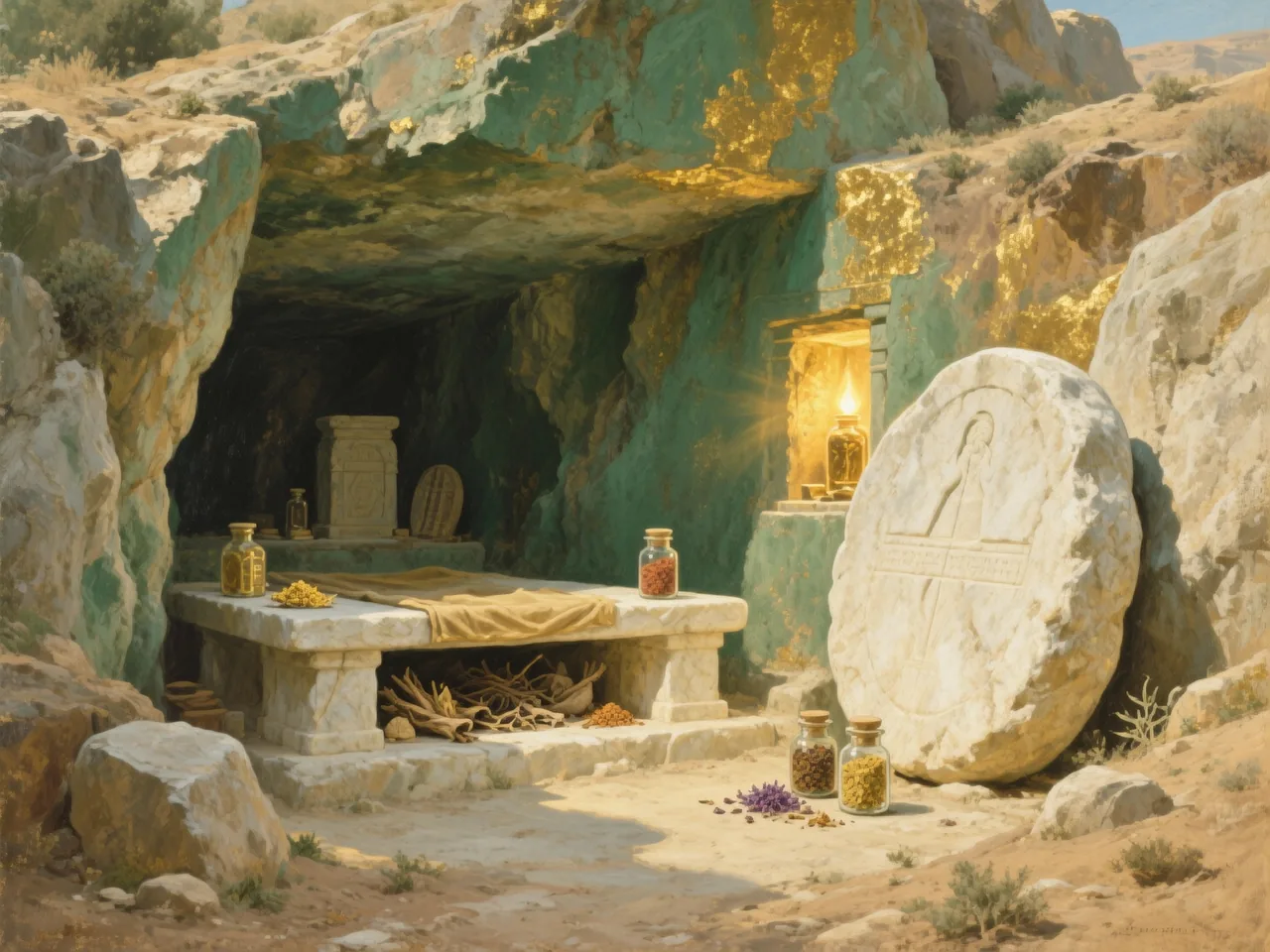
1 When the Sabbath was over, Mary Magdalene, Mary the mother of James, and Salome bought spices so they could go and anoint the body of Jesus.
2 Very early on the first day of the week, just after sunrise, they went to the tomb.
3 They were asking one another, “Who will roll away the stone from the entrance of the tomb?”
4 But when they looked up, they saw that the stone had been rolled away, even though it was extremely large.
5 When they entered the tomb, they saw a young man dressed in a white robe sitting on the right side, and they were alarmed.
6 But he said to them, “Do not be alarmed. You are looking for Jesus the Nazarene, who was crucified. He has risen! He is not here! See the place where they put Him.
7 But go, tell His disciples and Peter, ‘He is going ahead of you into Galilee. There you will see Him, just as He told you.’”
8 So the women left the tomb and ran away, trembling and bewildered. And in their fear they did not say a word to anyone.
Study guide · not Scripture
Meaning & context
Historical & literary context · Mark 15:33–47; Mark 16:1–8
Two scenes, with a passage between them
These are two selections, not one uninterrupted paragraph. Between them, Mark 15:40–47 describes women observing, Joseph of Arimathea obtaining Jesus' body, and his burial. Keep that intervening scene in mind when the women come to the tomb. The site preserves the two headings and their different chapter numbers.
Sources: Mark 15 — Berean Standard Bible · Mark 16 — Berean Standard Bible
Scripture observation · Mark 15:33–39
1. The death scene does not hide distress
The first reading includes darkness, Jesus' anguished cry, his death, the torn temple veil, and the centurion's response. Do not rush past the suffering to reach the next scene. Nor should the cry be turned into a statement that God has abandoned a reader who is grieving.
Sources: Mark 15 — Berean Standard Bible
Scripture observation · Mark 16:1–7
2. The women come expecting to anoint a body
Mary Magdalene, Mary the mother of James, and Salome bring spices. They wonder about moving the stone, then find it already moved. A young man in a white robe tells them that Jesus has risen and directs a message to the disciples and Peter. This is an announcement, not a scene of Jesus appearing to them.
Sources: Mark 16 — Berean Standard Bible
Scripture observation · Mark 16:6–8
3. Fear is the last response in this selection
Verse 8 describes the women fleeing in fear and bewilderment. Read that reaction alongside the announcement in verse 6 rather than erasing either one. The passage does not tell us everything that later happened, and this guide does not invent their next conversation.
Sources: Mark 16 — Berean Standard Bible
Textual history & tradition note · Mark 16:8
Why your Bible may continue after verse 8
The BSB footnote at 16:8 notes that some early manuscripts end there and that other endings exist. The USCCB notes discuss the later composition of 16:9–20 while also recording its acceptance as canonical in Catholic tradition. Manuscript history and a church's canonical reception are different questions. Our chosen reading stops at 16:8; it does not claim that every Christian Bible does.
Sources: Mark 16 — Berean Standard Bible · Mark 16: textual and canonical notes
Pastoral application · Mark 15:33–39; Mark 16:1–8
Finish the week without forcing a feeling
What changes between the death scene and the tomb? Which response do you want to understand better? You may end the week with questions or grief as well as hope. Completing seven readings does not require a particular emotional response or prove anyone's spiritual standing.
Sources: Mark 15 — Berean Standard Bible · Mark 16 — Berean Standard Bible
Sources & review
Bibleward · AI-assisted study guide
Reviewed 2026-09-13. AI-assisted writing and automated content review; not individual pastoral approval. Scripture observations, interpretation, and application are labelled separately.
- Mark 15 — Berean Standard Bible — Mark 15; exact selected verses and notes checked against the local BSB v5.9 corpus. Linked supplementary commentary is not used.
- Mark 16 — Berean Standard Bible — Mark 16; exact selected verses and notes checked against the local BSB v5.9 corpus. Linked supplementary commentary is not used.
- Mark 16: textual and canonical notes — Notes on 16:1–8 and 16:9–20 distinguish manuscript history from Catholic canonical reception. NABRE wording is not substituted for BSB.
- Berean Bible: Licensing and Terms — Public-domain dedication effective April 30, 2023. No commentary, recordings or third-party artwork are reproduced.
Scripture is the Berean Standard Bible (BSB), dedicated to the public domain. Exact Scripture remains separate from these original AI-assisted Bibleward explanations. Linked commentary is cited and summarized, not reproduced; no permission to reuse third-party prose or artwork is implied.
Report a content concernReflection, prayer, and reading progress stay in this browser; they are not synced to an account.