Day 11 · Matthew 6:19–34 · Berean Standard Bible
Matthew 6:19–34 explained: treasure, worry, and seeking God
Matthew 6:19–34 connects worry about daily needs with a larger question: what governs a person's life? Jesus contrasts earthly and heavenly treasure, God and money, then invites his listeners to trust their Father's care. This is not a promise that faith removes every practical problem or anxiety symptom.
This guided day and both English narrators are free. No account is needed.
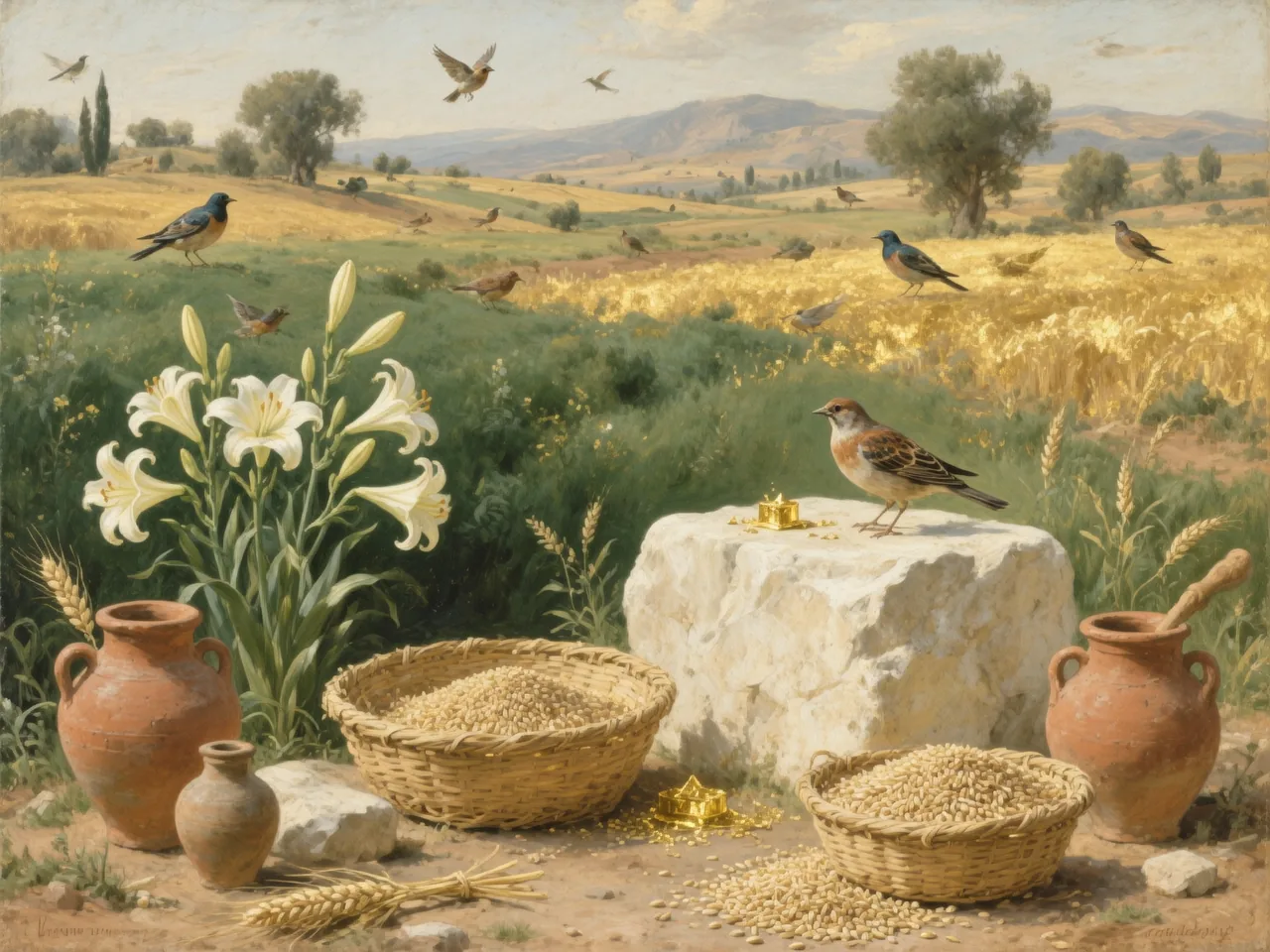
Jesus asks what we treasure, what shapes our vision, and whom we serve. He then speaks to worry with images of birds and flowers, reminding His listeners that the Father knows their needs. This is not a command to pretend bills, food, clothing, illness, or tomorrow do not matter. It is an invitation to bring today's real needs under God's care, seek His kingdom first, and take the next faithful step without carrying every possible future at once.
Matthew 6:19–34
19 Do not store up for yourselves treasures on earth, where moth and rust destroy, and where thieves break in and steal.
20 But store up for yourselves treasures in heaven, where moth and rust do not destroy, and where thieves do not break in and steal.
21 For where your treasure is, there your heart will be also.
22 The eye is the lamp of the body. If your eyes are good, your whole body will be full of light.
23 But if your eyes are bad, your whole body will be full of darkness. If then the light within you is darkness, how great is that darkness!
24 No one can serve two masters: Either he will hate the one and love the other, or he will be devoted to the one and despise the other. You cannot serve both God and money.
25 Therefore I tell you, do not worry about your life, what you will eat or drink; or about your body, what you will wear. Is not life more than food, and the body more than clothes?
26 Look at the birds of the air: They do not sow or reap or gather into barns, and yet your heavenly Father feeds them. Are you not much more valuable than they?
27 Who of you by worrying can add a single hour to his life?
28 And why do you worry about clothes? Consider how the lilies of the field grow: They do not labor or spin.
29 Yet I tell you that not even Solomon in all his glory was adorned like one of these.
30 If that is how God clothes the grass of the field, which is here today and tomorrow is thrown into the furnace, will He not much more clothe you, O you of little faith?
31 Therefore do not worry, saying, ‘What shall we eat?’ or ‘What shall we drink?’ or ‘What shall we wear?’
32 For the Gentiles strive after all these things, and your heavenly Father knows that you need them.
33 But seek first the kingdom of God and His righteousness, and all these things will be added unto you.
34 Therefore do not worry about tomorrow, for tomorrow will worry about itself. Today has enough trouble of its own.’’
Study guide · not Scripture
Meaning & context
Historical & literary context · Matthew 6:19–34
Why the teaching on worry starts with treasure
Day 11 begins before the familiar images of birds and flowers. Richard Beaton connects verses 25–34 with the preceding challenge about allegiance to God rather than wealth. Reading the whole selection keeps the closing advice about tomorrow from becoming a detached instruction simply to feel calmer.
Sources: Matthew 6 — Berean Standard Bible · Commentary on Matthew 6:24–34
Scripture observation · Matthew 6:19–24
1. Treasure and allegiance are connected
Jesus contrasts possessions that can decay or be stolen with treasure in heaven, and connects treasure with the heart. Verse 24 makes the choice explicit: God and money cannot both be masters. The issue is not merely how much a person owns, but what receives their devotion.
Sources: Matthew 6 — Berean Standard Bible
Scripture observation & attributed interpretation · Matthew 6:22–23
2. The eye image belongs inside this argument
Verses 22–23 compare the eye to a lamp and contrast light with darkness. The USCCB's explanatory note reads the image, in this context, in relation to Jesus' teaching about earthly wealth. This is a contextual interpretation of a metaphor, not a claim that eyesight or disability reveals someone's moral character.
Sources: Matthew 6 — Berean Standard Bible · Matthew 6: explanatory notes
Scripture observation · Matthew 6:25–34
3. The Father knows that ordinary needs are real
Birds and flowers illustrate God's care, while food, drink, and clothing remain named human needs. Verse 33 gives priority to God's kingdom and righteousness. Verse 34 still acknowledges trouble within a day. The passage does not pretend that a trusting person's circumstances contain no difficulties.
Sources: Matthew 6 — Berean Standard Bible
Editorial reading boundary · Matthew 6:25–34
Trust is not a mental-health diagnosis
Beaton cautions against reading this passage as a call to abandon ordinary responsibilities. Bibleward also does not use Jesus' words to diagnose anxiety as a spiritual failure or guarantee financial security. NIMH distinguishes anxiety disorders from ordinary worry and points readers toward help and support. Prayer and reading are not substitutes for appropriate professional care.
Sources: Commentary on Matthew 6:24–34 · Anxiety Disorders
Pastoral application · Matthew 6:19–34
Separate today's responsibility from tomorrow's fear
What seems to receive most of your attention in this passage's contrast between treasure and trust? What one practical responsibility, or request for support, could you attend to today? You can leave these questions unanswered when they feel burdensome; progress here is not a test of how calm you become.
Sources: Matthew 6 — Berean Standard Bible · Anxiety Disorders
Sources & review
Bibleward · AI-assisted study guide
Reviewed 2026-09-14. AI-assisted writing and automated content review; not individual pastoral approval. Scripture observations, interpretation, and application are labelled separately.
- Matthew 6 — Berean Standard Bible — Matthew 6; selected verses and notes checked against the local BSB v5.9 corpus. Linked supplementary commentary is not used.
- Commentary on Matthew 6:24–34 — May 25, 2008; connection of 6:19–24 with 6:25–34 and the rejection of an instruction to abandon ordinary responsibilities. No diagnosis of anxiety from faith is adopted.
- Matthew 6: explanatory notes — NABRE notes on 6:19–34 and 6:22–23; the eye image in its wealth context. Commentary only; NABRE Scripture text is not reproduced.
- Anxiety Disorders — What is anxiety? and Find help and support; distinguishes ordinary worry from anxiety disorders and points to professional support. No treatment prescription or diagnosis.
- Berean Bible: Licensing and Terms — Public-domain dedication effective April 30, 2023. No commentary, recordings or third-party artwork are reproduced.
Scripture is the Berean Standard Bible (BSB), dedicated to the public domain. Exact Scripture remains separate from these original AI-assisted Bibleward explanations. Linked commentary is cited and summarized, not reproduced; no permission to reuse third-party prose or artwork is implied.
Report a content concernReflection, prayer, and reading progress stay in this browser; they are not synced to an account.