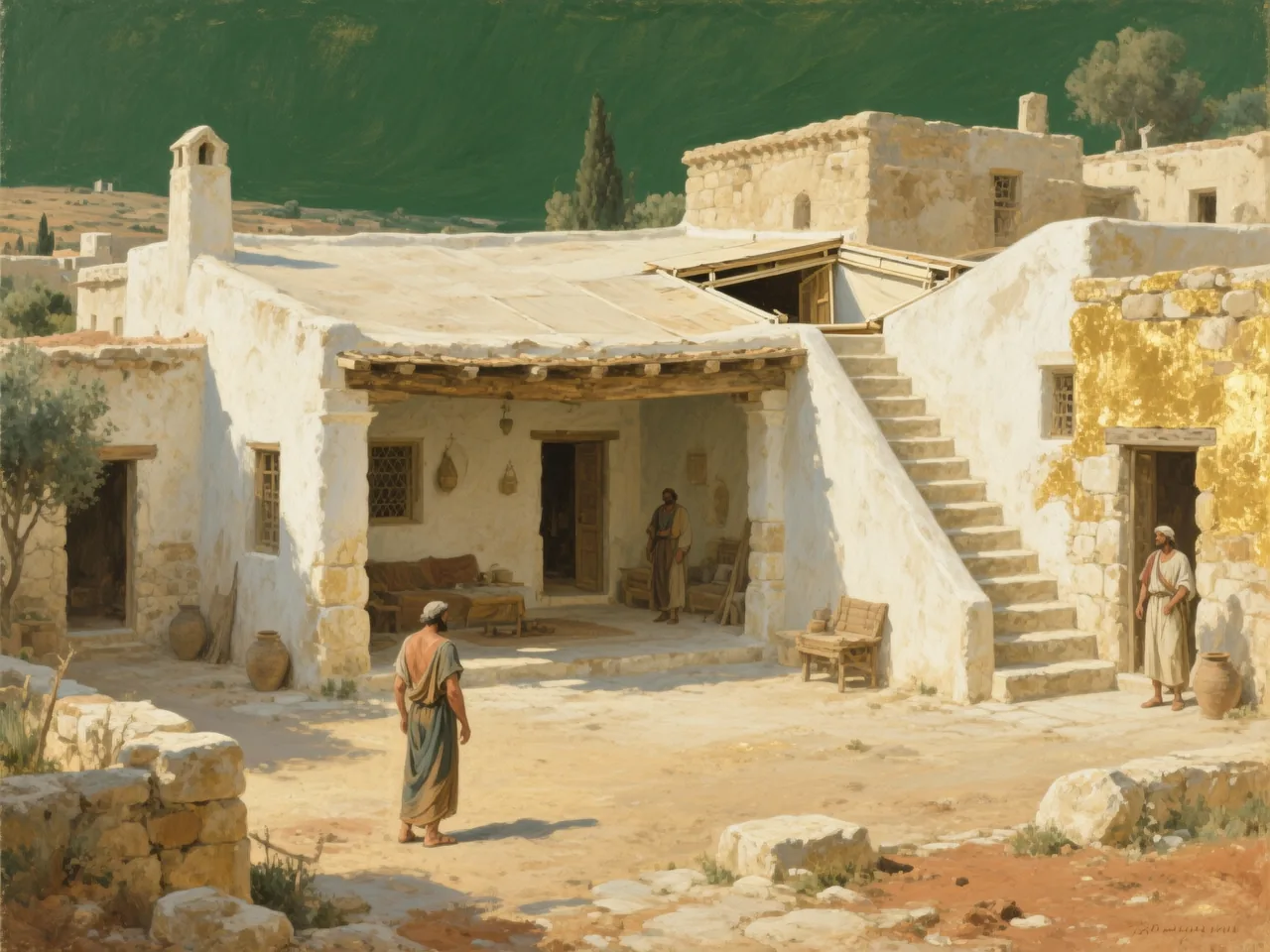
Day 03 · Mark 2:1–12 · Berean Standard Bible
Mark 2:1–12 explained: forgiveness and the lowered mat
Mark 2:1–12 connects the healing of a paralyzed man with a dispute about Jesus' authority to forgive sins. Four people bring the man through a roof, but the central question is larger than their persistence: what authority does Jesus have?
This guided day and both English narrators are free. No account is needed.
Back in Capernaum, Jesus teaches in a crowded house. Four people open the roof and lower a paralyzed man. Jesus declares forgiveness, responds to the scribes' objections and tells the man to rise; the man walks out.
Mark 2:1–12
1 A few days later Jesus went back to Capernaum. And when the people heard that He was home,
2 they gathered in such large numbers that there was no more room, not even outside the door, as Jesus spoke the word to them.
3 Then a paralytic was brought to Him, carried by four men.
4 Since they were unable to get to Jesus through the crowd, they uncovered the roof above Him, made an opening, and lowered the paralytic on his mat.
5 When Jesus saw their faith, He said to the paralytic, “Son, your sins are forgiven.”
6 But some of the scribes were sitting there and thinking in their hearts,
7 “Why does this man speak like this? He is blaspheming! Who can forgive sins but God alone?”
8 At once Jesus knew in His spirit that they were thinking this way within themselves. “Why are you thinking these things in your hearts?” He asked.
9 “Which is easier: to say to a paralytic, ‘Your sins are forgiven,’ or to say, ‘Get up, pick up your mat, and walk’?
10 But so that you may know that the Son of Man has authority on earth to forgive sins...” He said to the paralytic,
11 “I tell you, get up, pick up your mat, and go home.”
12 And immediately the man got up, picked up his mat, and walked out in front of them all. As a result, they were all astounded and glorified God, saying, “We have never seen anything like this!”
Study guide · not Scripture
Meaning & context
Historical & literary context · Mark 2:1–12
A crowded house and a growing controversy
The scene opens in Capernaum, with the doorway blocked by a crowd. James Hanson places this passage at the beginning of a sequence of disputes that continues into Mark 3. The scribes' question matters within that story; it is not permission to caricature Judaism or Jewish people.
Sources: Mark 2 — Berean Standard Bible · Commentary on Mark 2:1–22
Scripture observation · Mark 2:1–4
1. Four people help someone reach Jesus
The man cannot get through the crowd, so those carrying him open the roof and lower his mat. Mark records their action without giving us their names or a detailed account of the building. We can notice their practical help without inventing motives or archaeological details.
Sources: Mark 2 — Berean Standard Bible
Scripture observation · Mark 2:5–9
2. Forgiveness raises the question of authority
Jesus responds first by announcing forgiveness. Some scribes reason that only God can forgive sins and question his words. The text then shows Jesus addressing their unspoken objection. This moves the story beyond a striking entrance through the roof to the identity and authority of Jesus.
Sources: Mark 2 — Berean Standard Bible
Scripture observation · Mark 2:10–12
3. The man carries the mat that carried him
Jesus links the instruction to stand and go home with his authority to forgive. The man gets up, takes his mat, and leaves in front of everyone. The crowd's amazement closes the scene. The visible action answers the challenge in the story; it is not a repeatable test we can demand of another person.
Sources: Mark 2 — Berean Standard Bible
Editorial reading boundary · Mark 2:5–12
Do not use illness as evidence of guilt
The passage does not identify a particular sin as the cause of this man's paralysis. Nor does it authorize us to judge someone's faith by whether they recover. Keep the man's healing within this narrative instead of treating another person's disability as a moral diagnosis. This guide does not attempt to settle later traditions' practices of confession.
Sources: Mark 2 — Berean Standard Bible
Pastoral application · Mark 2:1–12
Think about help that respects the person
Who makes access possible in this scene? What would practical, welcome help look like in a situation you know? Ask what someone wants rather than assigning them a spiritual lesson. Reflection on this passage is optional and is not a substitute for their own voice.
Sources: Mark 2 — Berean Standard Bible
Sources & review
Bibleward · AI-assisted study guide
Reviewed 2026-09-13. AI-assisted writing and automated content review; not individual pastoral approval. Scripture observations, interpretation, and application are labelled separately.
- Mark 2 — Berean Standard Bible — Mark 2; exact selected verses and notes checked against the local BSB v5.9 corpus. Linked supplementary commentary is not used.
- Commentary on Mark 2:1–22 — January 10, 2016: the controversy sequence through 3:6 and the warning against denigrating Judaism.
- Berean Bible: Licensing and Terms — Public-domain dedication effective April 30, 2023. No commentary, recordings or third-party artwork are reproduced.
Scripture is the Berean Standard Bible (BSB), dedicated to the public domain. Exact Scripture remains separate from these original AI-assisted Bibleward explanations. Linked commentary is cited and summarized, not reproduced; no permission to reuse third-party prose or artwork is implied.
Report a content concernReflection, prayer, and reading progress stay in this browser; they are not synced to an account.