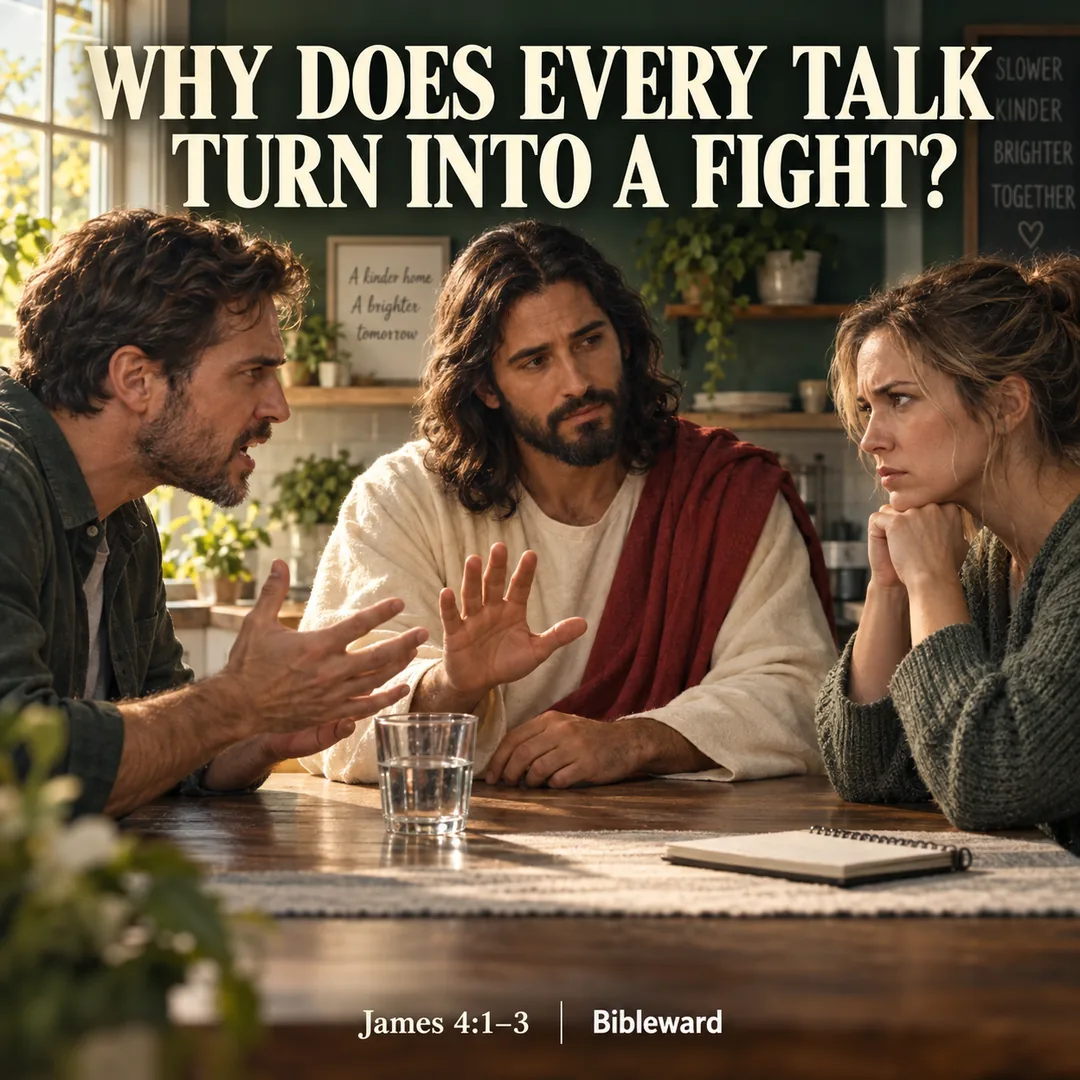
Imagined everyday situation
When the message stops being the point
Imagine an ordinary evening. You ask, “Why didn't you reply to my message?” The answer comes back: “I was busy. Do I have to explain every minute?”
You wanted an answer. Now you want them to admit how unfair they sound. They bring up something you did last week. You find an older example. Before long, the message has almost disappeared from the conversation. What remains is a contest over who cares less.
This is an imagined scene, but perhaps some part of it feels familiar.
In some arguments, a real concern becomes tangled with the need to win, defend our character or make the other person feel what we felt. James offers a way to examine that shift. He asks his readers to look at their desires and at what their words are doing. That does not make every disagreement selfish or both people equally responsible.
Sources: Bibleward editorial method · BSB James 3 · BSB James 4
Scripture in context · James 3:13–18 and 4:1–3
What James asks his readers to examine
In James 3:13–18, wisdom shows itself in conduct. James contrasts jealousy and selfish ambition with a wisdom marked by gentleness, mercy, sincerity and a concern for peace. The surrounding chapter has already warned about the damage speech can do.
Then James 4:1–3 asks where the quarrels among his readers come from. He connects their fighting with competing desires and challenges even the motives behind their prayers.
These are connected instructions to the believing community addressed by the letter. James is confronting its conduct; he is not giving a complete explanation of every modern argument. Applying his words to a disagreement is an invitation to examine our own response, not permission to pronounce someone else's hidden motive.
That distinction matters. You can have a valid concern about an unanswered message. You can also express that concern in a way that humiliates someone. Taking responsibility for the second does not require pretending the first was unimportant.
Sources: BSB James 3 · BSB James 4
Optional reflection
What am I asking for—and how am I trying to get it?
Return to the imagined conversation. Under “Why didn't you reply?” there might be a practical problem: dinner plans were waiting on an answer. There might be a fear: “I don't seem to matter to you.” Or there may be a repeated pattern that needs addressing.
You do not need to decide which explanation fits before listening. Start by separating what happened from what you concluded.
“I didn't receive a reply” describes the event. “You don't care about me” makes a much larger judgment. That judgment might express a real hurt, but it still needs a conversation rather than being treated as established fact.
One useful question is: What do I want from this conversation? An explanation? A workable plan? An apology? Or has the aim become making the other person lose?
This is an application of James' challenge, not a test that labels every need selfish. Wanting consideration is reasonable. Using ridicule to demand it still deserves examination.
Sources: Bibleward editorial method · BSB James 4
Scripture in context · James 1:19–22
Listening does not mean giving up your concern
Earlier in the letter, James 1:19–22 places listening ahead of hasty speech and anger, then moves toward receiving and acting on God's word. His concern goes beyond sounding calm: faith should shape what people actually do.
For an ordinary disagreement, that can begin with hearing one complete answer before preparing the next accusation. You might discover a misunderstanding. You might also discover that the original problem is real and still needs a clear response.
A quieter voice cannot settle every issue. Nor does a firm voice prove someone is wrong. The question is whether you can be truthful without adding contempt—and whether the other person is willing to do the same.

Sources: BSB James 1 · Bibleward editorial method
Suggested words · not Scripture
Try restarting one conversation
Use this only for a disagreement in which you can speak freely and safely. It is an optional practice, not a promise that the other person will respond well.
Before restarting, finish three sentences for yourself:
“What happened was…” Stick to the particular event.
“What I made it mean was…” Name your interpretation without treating it as certainty.
“What I would like us to discuss is…” Ask for something specific enough to answer.
In our example, a restart could sound like this:
“I was waiting for your reply before making dinner plans. I took the silence to mean I didn't matter, but I don't know what was happening for you. Can we work out what to do when one of us can't reply?”
If you also said something cruel, name that separately:
“Calling you selfish was hurtful. I'm sorry I said that. I still want to talk about the unanswered message, without insulting you.”
These are suggested words, not Scripture. Adjust them to the actual situation. An apology does not erase the practical problem, require instant forgiveness, or control the other person's response. It takes responsibility for a particular action.

Sources: Bibleward editorial method
Safety and a next step
When this is more than an argument
Threats, coercion and violence are not ordinary communication problems. If speaking honestly brings fear of retaliation, do not treat this exercise as an obligation to confront the person or reconcile. Abuse is not something a targeted person causes by failing to communicate well. Love is respect distinguishes ordinary disagreement from intimidation and control.
Seek support from a trusted person and an appropriate local abuse-support service. If danger is immediate, contact local emergency services when safe to do so. Gentleness does not require continued access to you, and peace must not be used to silence harm.
For an ordinary disagreement, begin more modestly: choose one concern to explain without turning it into a verdict on the other person's worth. Read James 3:13–18 again, then ask which quality you want your next sentence to show.
For further reading, Love in Practice follows mercy, service and responsible care through seven Bible readings.
Sources: love is respect: Conflict resolution · BSB James 3 · Bibleward editorial method
About this reflection
About this reflection
An AI-assisted Bibleward reflection. The opening scene and suggested dialogue are imagined examples, not personal testimony. Scripture is paraphrased from the linked passages; the practical suggestions are editorial applications. No individual pastoral or clinical endorsement is claimed.
Sources: Bibleward editorial method · Berean Bible Terms
Sources and further reading
- BSB James 1
Numbered BSB Scripture verses James 1:19–22; listening, anger and acting on the word.
- BSB James 3
Numbered BSB Scripture verses James 3:13–18 in the chapter’s wider speech context.
- BSB James 4
Numbered BSB Scripture verses James 4:1–3; desires and quarrels among the addressed community.
- love is respect: Conflict resolution
Primary relationship-safety guidance distinguishes ordinary disagreement from intimidation and control; no third-party prose is reproduced.
- Berean Bible Terms
Publisher’s public-domain and adaptation terms; no direct Scripture quotations are added.
- Bibleward editorial method
First-party editorial provenance: imagined situations, optional exercises and prayers are original applications, not Scripture or submitted testimony.
Study guidance · not Scripture. AI-assisted writing and automated content review; no individual pastoral endorsement is claimed.